

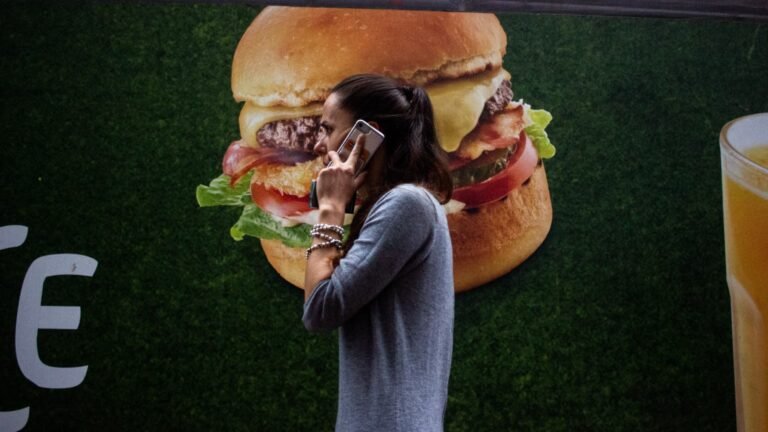

In Amsterdam, a municipal decision that came into force on May 1, 2026 prohibits advertising in public spaces for meat and products linked to fossil fuels (airplanes, SUVs, oil), in order to align urban advertising with climate objectives, to an unprecedented extent but still debated as to its real impact.
No more hamburgers, plane tickets, family SUVs and other discounted gas subscriptions… Amsterdam residents will no longer see these types of products and services on posters in their city.
Adopted by the municipal council in 2024, the ban on advertisements for meat-based foods or fossil fuel products came into force on May 1. This decision, unprecedented in the world for a capital, modifies local rules governing display and advertising contracts on media belonging to the city. The objective is explicit: to align communication in public space with municipal climate commitments, in particular carbon neutrality targeted by 2050.
Concretely, we will no longer see posters for oil groups like Shell or Totalenergies, nor for airlines such as Ryanair or KLM praising low-cost flights; advertisements for thermal cars from brands like Renault or Volkswagen will also disappear, as will fast food campaigns promoting meat products, for example at McDonald’s or KFC.
Added to this are commercial offers linked to gas or oil (fossil energy contracts, seasonal promotions), even when they are presented as “transitional”. In practice, this means that very banal messages such as “cheap flights to New York”, “diesel family SUV”, “double cheeseburger” or “reduced gas offer” will no longer be visible on bus shelters, signs or street furniture managed by the city, reflecting a clear desire to no longer normalize this consumption in public spaces.
What is specific to Amsterdam, and what makes it a world first, is the extension of this ban to meat advertising. Meat products (beef, pork, poultry) are included because of their high carbon footprint. This provision is part of a broader food strategy for the city, which encourages the reduction of meat consumption for environmental and public health reasons.
A purely symbolic act?
At tram stops, the old McDonald’s ads have disappeared to make way, for example, for a promotion of the Rijksmuseum, the national museum of the Netherlands. “If you claim to be at the forefront of climate policy and rent out your premises to diametrically opposed organizations, what are you doing? “, said Anneke Veenhoff, municipal councilor and member of the GroenLinks party. Most people don’t understand why the municipality should make money by renting our public space for something we have active policies against. »
From a legal point of view, the rule only applies to media controlled by the municipality: urban billboards, bus shelters, advertising furniture and certain areas of the local transport network. It is integrated into contracts concluded with advertising agencies (for example those which operate street furniture), which allows the city to enforce the ban without legislating at national level. On the other hand, the measure does not concern private media (press, internet, television) nor completely private advertising spaces.
According to Anke Bakker of the Party for the Animals, interviewed by the BBC, removing this visual incentive both reduces impulse purchases and indicates that cheap meat and fossil fuel-intensive travel are no longer desirable lifestyle choices. A gesture, however, more symbolic than economic. Advertisements for meat products represented only 0.1% of advertising expenditure in the capital of the Netherlands and those for fossil fuel derivatives only 4%. Most of the advertising is devoted to clothing, electronic devices and other film posters.
“Inappropriate handling”
Amsterdam’s decision provokes contrasting reactions depending on the actors concerned. The Dutch Meat Association strongly criticizes the measure, calling it an “inappropriate manipulation of consumer behavior”, recalling that in its view meat provides essential nutrients and must remain visible and accessible. For their part, tourism professionals, notably the Dutch Association of Travel Agencies, denounce a disproportionate attack on commercial freedom, in particular for offers including plane flights.
Conversely, activists like lawyer Hannah Prins and her organization Advocates for the Future, in conjunction with the Fossil Free Advertising collective, defend an assertive strategy: causing a “tobacco moment” for products with a high carbon footprint. Prins illustrates this idea by evoking the time when Johan Cruyff appeared in tobacco advertisements, then perceived as normal, before mentalities changed. According to her, what we see in public space profoundly shapes social norms; in this logic, reducing the visibility of meat or highly emitting activities amounts to redefining what is considered acceptable in society.
Amsterdam’s policy is part of a dynamic already underway in the Netherlands. From 2022, the city of Haarlem was the first in the world to announce a ban on meat advertisements in public spaces, which will come into force in 2024 at the same time as that on fossil fuels. Other cities like Utrecht and Nijmegen followed, extending these restrictions to meat, and in some cases dairy products, in addition to already existing bans on fossil fuels, thermal cars and aviation.
Change social norms
Internationally, this type of regulation is progressing, with cities like Edinburgh in Scotland, Sheffield in England, Stockholm in Sweden and Florence in Italy which have also banned or are considering banning advertising for fossil fuels.
In France, the Climate and Resilience Act, adopted in 2021 and entered into force on January 1, 2022, prohibits advertising for certain fossil energy products, in particular petroleum fuels such as gasoline or diesel. However, its scope remains limited. Thus, advertisements for airlines, thermal vehicles or even certain energy offers including gas remain authorized, although sometimes governed by other rules. Unlike the Amsterdam model, this law also does not extend to meat or other products with a high carbon footprint, making it a targeted measure rather than a blanket ban on the promotion of polluting consumption patterns.
Activists hope the Dutch model can inspire other jurisdictions. However, there remains an important limit: these bans concern physical public spaces, while advertisements continue to circulate massively on social networks and digital platforms.
The real impact of these measures still remains uncertain, but some researchers see it as a promising experiment. Epidemiologist Joreintje Mackenbach points out that removing certain advertisements can change social norms, as shown by a drop in junk food sales after they were banned from London transport.
Originally published at Almouwatin.com