


Germany’s modern “Scientology declarations” cannot be equated with the Nazi persecution of Jews. But they do raise a serious rule-of-law warning: when public authority uses forms, eligibility conditions or administrative language to single out a disfavoured belief community, the state moves from judging conduct to judging identity. That is precisely the danger Germany’s post-war constitutional order was built to prevent.
There are historical comparisons that must be made with care. Germany in 2026 is not Nazi Germany. Scientologists today are not Jews under National Socialism. No serious observer should confuse administrative discrimination with genocidal persecution. But there is a narrower, legitimate and urgent comparison: the way a state can use legal and bureaucratic language to turn a minority identity into a reason for exclusion.
That is why a page of the Reichsgesetzblatt from 14 November 1938 still matters. On page 1580 of Part I, No. 189, the Nazi state published the Verordnung zur Ausschaltung der Juden aus dem deutschen Wirtschaftsleben — the “Ordinance for the Exclusion of Jews from German Economic Life.” Its language was dry, legal and administrative. Its purpose was not. It barred Jews from retail businesses, mail-order companies, crafts, markets, fairs and exhibitions. The United States Holocaust Memorial Museum describes the decree as part of the post-Kristallnacht legal escalation that almost completely removed Jews from German economic and social life.
This is not raised to accuse modern Germany of repeating 1938. It is raised because Germany, of all countries, should understand that rights can be destroyed not only by violence, but also by forms, declarations, exclusions and official categories.
The modern “faith-breaker” declaration
That is the uncomfortable context in which Germany’s modern Scientology Schutzerklärung should be examined. These declarations, sometimes described by critics as “sect filters,” ask applicants, contractors or beneficiaries to distance themselves from Scientology, the teachings of L. Ron Hubbard, or related methods and organisations. In practice, they can condition access to public benefits, grants, tenders, employment-related opportunities or contractual participation on a statement of ideological non-affiliation. The mechanism is not a ban. It is more subtle: sign the declaration, or risk exclusion.
A better English name for such a form would be a “faith-breaker declaration.” It does not simply ask whether someone has complied with the law. It asks a person to separate himself or herself from a belief, a teaching, a religious or philosophical association. That is exactly where a liberal constitutional state should stop.
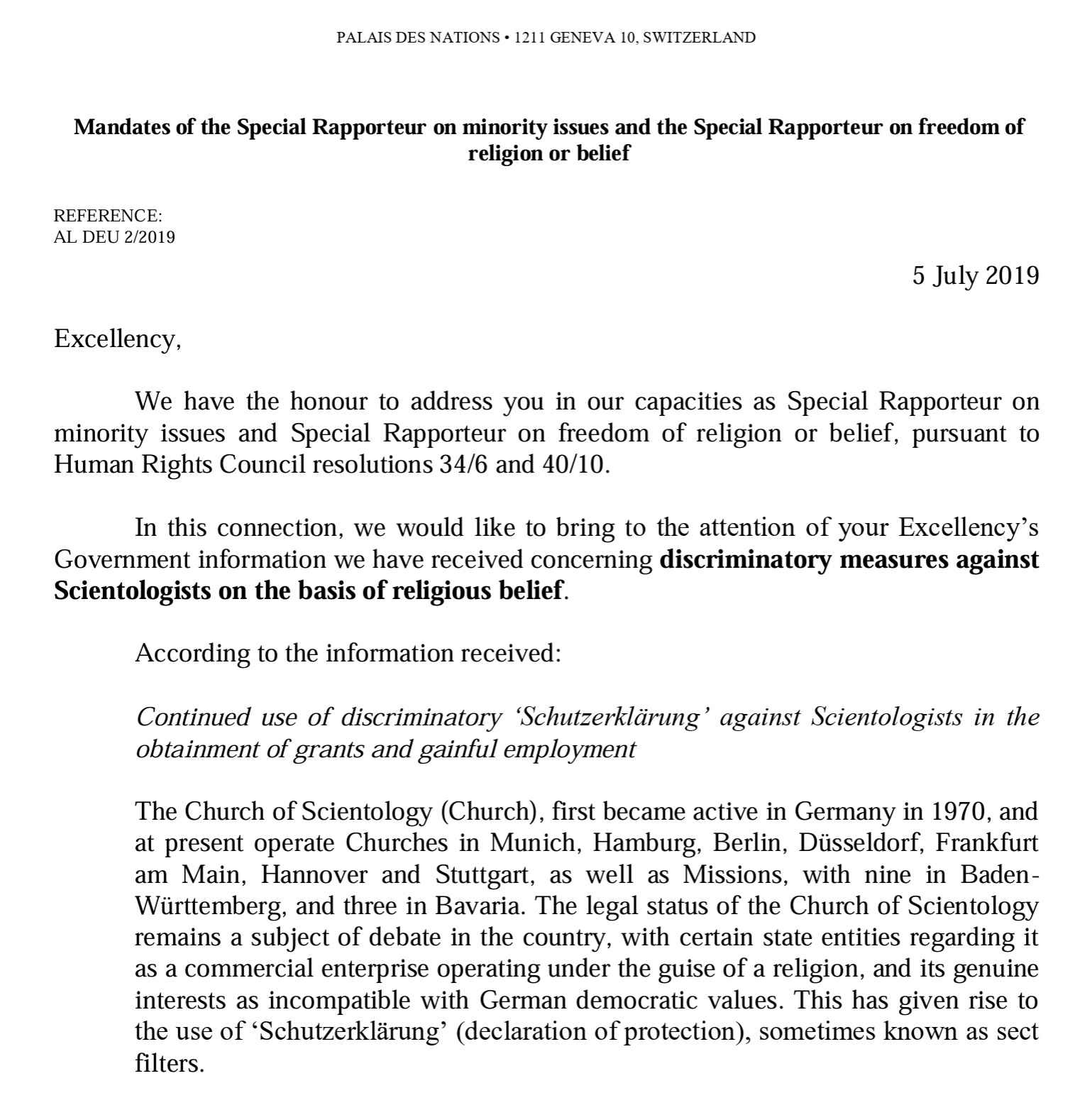
In 2019, two United Nations Special Rapporteurs — Fernand de Varennes, then Special Rapporteur on minority issues, and Ahmed Shaheed, then Special Rapporteur on freedom of religion or belief — formally asked Germany to explain the compatibility of these “sect filters” or Schutzerklärungen with international human rights law.
Their communication to the German government warned that, if the allegations were accurate, excluding individuals from opportunities on the basis of religion or belief would raise serious concerns under international human-rights standards.
The UN Special rapporteurs told the German gobvernment:
“…we would like to express our concern about the continued use of measures that explicitly prevent individuals from obtaining grants and employment opportunities otherwise extended to the general population, on the basis of religion or belief. Regardless of the official state position on the status of Scientology as a religious organisation, group, sect, or otherwise, religion or belief is a matter of personal conscience rather than government designation. Individuals identifying as Scientologists should not have to endure undue scrutiny nor disclose their beliefs unless a legitimate, substantiated reason can be provided, for which the burden of proof falls upon the State. By continuing to uphold measures that reinforce negative stereotypes about Scientologists, the State may cultivate an environment not fully conducive to the enjoyment of the right to freedom of religion or belief particularly for religious minorities. By allegedly operating from a negative presumption as to the aims of the Church, these measures may also constitute a conflict with the State mandate of neutrality, which requires a fundamental attitude of tolerance and equitable treatment of all religious groups within the context and limits of public interest, and in conformity with the provisions of international human rights law. The State does not have the responsibility of judging the intrinsic value or truth of religion or belief. (E/CN.4/1998/6/Add.2)
Mandates of the Special Rapporteur on minority issues and the Special Rapporteur on freedom of religion or belief // REFERENCE: AL DEU 2/2019 // 5 July 2019
A constitutional problem already recognised by Germany’s highest administrative court
The German Federal Administrative Court later reached a conclusion that should have ended the practice, at least in public administration. In its 2022 judgment concerning Munich’s refusal of an environmental subsidy for an electric bicycle, the Court held that a municipality could not make public funding dependent on a declaration distancing the applicant from Scientology.
The Court stated that demanding such a worldview declaration, and linking refusal to exclusion from the benefit, interfered with freedom of religion and worldview under Article 4 of the German Basic Law and violated equality principles under Article 3. Legal commentators also noted that the declaration had no proper connection with the purpose of the subsidy, which was environmental, not ideological.
That judgment is devastating for the logic of the “faith-breaker” form. The subsidy in question had an environmental purpose. Whether the applicant accepted or rejected Scientology had no rational connection to that purpose. Public authorities may not use an unrelated public programme as an occasion to identify, expose or disadvantage people because of their religious or worldview convictions.
The warning from 1938 is not equivalence, but administrative logic
This is where the comparison with 1938 becomes legally and morally relevant — not as an equivalence of crimes, victims or regimes, but as a warning about administrative logic.
The 1938 ordinance said, in substance: because you are Jewish, you may not participate normally in economic life.
The modern Schutzerklärung says, in substance: unless you distance yourself from Scientology, you may be excluded from certain public opportunities, and find yourself a living for you and your family.
The scale, ideology and consequences are radically different. But the legal danger belongs to the same family: the state stops judging conduct and begins judging identity, belief or association.
Germany’s post-war constitutional order was built precisely to prevent this. Article 4 of the Basic Law protects freedom of faith, conscience and creed. Article 3 prohibits unequal treatment, including on grounds of faith or religious opinions. These guarantees are not decorative. They are the constitutional answer to a past in which bureaucracy became an instrument of exclusion.
Rule of law means judging conduct, not belief
The defenders of Schutzerklärungen may argue that Scientology is controversial, that public authorities have concerns, or that the state has an interest in protecting the constitutional order. But constitutional democracy is tested precisely when the minority is unpopular. If there is unlawful conduct, the state may investigate and act. If there is fraud, coercion, abuse or criminality, the law already provides remedies. What the state may not do is create a loyalty test against a named belief community and attach it to ordinary civic, economic or administrative participation.
That is the difference between rule of law and suspicion by category.
The most dangerous bureaucratic acts often arrive in neutral language. They do not announce themselves as persecution. They appear as eligibility criteria, declarations, compliance forms, procurement clauses, administrative safeguards. But a form can still be discriminatory. A declaration can still coerce conscience. A condition can still punish belief.
The “faith-breaker” declaration is particularly troubling because it forces a person into a constitutional trap. To obtain access to a public opportunity, the person must either deny a connection with Scientology, distance themselves from a worldview, or refuse and risk exclusion. That is not a normal administrative requirement. It is a compelled ideological statement.
The Federal Administrative Court recognised this problem. It treated the demand for a Scientology declaration not as harmless paperwork, but as an intrusion into the protected sphere of religion and worldview. The Court also made clear that a public authority cannot invent such a condition without a proper legal basis and without a concrete connection to the public purpose at stake.
The principle should extend beyond one subsidy case
That principle should apply far beyond one electric-bicycle subsidy. It should apply to procurement. It should apply to public grants. It should apply to access to publicly supported opportunities. It should apply wherever a German public body is tempted to ask: “Are you, or have you been, connected to Scientology?”
Germany has worked for decades to become a state of constitutional memory. It teaches, commemorates and legislates from the premise that the dignity of the person must never again be subordinated to collective suspicion. But memory is not only about condemning the past. It is about recognising smaller, modern forms of exclusion before they harden into accepted administrative practice.
The lesson of 1938 is not that every discriminatory form is Nazism. That would be historically false and morally irresponsible. The lesson is that exclusion becomes far easier when it is translated into bureaucracy.
A democratic Germany does not need to be accused of repeating the past. It needs to be reminded of the promise it made after the past: never again should public authority single out a disfavoured minority and make normal participation in economic, civic or administrative life depend on identity, belief or forced distancing.
The question, then, is simple.
If Germany’s highest administrative court has already said that a public benefit cannot be conditioned on a declaration against Scientology, why do such “faith-breaker” practices still survive in public life?
And if Germany rightly asks other countries to protect freedom of religion or belief, why does it tolerate bureaucratic instruments at home that ask people to break faith with their own?