

Thursday, March 26, 2026
Home Blog Page 118

‘Mobs’ target Palestinians in occupied West Bank as floods ravage Gaza

0

OHCHR condemned this week’s attacks as heinous and said they reflected a broader pattern of increased violence against Palestinians.

Several people were reportedly injured in the attacks, which included a raid on a dairy factory, while delivery trucks and homes were set on fire.

The rise in violence comes as Israeli authorities have also intensified house demolitions in addition to property seizures and the forced displacement and transfer of thousands of Palestinians by Israeli settlers and the army, continued OHCHR, during a briefing for UN journalists in Geneva.

The officials reiterated that Israel’s assertion of sovereignty over the occupied West Bank and its annexation of parts of it constitute a violation of international law, which was confirmed by the International Court of Justice (ICJ).

Floods in Gaza

Meanwhile, in Gaza, hundreds of tents and makeshift shelters were flooded due to heavy rains on Friday.

“We fear that thousands of displaced families will find themselves fully exposed to these harsh weather conditions” amid broader health and protection concerns, U.N. spokesman Stéphane Dujarric said at a later news briefing in New York.

UN partners are working to provide shelter support through rapid response teams.

Around 1,000 tents were distributed to families in Deir al Balah and Khan Younis on Thursday. Between Sunday and Wednesday, partners provided around 7,000 blankets to more than 1,800 households, as well as some 15,000 tarpaulins to more than 3,700 households and winter clothing.

Humanitarian partners stress that proper flood prevention requires equipment that is not available in Gaza, including tools to drain water from tents and to remove solid waste and rubble.

Aid articles “blocked in Jordan”

“Millions of urgently needed shelter items remain stranded in Jordan, Egypt and Israel, awaiting clearance to enter Gaza,” Dujarric continued.

“The dire living conditions also increase people’s exposure to explosive ordnance, with children among the most exposed. Some people have been injured while collecting firewood; others have to pitch tents near areas suspected of containing unexploded remains simply because they have no safer options.”

The spokesperson stressed the need for full and sustained opening of existing and additional crossing points, clearance of aid and essential equipment for entry, and access to all aid items from the UN and its partners.

Originally published at Almouwatin.com
Security Council sets stage for race for next Secretary-General

0

Governments will soon submit letters of nomination for candidates to lead the 80-year-old organization, whose top job is traditionally rotated according to geographic region – although until now all U.N. chiefs have been men.

The Secretary-General is appointed by the General Assembly, the most representative body of the United Nations, on the recommendation of the 15 members of the Council.

An “important” responsibility

“As the year draws to a close, the Council moves closer to one of its most important responsibilities, the process of selecting the next Secretary-General,” said Danish Ambassador Christina Markus Lassen, co-chair of the informal working group on documentation and other procedural matters.

“In the coming months, the Council will discuss how it votes, how it engages with candidates, how it informs the broader membership of its progress and results.”

Russia assumed the council’s rotating presidency in October and Ambassador Vasily Nebenzya said the country “quickly began working to reach an agreement” on the joint letter of invitation with the General Assembly inviting countries to submit their candidates.

“We are confident that the document will be adopted in a short time to officially launch this important process,” he said.

“We are convinced that the efforts of the Security Council will help facilitate the selection of the most worthy candidate for the future head of the Secretariat.

A female leader

The next UN secretary-general will serve a five-year term starting in January 2027, following the departure of Portugal’s current leader, António Guterres.

As no woman has ever held this position, the representative of Chile spoke in favor of an “open, participatory and inclusive process”.

“After 80 years, the time has come for a woman to lead this organization; a woman who, through her leadership and vision, can give the multilateral system the credibility it needs to respond to the challenges of our time,” he said.

“The principle of regional rotation must also be respected, and it is the turn of the Latin America and Caribbean region to lead this position,” he added.

Loraine Sievers, former head of the UN Security Council Secretariat, briefs the Security Council meeting on the Security Council’s working methods.

Productive meetings are important

More than 40 countries participated in the debate on the Council’s working methods, known as Note 507, adopted last December.

How meetings are conducted has become increasingly important over the past year, given the pressing crises on the agenda, said Loraine Sievers, former head of the office that supports the council’s daily work.

“Of course, people are mainly focused on the statements made here and voting on the draft resolutions,” she said.

“But even when Council members and non-member participants display very different positions, the Security Council and the UN itself can gain or lose credibility depending on how orderly and professionally Council meetings are conducted. »

Originally published at Almouwatin.com
Restoring dignity in Gaza: the clean-up begins

0

Dozens of participants – including UN officials, volunteers and residents recently returned from the southern Gaza Strip – took part in the activities in the city center. One participant, a woman in a wheelchair, held up a sign reading “We will rebuild Gaza” to express her support for the campaign.

Amjad Al-Shawa, director of the Palestinian NGO network, said the initiative represents “a shared message to the world that the people of Gaza are capable of bringing their city back to life.”

He added that specialized engineering teams working on rubble management have started looking for solutions to deal with more than 60 million tonnes of debris resulting from the destruction of homes and infrastructure, noting that “Today’s volunteer campaign is just the beginning of a long process until Gaza becomes more beautiful than it was. »

Volunteers, NGOs and the UN are involved in the “We will rebuild Gaza” campaign.

Heads of UN agencies also joined the cleanup efforts, reaffirming their support for local initiatives.

Alessandro Marakic, head of the United Nations Development Program (UNDP), said: “we are here with local authorities, civil society organizations and the Chamber of Commerce to start the clean-up operations. What we are seeing today is people returning to their city and regaining some of their dignity by restoring order to the streets.”

He added that the program carries out solid waste collection daily and is currently preparing plans for the winter season to ensure proper water and wastewater management.

The campaign included the deployment of machines and trucks to clear debris from the streets, while dozens of workers and volunteers took part in removing trash and cleaning public spaces, as part of broader efforts to breathe life back into the city after several months of war.

Originally published at Almouwatin.com

“When funding flows, ambition grows”: the COP30 call to action

0

At every negotiating table and in every diplomatic statement is a harsh truth shared by nations on the front lines of the climate crisis: without finance, there is no path to security, justice or survival.

Many urgent measures are needed to ensure a livable planet and protect millions of lives. But all of them – every breakthrough, every shield of resilience – depends on one essential driver: funding.

On Saturday, discussions at the United Nations climate change conference, as the annual COPs are officially called, revolved around financial mobilization, or what leaders called the engine of the climate transition.

A question of survival

Convening the third high-level ministerial dialogue on climate finance, COP30 We heard from representatives of nations deeply affected by climate impacts, many of whom described access to financial resources as “a matter of survival.”

UN President of the General Assembly Annalena Baerbock said in her opening remarks that COP30 should mark the start of implementing annual climate finance of up to $1.3 trillion – disbursements that “reach those who need it most, quickly, transparently and equitably”.

She emphasized that climate action and social justice are “inseparable,” noting:

“Climate insecurity fuels hunger and poverty, poverty fuels migration and conflict; and conflicts, in turn, deepen poverty and discourage investment. »

Breaking this vicious cycle, she said, is essential to achieving global climate goals.

Renewable energies take the lead

Reflecting on the 10th anniversary of Paris AgreementMs. Baerbock recalled that in 2015, many delegates were moved to tears by the historic outcome that produced the first legally binding global climate treaty, involving more than 190 countries.

She pointed out that at the time, renewable energy was widely considered “unrealistic”. Today, it is the fastest growing energy source on Earth.

By 2024, global investment in clean energy will reach $2 trillion, about $800 billion more than in fossil fuels. Solar power has become the cheapest form of electricity in history.

Africa’s untapped potential

Yet Baerbock warned that “vast potential remains untapped because capital is still not reaching where it is most needed”, notably in Africa.

More than 600 million Africans still lack access to electricity, even though the continent’s renewable energy potential is 50 times greater than projected global electricity demand for 2040.

She urged developed countries to fulfill their technological and financial commitments and advance the reform of global financial institutions.

The lifeblood of climate action

The UN’s executive secretary on climate change, Simon Stiell, also spoke at the meeting, highlighting the transformative power of climate finance.

He described finance as “vital element of climate action”, capable of transforming “plans into progress” and “ambition into implementation”.

Mr. Stiell stressed that the most vulnerable countries continue to face major challenges in accessing long-promised funds.

“When finances flow, ambition grows”

Despite billions being invested around the world in clean energy, resilience and just transitions, Stiell said the total volume remains “neither enough nor predictable enough” and is not equitably shared.

At COP30, the world is looking for proof that climate cooperation works.

“Real finance, flowing quickly and fairly, is at the heart of this evidence,” he said, urging delegates not only to demonstrate that climate cooperation works, but also that investments made today can shape “the growth story of the 21st century.”

The UN climate chief stressed:

“When funding flows, ambition grows,” enabling implementation that creates jobs, lowers the cost of living, improves health outcomes, protects communities and ensures a more resilient and prosperous planet for all.

UN NewsEastreport from Belémgiving you front row coverage of everything happening at COP30.

Originally published at Almouwatin.com
Restoring dignity to Gaza: the cleanup begins

0
Restoring dignity to Gaza: the cleanup begins

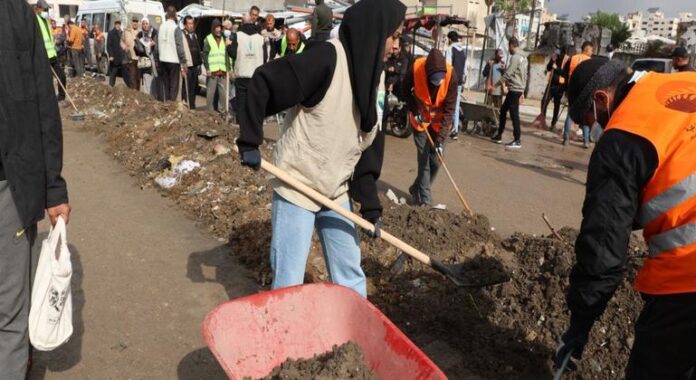
Dozens of participants — including UN officials, volunteers, and residents who recently returned from the south of the Strip — took part in the activities in the city centre. One participant, a woman in a wheelchair, held up a sign reading “We Will Rebuild Gaza” to express her support for the campaign.

Amjad Al-Shawa, Director of the Palestinian NGO Network, said the initiative represents “a shared message to the world that the people of Gaza are capable of bringing life back to their city.”

He added that specialised engineering teams working on rubble management have begun seeking solutions to deal with more than 60 million tons of debris resulting from the destruction of homes and infrastructure, noting that “today’s volunteer campaign is only the beginning of a long process until Gaza returns more beautiful than it was.”

Volunteers, NGOs and the UN are involved in the “We Will Rebuild Gaza” campaign.

UN agency officials also joined the cleaning efforts, reaffirming their support for local initiatives.

Alessandro Marakic, an official with the United Nations Development Programme (UNDP), said, “we are here with the local authorities, civil society organizations, and the Chamber of Commerce to start the cleaning operations. What we are witnessing today is people returning to their city and regaining part of their dignity by restoring order to the streets.”

He added that the program carries out daily solid-waste collection and is currently preparing plans for the winter season to ensure proper management of water and wastewater.

The campaign included the deployment of machinery and trucks to clear debris from the streets, while dozens of workers and volunteers took part in removing waste and cleaning public areas, as part of broader efforts to restore life to the city after many months of war.

Source link

Indigenous protesters block entrance to COP30, demand action from Brazilian government

0

The Munduruku, who live primarily in the Amazon states of Amazonas, Mato Grosso and Pará, are demanding an end to projects and extractive activities that threaten indigenous territories, particularly in the Tapajós and Xingu river basins.

“Legitimate” protests and government response

COP30 executive director Ana Toni called the protests “legitimate” and confirmed the government was listening to them. The demonstrators were invited to meet the Minister of Indigenous Peoples, Sônia Guajajara, and the Minister of Environment and Climate Change, Marina Silva.

Ms. Toni highlighted that COP30 has more than 900 indigenous participants, a significant increase from the 300 registered at last year’s conference in Baku, Azerbaijan.

“Brazil has a strong democracy that allows for different forms of protest, both inside and outside the conference,” she said, adding that hosting COP30 in the Amazon aimed to ensure that indigenous voices were heard.

© UNFCCC/Diego Herculano

Security guards guard the UN Climate Conference venue as Munduruku indigenous people protest.

The voices of indigenous youth highlight the urgency

For the participating indigenous youth, the demonstration reflects both the urgency of their demands and the value of being present at the international conference.

Amanda Pankará, from the Pankará people of Pernambuco, said UN News that COP30 provides a space where indigenous issues can gain visibility.

“We would have a lot more to contribute if more Indigenous people participated in these discussions. These demands are valid. We are demanding the right to land, the right to life… Being here today, representing those who have not had the opportunity to be here, reinforces our presence and our responsibility. We are the ones who create this barrier of protection, so we want to be heard.”

Commitment to climate action

At a meeting on Thursday, many indigenous leaders described COP30 as the most inclusive climate conference they had attended.

Young Chilean indigenous Emiliano Medina – from the Mapuche people – who participated in the meeting, said indigenous representatives reaffirmed their commitment to tackling the climate crisis.

He stressed that protests like Friday’s are a way to present demands and highlight policy shortcomings. “Similar protests have taken place around the world, in communities affected by climate change,” he said.

Indigenous people block the entrance to the United Nations Climate Conference in Belém, Brazil.

“The COP in the Amazon is supposed to hear these voices”

Ana Toni highlighted that holding COP30 in the Amazon allows broad participation of indigenous peoples, which would have been more limited if the event had taken place in Rio de Janeiro, São Paulo or Brasilia. She assured that protesters’ voices were being heard and noted that further protests are expected throughout COP30.

“The aim of holding a conference in the Amazon is precisely to listen to these demands,” she concluded.

UN NewsEastreport from Belémgiving you front row coverage of everything happening at COP30.

Originally published at Almouwatin.com

Diabetes now affects 1 in 6 pregnancies: what you need to know

0

This Friday, for World Diabetes Daythe UN highlights the impact of the disease on pregnancy, in line with this year’s global theme, managing diabetes “across the lifespan”.

The organization also launched its first-ever global guidelines on how to manage diabetes before, during and after pregnancy.

“These guidelines are grounded in the realities of women’s lives and health needs, and provide clear, evidence-based strategies for providing high-quality care to every woman, everywhere,” said Dr. Tedros Adhanom Ghebreyesus, who heads the United Nations World Health Organization.WHO).

The guide aims to support the 21 million pregnancies affected by diabetes each year, by providing recommendations that recognize the changing risks of diabetes throughout the lifespan.

Why it matters

Diabetes now affects more than 800 million people worldwide – and around half go undiagnosed, according to the WHO. new WHO report.

It is a major cause of heart disease, kidney failure, blindness and amputations. Its impact is growing most rapidly in low- and middle-income countries, where access to essential care and medicines is often limited.

This year’s World Diabetes Day message highlights the importance of improving diabetes care across the lifespan, starting even before pregnancy and continuing through early childhood and adulthood.

What is diabetes?

Diabetes occurs when the body fails to properly regulate blood sugar levels.

• Type 2 diabetes accounts for 95 percent of cases and is associated with being overweight, insufficient physical activity and genetics, according to the WHO.
• The causes of type 1 diabetes remain unknown and affected individuals require lifelong insulin treatment.
• The prevalence of diabetes has been increasing worldwide for decades, putting increasing pressure on health systems.

Pregnancy: a critical window

Diabetes in pregnancy may be pre-existing or first detected during pregnancy.

Women who develop diabetes during pregnancy are at higher risk of type 2 diabetes after delivery.

This condition increases the risk of life-threatening complications, including pre-eclampsia and other hypertensive disorders.

Babies face higher risks of stillbirth, seizures and birth defects. Children born after a pregnancy complicated by diabetes are more likely to develop obesity, cardiovascular disease and type 2 diabetes later in life.

What the WHO recommends

THE WHO Global Compact on Diabetes offers tools to improve prevention and care around the world.

The recently launched pregnancy guidelines contain 27 recommendations, including:

• Adopt a diet low in added sugars, with carbohydrates from whole grains, vegetables, fruits and legumes.
• At least 150 minutes of physical activity per week, including resistance training.
• Regular blood sugar monitoring
• Routine ultrasounds before and after 24 weeks
• Appropriate medical treatment

Originally published at Almouwatin.com

COP30: Climate crisis is a health crisis, warns WHO as philanthropists pledge $300 million for solutions

0

THE special report on health and climate changepublished by the United Nations World Health Organization (WHO) and the Brazilian government, warn that one in 12 hospitals could face climate-related closures. It calls for urgent action to protect health systems in a rapidly warming world.

This follows Thursday’s launch of the Belém Health Action Plana flagship initiative of COP30 placing health at the center of climate policy.

What the WHO says

“The climate crisis is a health crisis – not in the distant future, but here and now,” said WHO Director-General Dr Tedros Adhanom Ghebreyesus.

“This special report provides evidence on the impact of climate change on people and health systems, as well as concrete examples of what countries can do – and are doing – to protect health and strengthen health systems. »

Why it matters

Global temperatures are already above 1.5°C. The report finds that 3.3 to 3.6 billion people live in areas highly vulnerable to climate impacts, while hospitals face a 41 percent higher risk of damage from extreme weather compared to 1990.

Without rapid decarbonization, the number of healthcare facilities at risk could double by mid-century. The health sector itself contributes around 5% of global greenhouse gas emissions, underscoring the need for a rapid transition to low-carbon and climate-resilient systems.

Main gaps in health adaptation

The report highlights serious gaps in health adaptation planning:

  • Only 54 percent national health adaptation plans assess the risks for health establishments.
  • Less than 30 percent take into account income disparities.
  • Only 20 percent take gender into account.
  • Less than 1 percent include people with disabilities.

Progress has been made – the number of countries with multi-hazard early warning systems doubled between 2015 and 2023 – but coverage remains uneven, particularly in least developed countries and small island states.

What is done

To add momentum, a coalition of more than 35 philanthropic organizations today pledged $300 million to accelerate solutions at the intersection of climate and health.

The Climate and Health Funders Coalition – which includes Bloomberg Philanthropies, the Gates Foundation, the IKEA Foundation, the Rockefeller Foundation and Wellcome – will support innovations, policies and research on extreme heat, air pollution and climate-sensitive diseases, and strengthen health systems and data integration. Discover more here.

The coalition’s inaugural fundraising effort supports the Belém Health Action Plan and aims to deliver “no regrets” interventions that save lives now. With the past decade being the hottest on record and temperatures expected to remain near historic highs, experts warn that failure to act could have catastrophic consequences for human health.

“Adaptation is urgent”: COP30 health envoy calls for action

UN News spoke with Ethel Maciel, special envoy for health at COP30 and one of the architects of the Belém Health Action Plan. She emphasized that climate change is no longer a distant threat: it is now reshaping health systems.

“So how do we prepare our health units, our hospitals, our structures for these extreme events that will occur more and more frequently? And how can we ensure the training and capacity building of health professionals so that they can deal with these extreme events that will be caused by what we are already experiencing in these climate changes,” she said.

“An example here in Brazil is last year’s flood in Rio Grande do Sul, [which triggered] the largest dengue epidemic in history, caused by these climate changes. So this is not something we need to think about in the future; It’s happening now. It is therefore urgent to think about how to adapt our system.

Ms. Maciel described three pillars of the plan:

  • Monitoring integrate climate and health data, thereby forecasting heat-related health demand and better reporting climate-related cases.
  • Resilient systems and training so that healthcare professionals can identify and treat impacts such as dehydration or cardiac stress.
  • Research and innovation to be developed heat-resistant medicines and vaccines, reduce pollution in healthcare supply chains and expand the use of renewable energy.

She warned that implementation is essential in the Amazon, where deforestation could release unknown pathogens. “We have…pathogens that we don’t even fully know about yet [understand]she said, urging leaders to ensure that the plan “doesn’t just become another piece of paper and another really nice statement, but that doesn’t happen in practice.”

UN NewsEastreport from Belémgiving you front row coverage of everything happening at COP30.

Originally published at Almouwatin.com

Healing the Hidden Wounds of Childbirth

0

For women like Farhiya, 38, from rural Beletweyne, the consequences can be devastating: a painful obstetric fistula, a hole in the birth canal that left her incontinent, isolated and cut off from her community. “I was stressed, constantly worried and isolated from my community. I lived in my house as if I had […]

Originally published at Almouwatin.com

Synthetic biology to supercharge photosynthesis in crops

0


Nanoscale compartments – called encapsulins – have been designed to target plants’ biggest bottleneck: efficiently using Rubisco protein.

Source link
