The escalation of violence in the Middle East has entered its fourth day, with US and Israeli military strikes against Iran and subsequent Iranian counterattacks striking targets across the region, disrupting airspace and transport routes. The situation has caused civilian casualties and raised fears of instability […]
press releasePublished March 3, 2026 ImageGrzegorz Moroń, Well with nature / EEA Reducing pollution, in line with the EU Zero Pollution action plan, could improve mental health across Europe, according to an EEA briefing paper published today. The publication covers the links between air pollution, noise pollution […]
press releasePublished March 3, 2026 ImageGrzegorz Moroń, Well with nature / EEA Reducing pollution, in line with the EU Zero Pollution action plan, could improve mental health across Europe, according to an EEA briefing paper published today. The publication covers the links between air pollution, noise pollution […]
Reducing pollution, in line with the EU Zero Pollution action plan, could improve mental health across Europe, according to an EEA briefing published today. The publication covers the links between air pollution, noise and chemical pollution to mental health issues, as well as opportunities for action – including the positive effects of nature-based solutions on mental wellbeing.
A significant correlation between exposure to pollution (especially air, noise and chemicals) and mental health issues is emerging in scientific studies, even though more research is needed to establish a clear causality link, reveals the EEA briefing ‘Pollution and mental health: current scientific evidence’. Mental health disorders originate from a multitude of factors (genetics, social and economic determinants, psychological, lifestyle, etc.) some of them not yet completely understood. Pollution is increasingly being examined as one such contributing factor.
Europe has been experiencing a significant increase in the prevalence and incidence of mental health disorders in the past 25 years. Mental health disorders accounted for the sixth largest burden of disease in the EU in 2023, and represented the eighth most common cause of death.
A few examples covered by the briefing, where pollution is correlated with mental health issues:
Air pollution:
outdoor air pollution during critical stages of brain development — for example in utero, childhood and early adolescence — is associated with structural and functional brain changes.
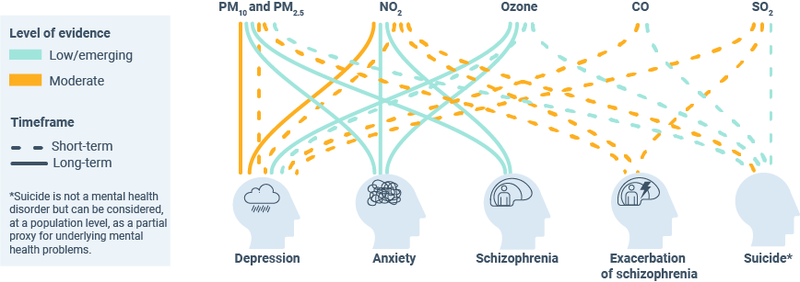
long-term exposure to poor air quality (mainly PM2.5 and NO2) is linked to an increased prevalence or risk of new onset depression
short-term peaks of exposure are associated with worsening schizophrenia symptoms;
Fig. 1 Links between air pollution and mental health disorders.
Notes: abbreviations: PM2.5 = particulate matter with a diameter under 2.5 micrometres; PM10 = particulate matter with a diameter under 10 micrometres; NO2 = nitrogen dioxide; SO2 = sulphur dioxide; CO = carbon monoxide. Source: comprehensive review of the literature, with a particular focus on systematic reviews and meta-analyses carried out by the European Topic Centre on Human Health and the Environment (ETC HE, 2026).
Environmental noise:
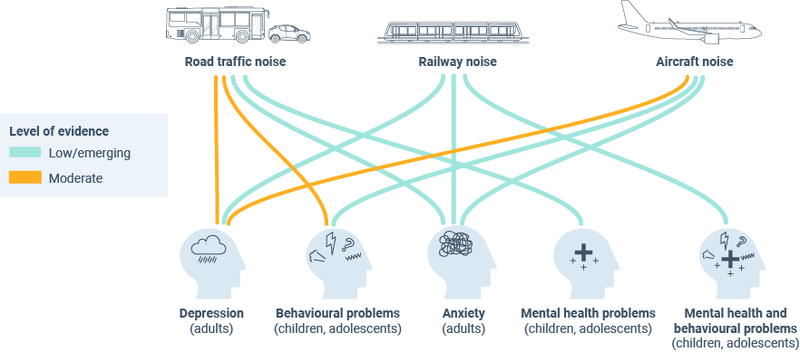
an increase in road-traffic noise is correlated with a small increase in the risk of depression (3%) and anxiety (2%);
exposure to environmental noise is associated with a higher prevalence of behavioural issues in children; this in turn affects their mental well-being;
there is a significant 2.2% increase in suicide rates per 10dB increase in railway noise.
a meta-analysis found a 12% increase in depression risk per 10dB Lden increase in aircraft noise.
Fig. 2 Links between environmental noise pollution and mental health issues
Source: ETC HE, 2026.
Chemicals:
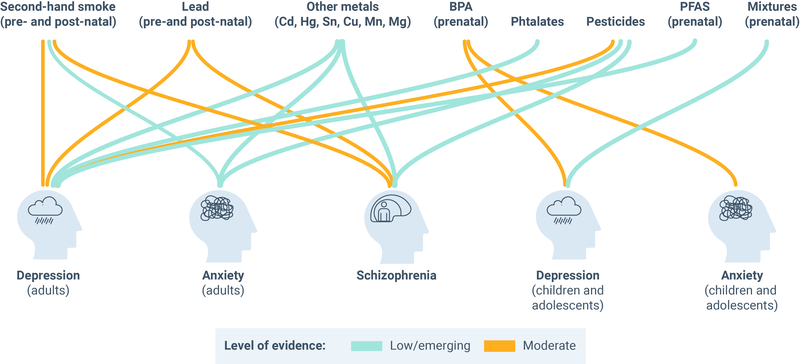
prenatal or childhood exposure to Pb is associated with both depression and schizophrenia;
exposure to second hand smoke is consistently linked to depression and schizophrenia, especially in vulnerable groups like children and pregnant women;
studies found an association between prenatal BPA exposure and depression as well as anxiety in childhood.
Fig. 3 Links between chemical pollution and mental health issues.
Notes: Abbreviations: SHS = second-hand smoke; Cd = cadmium; Hg = mercury; Sn = tin; Cu = copper; Mn = manganese; Mg = magnesium; BPA = bisphenol A; PFAS = per- and polyfluoroalkyl substances.
Sources: ETC HE, 2024, 2026.
Opportunities for action
While further research is needed to clarify causality, the existing evidence strengthens the case for full implementation of EU legislation and further reductions in pollution exposure.
The findings reinforce the relevance of the One Health approach, which recognises the interconnectedness of human, animal and environmental health. That doesn’t apply only to reducing pollution. Nature-based solutions can, in fact, be used to promote mental health, physical activity and social cohesion through access to green and blue spaces (activities on water or around water). Nature-based therapeutic approaches have been developed in recent decades: gardening, green exercise, forest-bathing have been shown to have some beneficial effects on mental health.
Delivering on the objectives of the EU Zero Pollution Action Plan, by reducing pollution and expanding access to nature could contribute to improved mental wellbeing for millions of Europeans.
The Tabernacle Choir and the Orchestra at Temple Square concluded their weeklong “Songs of Hope” tour in São Paulo, Brazil, on Sunday, March 1, 2026. Hundreds of thousands heard the musical message of hope and peace. More than 400 locations throughout Brazil held watch parties, thanks to Saturday night’s concert being streamed on YouTube. Media […]
The Tabernacle Choir and the Orchestra at Temple Square concluded their weeklong “Songs of Hope” tour in São Paulo, Brazil, on Sunday, March 1, 2026.
Hundreds of thousands heard the musical message of hope and peace. More than 400 locations throughout Brazil held watch parties, thanks to Saturday night’s concert being streamed on YouTube.
“Everyone had a smile on their face. They could feel something different,” said Elder Ulisses Soares of the Quorum of the Twelve Apostles of The Church of Jesus Christ of Latter-day Saints following the concerts held in Ginásio do Ibirapuera. “And I can tell you that [because] I know so many of the people attending these concerts. I grew up here. This is my land, my country, my language.”
The Choir last performed in Brazil in 1981 in the very same venue, a concert attended by Elder Soares and his wife, Rosana, when they were dating and had a “dream of seeing the Choir sing.”
“It was such a beautiful memory to cherish, especially because we were so excited to see the Choir,” said Elder Soares. “To come back 45 years later and accompany the Choir as a representative of the Savior Jesus Christ, bringing this message of hope to my own country, is deeply touching.”
Elder Soares welcomed the crowd at the start of each show with an invitation:
“As members of The Church of Jesus Christ of Latter-day Saints, we believe that all are invited to come unto Christ and to find in Him a constant source of light, divine guidance and inner renewal.”
The Apostle continued, “This concert, ‘Songs of Hope,’ is a sincere expression of that invitation. Through sacred music, we desire to point hearts to Him, Jesus Christ — the One who is, for us, the true source of hope.”
The arena was at maximum capacity each night, with hundreds more waiting and listening from the streets as music echoed into the neighborhood.
“I was expecting to just listen to beautiful songs, but I [felt] the songs,” said concertgoer Shellen Orteney. “I want to remember this feeling for the rest of my life.”
Elder-Soares-Tab-Choir
A member of the wipes away tears as she listens to The Tabernacle Choir at Temple Square perform at the Ginásio do Ibirapuera in São Paulo, Brazil, on March 1, 2026.2026 by Intellectual Reserve, Inc. All rights reserved.
Download Photo
Each night, the Choir performed several songs in Portuguese, including “Let Us All Press On,” “The Spirit of God” and “God Be with You Till We Meet Again,” and one verse of “I Believe in Christ.”
Henrique Bermann, who attended Saturday night’s concert, could not believe it. “I was not expecting the Choir to sing so beautifully, especially in Portuguese.”
The Tabernacle Choir Director Mack Wilberg believes performing in the language of the audience is part of the Choir’s mission.
“It binds us a little bit more together, and it shows that we truly care about communicating with those for whom we are performing,” said Wilberg.
Elder-Soares-Tab-Choir
The Tabernacle Choir and Orchestra at Temple Square performs a concert at the Ginásio do Ibirapuera in São Paulo, Brazil, on March 1, 2026.2026 by Intellectual Reserve, Inc. All rights reserved.
Download Photo
Dallen Herzog, a bass in the Choir, agrees.
“It takes a lot of work to learn a language. It takes a lot of work to learn a song. But it connects you to the people,” Herzog said. “When they hear [music] in their own language, it makes them feel a special connection to the song [and] to us.”
Wilberg also knows the Choir has had help in accomplishing this undertaking.
“We always feel providential help in our ability to learn this many songs in Portuguese — and in such a short time — [it’s] a miracle in and of itself,” he said.
To help connect with the local audience, the Choir was joined by several guest stars who performed alongside them.
At the Sala São Paulo on Wednesday, February 25, Myra Ruiz and Fabi Bang joined the Choir. They are known for their roles in Brazil’s version of the musical “Wicked.”
Ivete Sangalo was the surprise guest artist, with her appearance being announced an hour before her first performance with the Choir.
Nathan Pacheco, Beatriz Marmelo, Gabrielly Lourenço, João Daniel and Nicole Luz — all members of The Church of Jesus Christ of Latter-day Saints — lent their voices to share uplifting and inspiring music.
“One of the main reasons why I love music is because I feel like it’s kind of a lifeline between me and heaven,” said Pacheco. “It helps shorten the gap and breathes hope back into my heart.”
“I think we connected some generations and [did] something new, something fun, something special, something that will be remembered,” she said.
Daniel said he felt the power of the music within himself and hoped the audience felt the same.
“I heard ‘I Believe in Christ’ today, and it went deep within my heart,” Daniel said. “I believe that everyone felt something. And I believe that a lot of people heard the Choir today, and they will have the desire to come back to Christ.”
Providential Hand at Play in São Paulo
When asked why he wanted to go on tour with the Choir, the Rev. Dr. Amos Brown said, “I consider it providential.”
“I love this choir. People will be inspired, and we [will] have hope and not live in moments of depression and dejection and division,” he said.
Rev.-Brown-Brazil
Saiida Webb (center) talk with Rev. Amos Brown and his wife, Jane, inside the São Paulo Temple Visitors’ Center on February 25, 2026. Webb was part of the Amos C. Brown fellowship in 2024 and traveled to Ghana with him.2026 by Intellectual Reserve, Inc. All rights reserved.
Download Photo
Providence’s hand came into play again when the Rev. Dr. Brown took a tour of the São Paulo Brazil Temple Visitors’ Center and was reunited with Saiida Webb.
“It was such a privilege to see the Rev. Dr. Brown and his wife again here at the São Paulo Visitors’ Center,” Sister Webb said. “It was amazing to have the Rev. here and give him a tour and center it in our shared love for Jesus Christ.”
Following the tour, the sister missionaries and the Browns sang “God Be with You Till We Meet Again,” the same song the Choir sang to conclude each of their concerts.
Reflecting on the week, President L. Whitney Clayton of The Tabernacle Choir Presidency said, “We’ve met new friends down here. We’ve brought friends with us. It’s a blessing to be here with Elder Ulisses Soares. He brings warmth and light and happiness to everything he does.”
He concluded, “I think people have felt closer to the Lord and like they’re part of a great big celebration of faith. It has been a wonderful week.”
UN human rights office spokesperson Ravina Shamdasani also recalled the horror of a strike on Saturday which reportedly killed and injured dozens of girls in a primary school in Minab in the south of Iran.
“Children, little girls…at the beginning of the school day being killed in this manner, backpacks with bloodstains on them – this is absolutely horrific,” she said. “If there is any image that captures the essence of the destruction, despair and senselessness and cruelty of this conflict, those are the images.”
Ms. Shamdasani said that UN rights chief Volker Türk had been “deeply shocked” by the impacts of the hostilities on civilians and civilian infrastructure, and called for a “prompt, impartial and thorough investigation” into the circumstances of the Minab attack.
“The onus is on the forces that carried out the attack to investigate it. We call on them to make public the findings and to ensure accountability and redress for the victims,” she insisted.
Ms. Shamdasani also stressed that if attacks are found to be directed against civilians or civilian objects or indiscriminate attacks, they are “serious violations of international humanitarian law and may amount to war crimes.”
The OHCHR spokesperson expressed concern for the welfare of Iranians “given the Government’s record of cracking down with lethal force on [a] broad scale against those who oppose their rule and the new threats of senior officials against any expression of dissent at this time.”
She called on the authorities to safeguard Iranians’ fundamental freedoms and deplored people’s limited access to essential information amid a nationwide internet shutdown.
Since the conflict erupted on Saturday with Israeli and US attacks on Iran, Tehran responded by with counterstrikes against Israel and other US allies across the region. Ms. Shamdasani underscored the fact that besides Iran and Israel, the hostilities have so far impacted 12 other countries, destroying homes, businesses, airports and energy infrastructure.
Lebanese uprooted
In Lebanon, where armed militants Hezbollah entered the conflict, drawing Israeli strikes, “heavy displacement has been reported across parts of southern Lebanon, the Bekaa and southern suburbs of Beirut”, said UN refugee agency (UNHCR) spokesperson Babar Baloch.
Israel issued evacuation warnings to the residents of more than 53 Lebanese villages and conducted intense airstrikes across all three parts of Lebanon, he said.
As of Monday, “the conservative estimates suggest that nearly 30,000 people were hosted and registered at collective shelters,” Mr. Baloch said. “Many more slept in their cars on the side of roads or were still stuck in traffic jams, leaving the south to [reach] Beirut.”
According to media reports on Tuesday, Israeli ground troops entered southern Lebanon, following Hezbollah’s attacks on northern Israel.
The UNHCR spokesperson underscored the fact that many of the countries affected by the new conflict “already host millions of refugees and internally displaced people”.
Further violence and displacement risk overwhelming host communities’ capacities, he warned.
Supply chain fears
Severe disruptions to the transport of goods due to ever-broadening hostilities in the region are also affecting humanitarian supply routes and those who rely on them for their next meal.
Speaking from Cairo, Samer Abdel Jaber, Regional Director for the Middle East and North Africa at the UN World Food Programme (WFP), highlighted disruption in the Strait of Hormuz and the Red Sea which “will complicate maritime routes and delays and driving costs for most of our operations that depend on those routes”.
“With seas contested and airspace closing, we’re looking at adapting and [using] our supplier networks in other countries like Türkiye, like Egypt, like Jordan and Pakistan to support overland corridors,” he said.
The WFP official added that Egypt’s ports and the Suez Canal, “a key hub for us to support our operation in Gaza, but also in Sudan,” are still functioning.
He said that Israel’s decision to close border crossings to Gaza since the beginning of the conflict had been a concern but that “good news” of an imminent opening of the Kerem Shalom crossing came on Tuesday.
According to subsequent media reports the crossing, on the southern border of the Gaza Strip, did reopen on Tuesday.
“That is timely for us and we need to get in aid as fast as we can,” Mr. Jaber said. “We have wheat flour that is sufficient only for 10 days and food parcels that will maintain our programmes only for two and a half weeks…We need to make sure that there is continuous and scalable flow of food into the Gaza Strip,” he concluded.
The UN Security Council meets in New York under extraordinary circumstances on Monday: against a backdrop of escalating conflict in the Middle East and repeated calls from the UN to call on all parties to exercise restraint, the Council turns its attention to a long-standing but under-resolved crisis which are […]


 The escalation of violence in the Middle East has entered its fourth day, with US and Israeli military strikes against Iran and subsequent Iranian counterattacks striking targets across the region, disrupting airspace and transport routes. The situation has caused civilian casualties and raised fears of instability […]
 press releasePublished March 3, 2026 ImageGrzegorz Moroń, Well with nature / EEA Reducing pollution, in line with the EU Zero Pollution action plan, could improve mental health across Europe, according to an EEA briefing paper published today. The publication covers the links between air pollution, noise pollution […]
 press releasePublished March 3, 2026 ImageGrzegorz Moroń, Well with nature / EEA Reducing pollution, in line with the EU Zero Pollution action plan, could improve mental health across Europe, according to an EEA briefing paper published today. The publication covers the links between air pollution, noise pollution […]




 The UN Security Council meets in New York under extraordinary circumstances on Monday: against a backdrop of escalating conflict in the Middle East and repeated calls from the UN to call on all parties to exercise restraint, the Council turns its attention to a long-standing but under-resolved crisis which are […]