Sunday, June 21, 2026
Home Blog Page 66

EU Nears FoRB Envoy Pick After Long Vacancy

0
EU Nears FoRB Envoy Pick After Long Vacancy

Mairead McGuinness is reportedly set to become the European Union’s next Special Envoy on freedom of religion or belief, ending a politically awkward vacancy that, over the past year, drew mounting pressure from MEPs, bishops, advocacy organisations and commentators who warned that Brussels was weakening its own human-rights credibility by leaving the post unfilled.

After more than a year of silence around one of the EU’s most symbolic human-rights posts, Brussels appears close to acting. EURACTIV reported on 25 March that former European commissioner Mairead McGuinness is set to become the EU’s Special Envoy for the promotion of freedom of religion or belief outside the Union. If confirmed, the appointment would end a vacancy that became increasingly difficult for the Commission to explain as public calls for action grew louder across the past 12 months.

The post is not a ceremonial one. Under the Commission’s published mandate for the special envoy, the office is meant to engage national authorities and civil society in countries where violations occur, support interreligious dialogue, contribute to deradicalisation work, promote tolerance in education, and coordinate with the EU Special Representative for Human Rights. In other words, it is one of the Union’s clearest external instruments for turning its FoRB principles into diplomatic practice.

Yet when the second von der Leyen Commission took office on 1 December 2024, the envoy role was left vacant. That absence soon turned into a recurring point of criticism. In April 2025, the European Parliament’s Intergroup on Freedom of Religion, Belief and Conscience renewed its appeal to Commission President Ursula von der Leyen and Commissioner Magnus Brunner, calling for the urgent appointment of a qualified envoy with proper resources and autonomy. The letter of 4 April 2025, signed by the intergroup’s co-chairs and supported by a broader cross-party group of MEPs, argued that the worsening situation for believers and non-believers abroad required a timely, credible and fully backed appointment.

A month later, the intergroup published von der Leyen’s response, saying she remained committed to the role and intended to renew it. But the reassurance did not settle the matter. By the summer, frustration had deepened. On 22 August 2025, ECR MEPs Bert-Jan Ruissen and Carlo Fidanza publicly urged the Commission to fill the post immediately, saying it had been vacant since December 2024 and linking the delay to the EU’s wider response to religiously motivated violence and persecution.

Pressure widened further in autumn. In October 2025, the bishops of the European Union, gathered under COMECE, wrote to von der Leyen to say that one year into the mandate of the von der Leyen II Commission, the envoy was still missing. Their argument was not only moral but geopolitical: in a world marked by instability, the bishops said, the EU needed a visible and effective instrument to defend freedom of religion or belief as part of its external action.

By the end of 2025, the debate had also broadened beyond whether the envoy should be appointed to the kind of person the EU should choose. In December, Humanists International published a letter from 18 cross-party MEPs warning that the next envoy should not use the mandate in ways that undermine the rights of women, LGBTIQ+ people or non-believers. That intervention added a second layer to the discussion: not only speed, but also the universality and consistency of the human-rights framework the envoy is expected to uphold.

Human Rights Without Frontiers pushed the criticism further. In a series of reports during 2025 and early 2026, including a January 2026 assessment, the Brussels-based NGO argued that the Commission had allowed the office to lapse again without transparency, and criticised the absence of a public call for candidates. HRWF also framed the problem as structural, saying the envoy role has repeatedly suffered from long interruptions rather than stable continuity.

Willy Fautre from HRWF and through The European Times has also tracked the issue closely. In September 2025, it reported on the ECR call for an urgent appointment. More recently, it published a strongly worded piece titled “Shame on the EU! 15th month without EU Special Envoy on Freedom of Religion or Belief is over”, reflecting the sense among some observers that the vacancy had moved from bureaucratic delay into a test of political will.

The timing has been especially awkward for Brussels because the EU continues to present itself internationally as a defender of FoRB. Earlier this month, the EU Delegation in Geneva marked the 40th anniversary of the UN Special Rapporteur on freedom of religion or belief, stressing that the EU has long supported the mandate and sees FoRB as foundational for human dignity and social cohesion. That message sits uneasily beside the long vacancy in the Union’s own envoy post.

If McGuinness is confirmed, Brussels will be choosing a figure with deep institutional experience. According to her official Commission biography, she served as European Commissioner for financial services from 2020 to 2024, was First Vice-President of the European Parliament from 2017 to 2020, and had previously spent 16 years as an MEP. Official biographies of her earlier parliamentary work also note that she led Parliament’s dialogue with religious and philosophical organisations under Article 17, giving her familiarity with one of the EU’s most sensitive church-state interfaces.

That background may help explain why her name has circulated in Brussels for weeks. Dutch daily Reformatorisch Dagblad had already reported in early March that McGuinness was being considered for the FoRB brief, before EURACTIV published its exclusive on Tuesday. Several Brussels observers saw her as a plausible choice precisely because she combines political seniority, knowledge of the institutions and prior experience with religion-related dialogue inside the Parliament.

Still, any appointment is unlikely to end the debate entirely. Those who campaigned for the role’s reinstatement will want to see whether the envoy receives meaningful backing, staff and political access rather than a largely symbolic title. Rights organisations that warned against a selective reading of FoRB will also be watching closely. The deeper question raised over the past year has not only been whether the EU wants an envoy, but whether it wants one with enough independence, clarity and institutional support to matter.

That is why the reported nomination of McGuinness matters beyond personnel. It could close a damaging gap in the EU’s human-rights architecture. But it will only count as a real reset if Brussels now turns an overdue appointment into a durable and credible policy instrument.

Source link

Ukraine violence ‘worse than ever’, Security Council hears

0
Ukraine violence ‘worse than ever’, Security Council hears

Rosemary DiCarlo described the conflict as “nearly 1,500 days of death, destruction and despair” and reiterated the UN’s long-standing call for a ceasefire. 

Since the war began, 15,364 civilians have been killed, including 775 children, and more than 42,000 others injured, though actual numbers are likely to be higher.

“The suffering and destruction caused by the war in Ukraine can never be justified. The longer the war exists, the deadlier it becomes, with growing risks to regional and international security,” she said.

Rising death toll, energy sector hit 

Ms. DiCarlo reported that at least 188 civilians were killed in February, and 757 injured – a 45 per cent increase over the same period last year. 

Attacks have continued this month, including deadly assaults in Kharkiv, Kyiv, Donestk, Kherson and Zaporizhzhia, while reports point to an increase in strikes targeting railroads and other transport infrastructure.

“Over the winter, damage to Ukraine’s energy infrastructure brought the country’s energy grid to the brink of total collapse,” she told ambassadors. 

Some 60 per cent of gas production capacity has been destroyed and all power stations are damaged, according to the authorities, which has caused persistent disruption in electricity, heating and water supply across the country. 

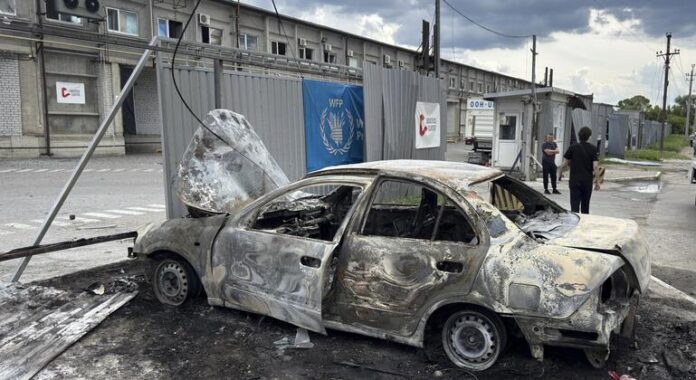
In the southern city of Odesa, energy, industrial and port infrastructure have been damaged. The latest attack took place on 19 March when drones hit apartment buildings. Four people were reportedly injured. 

Ukrainian drone attacks

Meanwhile, Russia has reported Ukrainian attacks that have impacted civilians and civilian infrastructure in its territory. 

They include the largest drone attack targeting the capital, Moscow, to date, which occurred over the weekend from 14 to 16 March when at least 250 drones were reportedly shot down. No civilian casualties were reported. 

“In Russian regions bordering Ukraine – Kursk, Belgorod and Bryansk, as well as the southern Krasnodar region – local officials have reported civilian casualties and damage to infrastructure from alleged strikes,” she said, although the UN is unable to verify these reports.   

Nuclear risks 

At the same time, military activity near Ukraine’s nuclear sites continues “with potentially devastating consequences” and recent developments also underscore the serious regional impact of the war. 

“Damage to the Novodnistrovsk hydroelectric plant in the south of Ukraine on 7 March led to an oil spill and widespread water pollution of the Nistru River in neighbouring Moldova,” she said. 

The crisis prompted “a 15-day environmental alert,” among other impacts. Furthermore, Moldavan airspace has repeatedly been violated by drones, according to officials. 

US diplomatic efforts welcomed 

Before concluding her remarks, Ms. DiCarlo underscored that a full, immediate and unconditional ceasefire is imperative. She welcomed diplomatic efforts led by the United States over the past year to advance peace.  

“As the most significant initiative to date to help restore momentum towards a peaceful resolution, these efforts require sustained commitment and support,” she said. 

She stressed that “the aim must be a just, lasting and comprehensive peace in line with the UN Charter, international law and relevant UN resolutions,” while Ukraine’s sovereignty, independence, and territorial integrity must be upheld. 

‘Sustained pattern’ 

UN Emergency Relief Coordinator Tom Fletcher, who also briefed the Council, warned against the rising bloodshed and the strikes on energy and other vital infrastructure. 

These attacks reflect a sustained pattern of damage to the systems on which civilians depend to survive, with humanitarian aid increasingly stepping in to fill the gaps left by the deterioration of essential services,” he said. 

He noted that the conflict “is increasingly characterised by the use of advanced technologies” and called for an investigation into the 20 March drone strike on a national non-governmental organization (NGO).  The humanitarians were evacuating older people in Donetsk oblast when their clearly marked van came under fire, killing two women and injuring two evacuees. 

Support humanitarians 

Mr. Fletcher also reported positive news, including that the UN and partners reached nearly one million people in January, providing food, cash assistance, medical care, shelter and protection.  

He ended by making three “asks” to the Council, urging members to insist that international law must be upheld to protect civilians and the infrastructure they rely on. 

The Council must also ensure rapid, safe and unimpeded humanitarian access to all civilians in need. 

His third request was for greater financial support for the $2 billion humanitarian plan to assist 3.6 million people this year. 

“Nearly three quarters of that plan is still unfunded, so please fund the response so that we can deliver life-saving aid at the scale and the speed needed,” he said. 

Source link

MIDDLE EAST LIVE 24 March: West Bank attacks and Lebanon in focus as Security Council meets

0
MIDDLE EAST LIVE 24 March: West Bank attacks and Lebanon in focus as Security Council meets

As the war continues to roil the Middle East and compound suffering for civilians across the region, the economic ramifications of the emergency are still playing out, with the Strait of Hormuz the focus of global attention with crude oil prices surging over $100 a barrel again. Meanwhile, settler attacks have escalated dramatically against Palestinians in the occupied West Bank, a topic that we’ll be across today also, with aid updates and live reporting from the Security Council. UN News app users can follow coverage here.

Source link

EuroLeague’s €3.2bn Moment Meets NBA Pressure

0
EuroLeague’s €3.2bn Moment Meets NBA Pressure

European basketball’s biggest story today is not only on the court. Fresh reporting on Tuesday says the EuroLeague and its licensed clubs are now valued at more than €3.2 billion, a figure that lands at a sensitive moment for the sport. With the NBA and FIBA still exploring a new European competition, the valuation reads as more than a financial update. It is also a statement that Europe’s existing elite club structure sees itself as a major sports property that does not intend to be sidelined.

According to reporting published today by AS and Palco23, and reflected in material from the EuroLeague Media Centre, a valuation study by JB Capital places the combined enterprise value of the league and its licensed clubs above €3.2 billion. The reports value the league itself at about €1.41 billion for the 2025-26 season, while the licensed clubs together are valued at roughly €1.8 billion.

More than a balance-sheet update

The figures matter because they point to a larger restructuring of the sport. Today’s reporting says individual club valuations range from more than €60 million to more than €320 million, and that the combined value of the league and its clubs could rise to €4.3 billion by the 2026-27 season if the current 10-year licensing framework evolves into a system of permanent franchises. In European sport, terms such as “license” and “franchise” are not merely technical. They signal different ideas about access, permanence and control.

Earlier this month, EuroLeague shareholders approved what the competition described as a transformational strategic roadmap. Business reporting said the plan includes evaluating a possible €1.5 billion capital raise to support growth initiatives, along with an additional €1 billion commercial vehicle focused on arena development and modernization. The same reporting linked the roadmap to permanent licenses, team expansion, digital acceleration, geographical growth and governance reform.

The NBA factor behind the timing

The valuation story lands in the middle of a wider struggle over who will shape elite basketball in Europe. In January, Reuters reported that NBA commissioner Adam Silver said a new Europe-wide competition could launch within the next two years, with the league hoping to tap the depth of supporter culture already seen around European football. The Financial Times also reported earlier this year that the NBA was preparing to present financial plans for a possible European league to prospective investors.

Seen in that context, today’s €3.2 billion figure looks like more than a business headline. It looks like a strategic message. EuroLeague is effectively telling clubs, investors and partners that it already has scale, commercial weight and long-term growth potential. The timing of the valuation, coming alongside the league’s new roadmap and the continuing NBA-FIBA interest in reshaping the market, gives the announcement significance well beyond sport finance.

A European sports question, not only a basketball one

For Europe, the issue goes beyond basketball finance. It touches on the wider European sports model, where club identity is often tied to cities, supporter communities and domestic competitions rather than to closed commercial systems. A move toward more permanent franchises may bring investment and stability, but it also raises familiar questions about merit, access and the relationship between continental competition and national leagues.

That broader background helps explain why basketball has become such a serious continental issue. As The European Times noted in an earlier feature on the rise of the sport across the continent, Europe’s basketball culture was not built only through commercial expansion, but through schools, municipal halls, historic clubs and deeply rooted fan communities. Today’s valuation does not erase that story. It shows that the old basketball map now sits inside a far larger investment battle.

For now, the same-day headline is clear: Europe’s top basketball competition has been valued at more than €3.2 billion, and that figure arrives just as the fight over the future of the sport is becoming more explicit. The next stage will show whether European basketball can modernise on its own terms, or whether outside capital and new league models will redraw the court entirely.

Source link

Italy’s Justice Referendum: A Crucial Test for Giorgia Meloni’s Government

0
Italy’s Justice Referendum: A Crucial Test for Giorgia Meloni’s Government

As Italy embarks on a pivotal two-day referendum on judicial reform, the outcome is poised to significantly impact Prime Minister Giorgia Meloni’s political standing. With voter turnout reaching unprecedented levels, the nation is divided over a proposal to restructure the judiciary, a decision that could redefine Meloni’s leadership and influence upcoming national elections.

Polling stations across Italy have opened for a crucial two-day referendum on judicial reform, marking a significant political moment for Prime Minister Giorgia Meloni‘s government. The vote centers on a proposal that aims to overhaul the judiciary by creating distinct career paths for judges and prosecutors. This change has not only polarized the political landscape but also united the centre-left opposition against the reform.

The proposed judicial reform, which passed through parliament last October without securing the necessary two-thirds majority to avoid a popular vote, has become a litmus test for Meloni’s leadership. The referendum requires voters to decide between confirming or rejecting the reform through a simple “Yes” or “No” vote on their ballot papers. Recent polling suggests a neck-and-neck race, with the “No” camp gaining momentum in the final days leading up to the vote.

High Voter Turnout Signals Intense Interest

According to data from the Interior Ministry’s Eligendo portal, voter turnout reached 14.88% by midday on Sunday, doubling the turnout rate of last year’s citizenship referendum and marking the highest engagement for any referendum in over two decades. This heightened participation underscores the high stakes involved and reflects the public’s vested interest in reshaping Italy’s judicial framework.

The current system allows judges and prosecutors to belong to the same professional body, with opportunities to switch roles throughout their careers after passing a unified entrance exam. The reform seeks to dismantle this structure by establishing separate career tracks for each role. Moreover, it proposes splitting the governing Superior Council of the Magistracy into two distinct councils—one for judges and another for prosecutors—each chaired by the Italian president and composed of members selected by lottery.

Political Ramifications for Meloni

The referendum is widely viewed as a barometer for Meloni’s government as national elections loom next year. Initially cautious about associating her image with the contentious reform, Meloni has recently embraced the “Yes” campaign more openly. In her campaign rhetoric, she has painted a stark picture of potential consequences should the reform fail.

“If the reform doesn’t pass this time, we will probably not have another chance,” Meloni declared at a campaign event last week. She argued that failure to implement these changes would result in “even more powerful factions” within the judiciary and raise public safety concerns due to lenient sentences.

Implications of a “No” Vote

A political analyst suggests that a victory for the “No” camp would deal a blow to Meloni’s perceived invincibility and invigorate opposition forces by highlighting an alternative governance path. Such an outcome could potentially weaken her domestic authority and complicate her international standing as she navigates through her tenure.

The referendum has not only tested Meloni’s policy agenda but also her ability to unify her party and rally public support amid growing political divisions. The centre-left opposition has capitalized on these divisions, positioning itself as a counterbalance to Meloni’s administration.

Looking Ahead

As Italians cast their votes, the outcome remains uncertain but undeniably critical for shaping Italy’s judicial landscape and its broader political future. A successful “Yes” vote would empower Meloni’s government to enact substantial reforms that could redefine judicial operations in Italy. Conversely, a “No” outcome could signal significant challenges ahead for her leadership.

With national elections on the horizon next year, this referendum serves as an early indicator of public sentiment and may influence electoral strategies across Italy’s political spectrum. As polling stations prepare to close after two days of voting, all eyes will be on Italy as it stands at this pivotal crossroads.

Source link

European Political Landscape Shifts as Slovenia’s Liberals Claim Victory and Italy Awaits Referendum Results

0
European Political Landscape Shifts as Slovenia’s Liberals Claim Victory and Italy Awaits Referendum Results

Slovenia’s liberal leader Robert Golob narrowly wins parliamentary elections, offering relief to EU diplomats. Meanwhile, Italy braces for the outcome of a critical referendum on judiciary reforms, seen as a confidence vote on the current government.

The political dynamics within Europe are witnessing significant shifts as Slovenia’s liberal leader Robert Golob secured a narrow victory in the recent parliamentary elections. This development comes at a crucial time as Italy is on the brink of concluding a pivotal referendum that could reshape its judiciary system. Both events hold substantial implications for the European Union’s political landscape.

Slovenia’s Liberals Secure Narrow Victory

In Slovenia, the incumbent liberal leader Robert Golob emerged victorious in the parliamentary elections held over the weekend. With 99.85% of the votes counted, Golob’s party, Gibanje Svoboda (The Freedom Movement), garnered 28.62% of the vote, slightly edging out the populist conservatives led by Janez Janša, who received 27.95%. This result translates into 29 seats for Golob’s party compared to Janša’s 28 seats, according to AFP.

The outcome is seen as a relief for Brussels due to Golob’s pro-EU stance. His victory positions him to lead exploratory talks to form the next government—a task that promises to be challenging given the close results and diverse political landscape in Slovenia. Addressing his supporters after the results were announced in Ljubljana, Golob expressed gratitude for the public’s confidence and extended an invitation to other parties to join discussions on forming a coalition government. “Since we have received the (people’s) confidence, now we can think about going forward under a free sun,” he stated.

Italy’s Referendum: A Test for Current Government

Meanwhile, Italy is in the final hours of a national referendum focused on amendments to its post-fascism constitution that aim to overhaul the judiciary system. The polling stations are set to close at 2 pm UK time (3 pm local), marking the end of what has been perceived as not just a technical vote but a de facto confidence measure on the current administration.

The referendum seeks public approval for changes that would significantly alter how justice is administered in Italy. Despite being a complex and technical ballot issue, it has taken on broader political significance as an indicator of support for the current government ahead of general elections scheduled for 2027. Early voter turnout reports indicate that over 46% of eligible voters had cast their ballots by Sunday evening, with preliminary suggestions hinting at potential support for the “yes” campaign.

Broader Implications Across Europe

The outcomes in Slovenia and Italy are part of a broader tapestry of political activity across Europe. In France, Socialist Emmanuel Grégoire was elected mayor of Paris as Marine Le Pen’s far-right National Rally failed to capture key cities during the second round of local elections. Similarly, in Germany, Chancellor Friedrich Merz’s Christian Democrats claimed victory in Rhineland-Palatinate, wresting control from their coalition partners, the Social Democrats.

These developments underscore shifting allegiances and evolving political sentiments across Europe. The Slovenian election results may bolster pro-EU sentiments within the bloc amidst rising populist movements. Meanwhile, Italy’s referendum could either consolidate or challenge the current government’s position.

As these electoral outcomes unfold, they will likely influence policy directions at both national and EU levels. Slovenia’s potential coalition negotiations will be closely monitored by EU diplomats eager to maintain stability and continuity within member states. In Italy, the referendum results will be pivotal in determining not only judicial reforms but also setting the tone for future political debates leading up to the next general election.

With Denmark also heading to polls tomorrow and other European nations preparing for various local and national elections throughout the year, 2026 promises to be a year of significant political realignment across Europe. These developments will undoubtedly shape discussions around EU integration, sovereignty issues, and responses to global challenges such as economic recovery and security concerns.

Source link

Sudan: Hospital strike highlights surge in drone attacks on civilians

0
Sudan: Hospital strike highlights surge in drone attacks on civilians

The Teaching Hospital in East Darfur’s capital, Al Deain, was struck late Friday, a new low in the brutal conflict between the Sudanese Armed Forces (SAF) and the paramilitary Rapid Support Forces (RSF) that erupted in April 2023.

According to the UN World Health Organization (WHO), the number of people killed has risen to 70, including seven women and 13 children, following search efforts.

Health workers – one doctor and two nurses – were also among those killed, while injuries have increased to 146 people, including patients and family members accompanying them.

Health care a frequent target

Since the start of the conflict, the total number of fatalities linked to attacks on health facilities has surpassed 2,000 according to WHO.

“An attack on a hospital is not only an attack on a building, it’s an attack on people seeking care, on health workers risking their lives to save others, and on the very possibility of survival at times of crisis,” said WHO Deputy Representative to Sudan, Dr Hala Khudari.

“Sudan is approaching its third year of armed conflict, but the attacks on healthcare continue,” she deplored, stressing that health facilities, ambulances, health workers and patients have been “repeatedly targeted”.

The attack on the teaching hospital has effectively closed it and patients “may have to travel over 160 kilometers to reach the next referral hospital, which for patients requiring specialized services, is very difficult”, the UN health agency official said.

She stressed that Al Deain served as a referral hospital for over two million people in the city as well as nine other localities in the East Darfur state.

Perpetrator hunt

Asked who was responsible for the Al Deain attack, UN Human Rights Office (OHCHR) spokesperson Marta Hurtado said that while the perpetrators have not been identified, both parties to the conflict use drones extensively.

“Our call is for both parties to stop immediately using this type of weaponry,” she said.

Ms. Hurtado warned of a surge in the use of drones to conduct airstrikes this year in Sudan, which “underlines the devastating impact of high tech and relatively cheap weapons in populated areas”.

More than 500 civilians were killed in such strikes from 1 January to 15 March, she said, the vast majority in three states in the Kordofan region.

The deadly attacks continued in the past week, culminating with the Al Deain attack as the month of Ramadan came to a close on Eid Al-Fitr.

Chad strike condemned

The UN Human Rights office spokesperson also said that “widening drone attacks are spiralling across Sudan[’s] borders, with serious risk of further escalation, carrying regional consequences”.

She mentioned deadly drone strikes last week on the town of At Tina close to the Sudan-Chad border and in the border locality of Tine in Chad, “after earlier ground offenses by the RSF”.

“Continued patterns of such attacks striking civilians and destroying civilian infrastructures raise serious concerns about compliance with international humanitarian laws, fundamental principles of distinction, proportionality and precaution, and may amount to war crimes,” Ms. Hurtado concluded, calling for an end to “arms transfers that are feeding the conflict”.

Source link

The Cultural Power of Lucky Numbers in Today’s Online Entertainment

0


Source: Freepik  Most people have a lucky number. It can be a birthday, an important date, a cultural

Source link

Alibaba Unveils 5nm RISC-V Chip Built for the Age of AI Agents

0


Alibaba has pulled the wraps off the XuanTie C950, a 5-nanometer processor purpose-built for agentic AI workloads, and

Source link

SECURITY COUNCIL LIVE: Ukraine in spotlight as Russian strikes surge

0
SECURITY COUNCIL LIVE: Ukraine in spotlight as Russian strikes surge

The Security Council is met for an open briefing on Ukraine, requested by European members following Kyiv’s 18 March letter citing a surge in Russian strikes. Inside the country, attacks continue to take a heavy toll: since 19 March, at least 25 civilians have reportedly been killed and more than 130 injured, including children, particularly in Donetsk, Sumy and Zaporizhzhia. We’ll have live coverage below, app users can follow here – and for all our key meetings coverage each day, go here

Source link