A World Wide Fund for Nature (WWF) analysis shows that 17% of people in Europe could face high to extreme risks of water shortage by mid-century.
According to the authors of the study, this scenario could only be prevented if governments and businesses take urgent and decisive action to increase the sustainability of economies through nature-based solutions.
The organization points out that rivers in Europe are falling victim to the heat. “Four of the continent’s most important arteries – the Danube, the Po, the Rhine and the Vistula – are facing record low levels, threatening business, industry, agriculture and even drinking water supplies for local communities.
Using WWF’s water risk assessment tool, the new analysis shows that Europe will be even more vulnerable to droughts and water shortages in the coming years,” the statement said.
“Europe’s droughts should shock no one: water risk maps have long pointed to distinct water shortages across the continent. What should shock us is the fact that European governments, companies and investors continue to turn a blind eye to water risks , as if they will resolve themselves,” said Alexis Morgan, head of the Water Program at WWF International.
“We need urgent action to mitigate these risks, especially by investing in nature-based solutions to improve the condition of Europe’s rivers, lakes and wetlands.”
According to WWF’s analysis, the countries that will face the greatest risks by 2050 are Greece and Spain.
Cities under threat
WWF’s analysis covers the entire continent, but highlights the countries likely to face the greatest risks by 2050. Among them is Greece, 82% of the population and much of its GDP that may come from areas of high or extreme risk. At the same time, ¾ of Spain’s population and GDP could be at high risk, while cities in the Guadalquivir River basin (such as Seville, Murcia, Granada and Córdoba) are expected to be the most affected by water shortages by the middle of the century.
The research shows the most endangered European cities. Even in the most optimistic scenario, there will be at greater risk of water shortages in cities such as Rome, Naples and Toulouse. Dozens of cities are also at serious risk, including Yerevan, Tbilisi, Madrid, Malaga, Valencia, Lisbon, Athens, Thessaloniki, Birmingham, Bucharest, Moscow, Donetsk, Palermo, Bologna, Florence, Bari, Baku, Antwerp and Brussels.
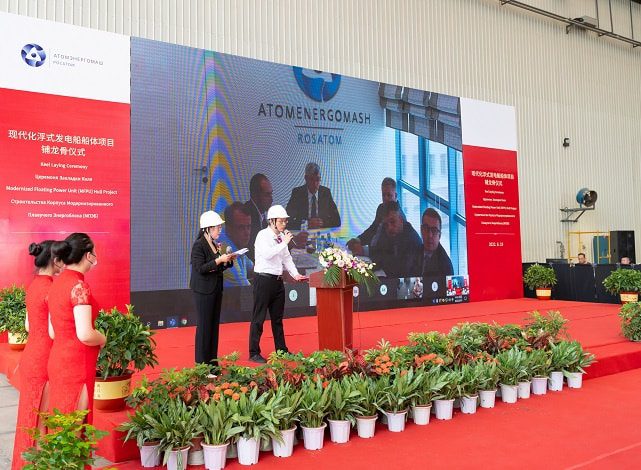
In China, the construction of the hull of the first floating nuclear power unit based on the Russian RITM-200 reactors has begun.
The length of the barge will be 140 meters, the width – 30 m, and the weight of the hull with equipment – 19,088 tons.
It is planned to be delivered to Russia by the end of 2023 so that the power equipment can be installed there.
This is the first of four floating power units in the arctic version with an installed electrical capacity of 106 megawatts each. They are intended for work in the waters of the CHukotka Autonomous District.
JSC Atomenergomash, ROSATOM’s mechanical engineering division is Russia’s largest power engineering company. The holding supplies reactor island and turbine island equipment to all NPPs of Russian design, manufactures equipment for LNG projects and waste processing industry, develops comprehensive solutions for energy/oil&gas/shipbuilding and other industries. The company’s technologies and equipment ensure operation of about 15% of NPPs in the world and 40% of TPPs in the Russian Federation and CIS countries. Atomenergomash consolidates the leading research, engineering and production facilities in Russia and abroad.
International tender to be announced to build substructures for two floating power units, reports Portnews.ru.
An international competition will be announced to build substructures for two floating power units (FPU), Director of the Northern Sea Route Directorate Vyacheslav Ruksha told IAA PortNews on the sidelines of Eastern Economic Forum. He confirmed IAA PortNews’ information about possible involvement of a Chinese shipyard. Taking into consideration the slow-down of the comprehensive plan and other, etc. there is a plan to have the main agreements signed by the end of September: between Atomflot and Baimsky GOK, between Atomflot and Atomenergomash JSC followed by the lower level agreements. The task is to get the first two FPU hulls in the CHaunskaya bay in autumn 2026.
Religious leaders in Russia have expressed their condolences on the death of Mikhail Gorbachev, who died on August 30 at the age of 91. They all express their gratitude for his political role in the emergence of religious freedom in the Soviet Union during the so-called “Perestroika” period. Against this background, the silence of the Moscow Patriarch Kirill makes an impression.
“Mikhail Gorbachev, the first president of the USSR, enabled Christians of various faiths in the country to practice their faith freely, and at a later stage of his life he himself became a believer,” Sergei Ryakhovsky, a member of the Public palace of Russia and bishop of the Evangelical Church. “Many of his ideas were desperately needed by society: the desire to have peace, to make the country more open, to solve the problem of the total deficit, and above all, what Christians of all faiths valued him for – he gave people the opportunity to freely believe in God. I knew Mikhail Sergeevich well, I met him more than once. I do not doubt the sincerity of his desire for the best, as well as the fact that at the end of his life he sincerely believed in God,” Ryakhovski said.
Rabbi Alexander Boroda, chairman of the Federation of Jewish Communities in Russia, noted the merits of Mikhail Gorbachev for the protection of the rights of believers, Interfax Religion reported. In his condolence address, Rabbi Boroda noted that under the first president of the USSR, opportunities for freedom of speech and self-expression, freedom of movement and private entrepreneurship appeared in Soviet society. In his address to Gorbachev’s daughter, Irina, he wrote: “Apart from this, I consider it necessary to express my personal gratitude to your father for the revival of religious freedom in our country – thanks to his reforms, a real upsurge and flowering of spiritual life took place.” .
Sheikh Ravil Gainutdin, head of the Russian Spiritual Council of Muslims, said in his condolences that Gorbachev’s political activity was marked by the revision of the state’s atheistic policy regarding the country’s religious communities. He recalled how Gorbachev, still as General Secretary of the Central Committee of the CPSU, allowed Soviet Muslims from Central Asia to perform Hajj in Saudi Arabia in 1989, reports TASS. “May the soul of the deceased rest in peace,” he adds.
The head of the Traditional Buddhist Sangha of Russia XXIV Pandit Khambo Lama Damba Ayusheev expressed his condolences to the relatives and friends of Gorbachev in connection with his death, noting that thanks to Gorbachev, Buddhists in the country received religious freedom.
“I express my deepest condolences to the family, friends and relatives on the occasion of the death of Mikhail Sergeevich Gorbachev. Thanks to his perestroika, the Buddhists got religious freedom and the opportunity to restore our datsans – monasteries and communities,” the Buddhist spiritual leader told TASS.
Teloh Tulku Rinpoche, honorary representative of the Dalai Lama in Russia, Mongolia and the CIS countries, supreme lama of Kalmykia, recalled that in the late 1980s the restoration of Buddhism began slowly, in particular in Buryatia, Kalmykia and Tuva. According to him, Gorbachev set an example of courage and determination by initiating changes in the USSR to improve the lives of the entire society.
Against this background, the silence of the Russian Orthodox Church, and more specifically of the Moscow Patriarch Kirill, makes a strong impression. Apparently, this has to do with the Kremlin’s subdued reaction to his demise. Mikhail Gorbachev will probably not be buried as a head of state, like the first president of the Russian Federation, Boris Yeltsin. According to propaganda, he was responsible for the collapse of the USSR, which led to the humiliation of Russia, which now has to correct his mistake and restore the Soviet empire.
Gorbachev himself says that he is an atheist. In 2008, he stated to “Notices”: “In general, to avoid misunderstandings, I would like to say: I was and remain an atheist…”. He says more than once that he grew up in a religious environment. For example, in an interview with “Komsomolskaya Pravda” he answers the question “Haven’t you started to believe in God?” like this:
“Our whole family was a believer. I was baptized as a child. Although my father and grandfather were communists, there was an icon and a lamp in the red corner. And next to him on the table were portraits of Lenin and Marx. So in our family there was equality between ideology and faith. I don’t go to church myself. And I think it’s hypocritical for people to stand around with candles for show. In front of the TV cameras. During “perestroika”, however, I once gathered the hierarchs of all religions in the Soviet Union in the hall of the Politburo and we created the Law on Freedom of Conscience and Religion. By the way, it still has no analogue in the world.”
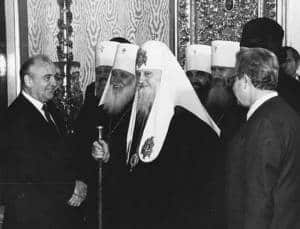
Pictured: Meeting of Mikhail Gorbachev with Moscow Patriarch Pimen and hierarchs in 1988.
Christianity is a challenge to many philosophical and religious systems. But at the same time, it meets the demands of most of them. And the strongest thing in Christian spirituality is not negation, but affirmation, comprehensiveness and completeness.
If Buddhism is imbued with the passionate longing for deliverance from evil, the longing for salvation; if the Buddha claimed that, like salt in the waters of the sea, his teaching of karma was imbued with the idea of salvation, then this thirst for salvation and the promise of salvation are inherent in Christianity.
If in Islam we find the absolute devotion of man to God, Who is the sovereign ruler of the cosmos and human destinies, we find the same in Christianity.
If in the Chinese worldview the sky – Qian – represents a guide for man in the things of life, even in the smallest and unimportant, in the various shades of tradition, this is available in Christianity.
If Brahmanism, modern Hinduism, reveals to us the manifold manifestations of the Divine, so does Christianity.
If, finally, pantheism affirms that God is in everything, that He, like some mysterious power, permeates every atom of the universe, Christianity also agrees with this, although it does not limit its understanding of God’s influence solely to this pantheistic omnipresence.
We would be mistaken, however, if we consider Christianity to be some kind of eclecticism, which has purely and simply collected in itself the elements of previous beliefs. It shows the colossal power of something new. And this newness is not so much in the teaching as in the penetration of another life into our unenviable life.
The great teachers of mankind – the authors of the “Upanishads”, Lao-tzu, Confucius, Buddha, Muhammad, Socrates, Plato and others – perceived the truth as a mountain peak, which they climbed with great effort. And quite rightly so. For truth is not something easily attainable; it really looks like a high mountain, which we climb, breathing heavily, clinging to the ledges, often looking back at the past, feeling the difficult road ahead. I will never forget the words of truth spoken by the ordinary Himalayan mountaineer, Sherpa by nationality, Tensing, who climbed Everest with the Englishman Hillary. He said that mountains should be approached with reverence. In the same way – and to God. Indeed, mountains require a special frame of mind to be penetrated by their majesty and beauty. The truth is hidden from those who set out toward it without reverence, without willingness to press on, despite the dangers and pitfalls. Climbing – this is the history of mankind.
You would easily object to me: how many steps are there leading down? Yes, of course, at first glance, the steps leading down are more. People who have fallen and descended into the abyss are more. But it is more important to us that man still climbed these sky-high peaks. And with this, man is great – with his ability to climb where, in the words of Pushkin, he is in “neighborhood with God” – in the mountains of mental and spiritual contemplation.
A person has two homelands, two fatherlands. One – this is our land. And that point on earth where you were born and grew up. And the second fatherland is the hidden world of the spirit, which is invisible to the eye and imperceptible to the ear, but to which we belong by nature. We are children of the earth and at the same time guests of this world. In his religious pursuits, man realizes infinitely more of his higher nature than when he fights, plows, sows, builds. And termites build and have to fight in their own way – not really as fiercely as humans. And ants sow, there are such species. But none of the living creatures, except man, has ever thought about the meaning of being, has never risen above natural physical needs. No animate being, except man, is capable of going to risk, and even to mortal risk, for the sake of truth, for the sake of that which cannot be touched with the hand. And the thousands of martyrs of all times and nations represent in themselves a unique phenomenon in the history of our entire solar system.
When we turn to the Gospel, we enter another life. Not in this world, which offers us exciting quests in the rush to heaven, but we find ourselves before the mystery of the answer. For twenty-five years Prince Siddhartha Gautama, the future Buddha, spent in ascetic efforts to attain contemplation. Yogis, philosophers, and ascetics put in the same amount of work mentally, spiritually and psychophysically, while Jesus Christ came from an ordinary village, where he led the life of an ordinary man. Everything was already given in Him and He never had to climb anywhere. On the contrary, He condescended to the people. Every great sage has realized his ignorance. Socrates said: “I know that I know nothing.” The greatest saints of all ages and nations considered themselves the greatest sinners to a far greater degree than you and I, because they were nearer to the light, and every stain on their lives and consciences was more conspicuous. , than in our gray life. Christ has no consciousness of something attained by Himself. He comes to men, bringing to them what is in Him originally, by nature.
I must draw your attention to the fact that Jesus Christ did not begin to preach Christianity as a concept. What He announced to people, He called “besora”, in Greek “evangelion”, which translates as “glad tidings”, “joyful news”.
What is this joyful, good news?
A person has the right not to trust the universe. A person has the right to feel himself on earth in a foreign and hostile world. Contemporary writers such as Albert Camus, Jean-Paul Sartre and others often speak of the terrible absurdity of existence. We are surrounded by something dangerous, inhuman, senseless, absurd – and it is impossible to trust it. A cold, dead or dying world. Indeed, I would like to insure, – these writers, novelists, dramatists, philosophers proceed from the position of the atheistic worldview – that is, the atheistic existentialism of Sartre and Camus, and somehow they have not seen one thing. When they say that the world is absurd, that is, meaningless, they know this because the opposite concept, the concept of meaning, is embedded in man. He who does not know what sense is, will not understand what is absurd. He will never be outraged by absurdity, he will never rise against it, he will live in it, like a fish in water. It is precisely that one rises against the absurd, against the meaninglessness of existence, that speaks in favor of the existence of meaning.
The ancient biblical narrative assures us that we can make an inner change and say “Yes!” to being, to trust what seems scary and ugly to us. And then through the chaos, through the absurd, right through the monstrosity of life, like the sun through a fog, the eye of God will look at us – the God who has a personal being and the personality reflected in each human person. And contact with Him is possible as a union of close beings. The whole meaning of humanity is its amazing analogy to the One who created the world. Charles Darwin shared that although he himself perceived the world mechanically, as a process, he still thought about its complexity and couldn’t understand: could only blind chance really have given rise to all this, and shouldn’t we look for some kind of reason behind it all? something similar to ours? We may add to the above: not merely analogous, but infinitely superior to our reason.
And in the Old Testament biblical religion, which has already been mentioned, the concept of faith-trust arises. Not faith as a theoretical, philosophical or religious belief, but faith as an act of breaking through dead, absurd reality when one speaks to God: I accept and perceive. Thus arose the ancient covenant between God and man, the ancient union. Naturally, the union between primitive, old man and the Divine could not be final and perfect. This was the upbringing of the human race, the childhood of mankind; adolescence followed, and in the 7th century BC. prophet Jeremiah wrote: “Thus says the Lord. I will make a new covenant with the people, “berit hadasha”, a new union that will not be like the old one, like the previous one. It will be written in hearts.”
And 700 years after the prophet Jeremiah, twelve people gather in a small room and perform a sacrifice. Usually the sacrifice was blood. Blood was a symbol of life. And life belongs to God alone. And the members of the assembled society sprinkled themselves with the blood of the sacrificial animal. Such was the ancient practice among all peoples, even in the most primitive times, in the Paleolithic. And Moses, when he concluded a covenant with God, sprinkled everyone with the blood of the sacrificial lamb. But on the night of which I speak, in the spring of the 30th year of the first century of our era, Jesus of Nazareth, surrounded by the Twelve, performed a rite to commemorate the freedom granted by God. There is no blood here, but a cup of wine and bread. He breaks this bread and distributes it to everyone saying, “This is My Body.” As a sacrificial lamb for the people. And he passed the cup to the disciples, saying: “This is My blood, which I shed for you; The New Testament is in My blood.” In such a way, at this sacred table that we are talking about with you, in every liturgy, God and man are united. Jesus of Nazareth performs this sacrifice. And from that moment, from that holy night, the cup does not stop being raised and the Eucharist is performed. In all branches of Christianity, in all churches and even sects, everywhere this sign is present.
Sometimes they emphasize that Christ heralded a new morality. He said: “A new commandment I give you – love one another as I have loved you.” There was a commandment to love before, and the words “to love your neighbor as yourself” belong to Moses. And Christ gives them a special sound – “as I have loved you”, because because of this love He stays with us on the polluted, bloodied and sinful earth – just to be with us. Thus His love becomes self-giving love, and because of this He also says the following: “Whoever wants to follow Me must first deny himself.” Meaning “from his individuality”, not from his personality, because personality is holy, but from his false self-affirmation. To give one’s self, to take up one’s cross, i.e. his service and suffering with joy and then follow Him.
Christ calls man to the realization of the Divine ideal. Only short-sighted people can imagine that Christianity has passed away, that it took place in the 13th century or the 4th century or whenever. I would say that it has only taken the first tentative steps in the history of the human race. Many of Christ’s words are still incomprehensible to us, because we are Neanderthals in spirit and morality. The gospel arrow is aimed at eternity.
You will say: how so, given that we had such great artists as Andrei Rublev, etc.! Yes, of course, there were also great saints who were forerunners, they walked the earth against the background of the black sea of filth, blood and tears. Obviously, this is the main thing that Tarkovsky wanted (perhaps unintentionally) to show in his film “Andrei Rublev”. Just think on what background the master creates this most tender, enchanting, Divine vision of the Trinity! What is depicted in the film is true. Wars, torture, betrayals, violence, fires, savagery. Against this background, a person not enlightened by God could only create “Capriccios”, such as Goya judged. And Rublev created a divine vision. Therefore, he drew not from the reality around him, but from the spiritual world.
Christianity is not a new ethic, but a new life. A new life that brings man into direct contact with God. This is the new covenant, the New Covenant. What is the secret, how do we understand this? Why is humanity attracted to the person of Jesus Christ like a magnet? So he has shown neither the mystery of the sages, nor the poetic exoticism of Eastern philosophy? What he spoke was so simple, so clear. And even the examples in his parables are taken from everyday life. This is the secret that He reveals in short words, such as we hear in the Gospel according to John. Philip says, “Show us the Father, the Father of all.” He Whom the Greeks called “Arches,” First, where is He? And Jesus answers in a way that no philosopher on earth has answered: “I have been with you so long, and you do not know Me, Philip? He who has seen Me has seen the Father.”
He spoke similar words more than once, and many people turned their backs on Him and left in resentment, for this was always a great challenge. They had to penetrate a special secret. Christ never directly formulated this mystery. He only asked people: “Who do you think I am – a prophet, the resurrected John the Baptist?” – “You are the Anointed One, the King, the Messiah, the Son of the Living God.” He asks His questions to this day, asking each one of us, because this is what God says through human mouths. Jesus Christ is the human form of the Infinite, the Inscrutable, the Immeasurable, the Unspeakable, the Nameless. And Lao-tzu was right to say that the name we pronounce is the eternal name. He becomes not only nameable, but even named by a human name. He Who bears with us the burdens of life. It is the center and center of Christianity.
Note: A lecture delivered in the Moscow Technical House on September 8, on the eve of the tragic death of Father Alexander Men; published on a tape recording in “Literaturnaya Gazeta”, No. 51 of 19.12.1990, p. 5).
Gorbachev had a huge impact on the course of world history
Russian President Vladimir Putin today sent a telegram expressing his deep condolences to the family and relatives of the last Soviet leader, Mikhail Gorbachev, who died at the age of 91, TASS reported.
The text of the message was published on the website of the Kremlin.
“Mikhail Gorbachev was a politician and statesman who had a huge impact on the course of world history. He led our country in a period of complex, dramatic changes, large-scale foreign policy, economic and social challenges. He deeply understood the need for reforms and tried to propose his own solutions to pressing problems,” Putin wrote in the telegram. “I would also like to note the great humanitarian, charitable and educational activity that Mikhail Sergeevich Gorbachev has carried out in recent years,” he adds.
In conclusion, the Russian president said that he once again sends “sincere words of sympathy and support” to Gorbachev’s family and relatives in connection with their loss.
It is not yet clear whether Putin will attend Gorbachev’s funeral on Saturday
The funeral of the last leader of the Soviet Union, Mikhail Gorbachev, will take place on Saturday, his daughter announced. The service will be in the famous Hall of Columns in the House of Trade Unions in Moscow – the same place where Joseph Stalin’s body was displayed after his death in 1953.
Pavel Palazchenko, head of media relations at the Gorbachev Foundation, said the ceremony at the Column of Pillars would be organized by the protocol service of the Putin administration. “There is no information whether this is considered a state funeral or not,” he told RIA.
The service will be open to the public, and then Gorbachev will be buried at the Novodevichy Cemetery in Moscow, TASS reported. There is also the grave of Boris Yeltsin, the first president of Russia and Gorbachev’s political rival. Nikita Khrushchev is the only other Soviet leader buried there, and most others rest by the walls of the Kremlin in Red Square.
It is not yet clear whether Vladimir Putin will attend the funeral.
What are the expectations of the World Council of Churches and local authorities for the General Assembly in Karlsruhe which opens today, 31 August, and runs until 8 September? Here are the answers of some personalities at the first press conference. Three words seem to me to sum them up: encounter, dialogue and reconciliation.
Agnes Abuom, moderator of the WCC Central Committee, expects that the Karlsruhe meeting will allow the “celebration of the Creator and of Life”. May people welcome each other by listening to each other and may what will be lived here help her to live better in her church and her country! She emphasised the importance of listening to the people of indigenous peoples. She was indeed marked by the preparatory assembly dedicated to them.
Bishop Mary Ann Swenson of the Lutheran Church USA, vice moderator of the same committee, hopes that this assembly will enable us to be more perfect in love and to grow in discipleship. “We want to live an ecumenism of the heart, so that people can say, like the first Christians, ‘look how they love each other’, because there is so much violence in the world”
For Romanian Orthodox Metropolitan Nifon, another vice-moderator, an assembly is an opportunity to share the joys and sorrows of the Christian faith. The progress of visible Christian unity is his main expectation, but the sufferings of this world must not be neglected. “To alleviate them we must be united. Human elements may divide the churches, but the churches must work to express the faith that unites them, not just what distinguishes them from one another”.
Orthodox theologian Ioan Sauca, acting general secretary of the WCC, is convinced that the encounter between Christians is indispensable. “We do not have to wait until we agree on all points of doctrine to act together on today’s burning issues and in the new geopolitical reality. Churches are part of this divided world. They have to bear witness to reconciliation and unity. When the world looks at us, it looks not at our theology, but at what we can do together so that it can believe”.
Asked about the WCC’s relationship with the Russian Orthodox Church, which supported the war in Ukraine, he recalls that the WCC is a platform for dialogue. That is why its central committee, in its meeting last June, decided not to suspend it. (read my article here: https://www.reformes.ch/blog/martin-hoegger/2022/06/why-did-world-council-churches-refuse-suspend-russian-orthodox-church) He was pleased that young Ukrainians and Russians who participated in the youth assembly were eating together, despite political and social divisions.
To another question about the impossibility of taking the Lord’s Supper (or Eucharist) together, he stressed the importance of having a common Christological and Trinitarian faith – as indicated by the WCC’s theological basis – and criticised theological relativism.
Bishop Petra Bosse-Huber of the Protestant Church in Germany (EKD) and chair of the local committee hopes that the message of the assembly will be “God loves life, so he needs us”. She recalls that German churches were invited to participate in the WCC’s first assembly in 1948, in the aftermath of the war provoked by her country. Today, what about the Russian Orthodox Church?
Bishop Heike Springhart of the Protestant Church of Baden calls for dialogue on current issues, not only on the stage, but also in the street. “May we share stories of reconciliation as our parents did after the Second World War”.
The Catholic Archbishop of the region, Stefan Burger, hopes that this assembly will lead to trusting relationships, which are the prerequisite for good ecumenical relations.
Finally, for the mayor of Karlsruhe Frank Mentrup, it is a great honour to host this assembly. “May it be a celebration of the Christian faith in global diversity! May the dialogue that will be lived in this assembly be an example for other religions and the whole of society and may this meeting help us to develop a spiritual understanding of the need for dialogue,” he said.
This first rich day saw the visit of the President of the German Federal Government, as well as remarkable talks by President Abuom and Secretary General Sauca, and interventions by representatives of the Jewish and Muslim communities. It ended with a joyful ecumenical celebration. I will come back to this in the next article.
Experts from the International Atomic Energy Agency (IAEA) arrived in the Ukrainian city of Zaporizhzhia on Wednesday, the latest stage in their efforts to inspect conditions at the embattled nuclear power plant there.
Speaking to reporters, agency chief Rafael Mariano Grossi expressed confidence that they will be able to safely conduct their technical mission, which follows months of consultations amid fears of a potential catastrophe at Europe’s largest nuclear facility.
Potential for ‘prolonged’ mission
The mission will take a few days, he said, though adding that it could be “prolonged” if they can establish a continued presence at the site.
The Zaporizhzhia Nuclear Power Plant has been occupied by Russian forces since the early weeks of the conflict and has come under repeated shelling in recent weeks.
Asked if he believed Russia will allow the agency to see what is really happening there, Mr Grossi responded that his team is made up of very experienced people.
“I bring here the best and the brightest in safeguards, in safety, in security, and we will have a pretty good idea of what’s going on,” he said.
Political will
Mr Grossi was also asked by a journalist, how they could help avoid a feared meltdown or nuclear incident at the plant.
“This a matter of political will,” he said. “It’s a matter that has to do with the countries that are in this conflict, in particular the Russian Federation, which is occupying the place.”
Mr Grossi is leading the 13-member mission from the Vienna-based IAEA, which set out for Ukraine on Monday. He met with President Volodymyr Zelenskyy in the capital, Kyiv, the following day.
The team’s priorities include ensuring nuclear safety and security at the plant, as well as undertaking vital safeguard activities, and assessing the working conditions of the Ukraine personnel working there.
EU foreign ministers agree to suspend visa facilitation agreement for Russians
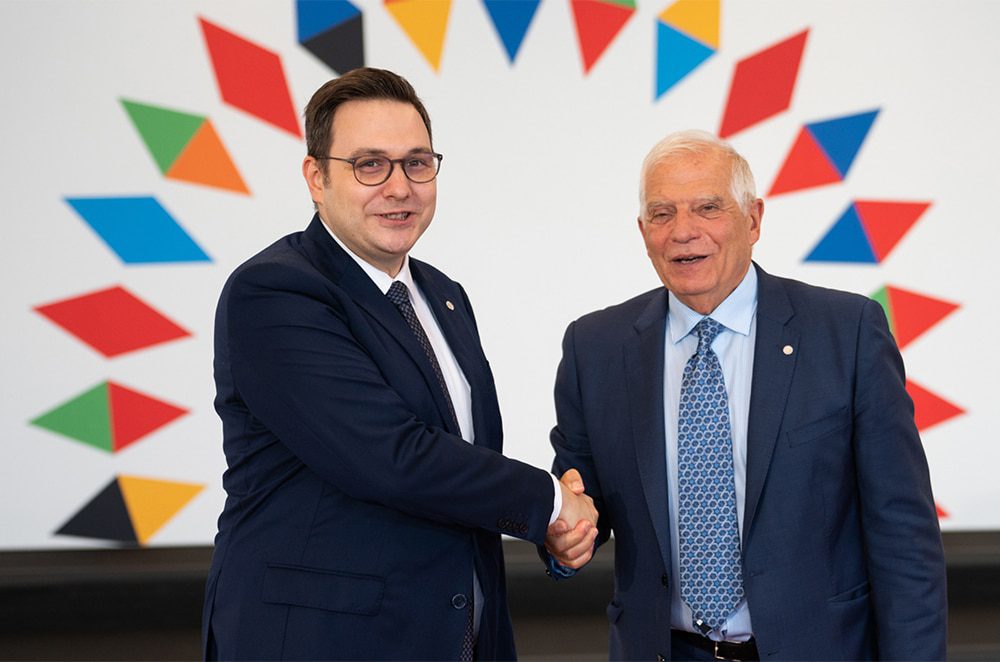
On 30 and 31 August 2022, Prague hosted an informal meeting of EU foreign ministers known as a Gymnich. The ministers primarily discussed two topics, namely the EU’s relations with Africa and the Russian aggression against Ukraine. The main outcome of the meeting was agreement among the Member States to suspend the visa facilitation agreement.
The main topic of the meeting of foreign ministers was the Russian aggression against Ukraine and its consequences. The ministers agreed that they would remain united in their approach to the hostile behaviour of Russia, and that they would provide Ukraine with the necessary support. Specific parameters of future military assistance to Ukraine were also discussed, with the ministers also addressing possible steps to strengthen the European Peace Facility to better meet the needs of the Ukrainian army.
The discussions also saw an important breakthrough in the visa policy in relation to Russia. The foreign ministers agreed to suspend the visa facilitation agreement that makes it significantly easier for Russian citizens to obtain Schengen visas.
In terms of our relations with Russia, we cannot continue as before. We have made progress at the meeting of foreign ministers and want to fully suspend the agreement that allows the simplified issuing of visas to citizens of the Russian Federation.
Jan LipavskýMinister of Foreign Affairs
According to Minister Lipavský, it is also however necessary to achieve mutual understanding between the Member States. On the one hand, there is the problem of the northern states that directly border Russia and which are seeing the arrival of large numbers of Russians. On the other hand, the individual Member States have differing stances on the issue. What is important now is that the European Commission and EU institutions prepare a proposal that reflects these different aspects.
High Representative of the Union for Foreign Affairs and Security Policy Josep Borrell recalled at the press conference that EU Member States already have considerable autonomy when issuing visas for entry into their own territory. “Member States have wide discretion in regulating their visa policies. Every Member State can thus also adopt and implement national measures in connection with the issuing of visas,” he said.
Nor were the European Union’s relations with Africa and the situation in African states in the context of the Russian aggression in Ukraine neglected. According to Minister of Foreign Affairs of the Czech Republic Jan Lipavský, it is essential to fight against Russian the propaganda narratives that Russia spreads in the region, and to offer African states advantageous cooperation with the European Union, for example in technology. High Representative Josep Borrell said that it is essential to work with the EU’s African partners in a coordinated manner.
As part of an informal lunch with the Associated Trio states, ministers discussed the European perspective of Georgia, Moldova and Ukraine, and how these countries can be helped on their road to the European Union. The future of the Eastern Partnership, an important instrument for cooperation, was also discussed.
The Forum 2000 conference, to focus on assistance to Ukraine, will follow on from the Gymnich meeting. Its topics will be the European perspective of Ukraine, post-war reconstruction, the punishment of war crimes, the resilience of democracy, and security.
Mikhail Gorbachev made a plea for dialogue and renounced the use of force during a visit to the European Parliament.
The former president of the Soviet Union was at the Parliament in 2008 for the Energy Globe Award where he picked up a lifetime achievement award. To mark the passing on 30 Augustof the last leader of the Soviet Union, who was praised by many for his role in bringing the Cold War to a peaceful end, we are republishing an interview from his visit. He talked about how countries should work together in the era of globalisation and his concerns about the environment.
You initiated momentous changes in the Soviet Union and did much to end the Cold War. What lessons can we draw from that experience when seeking a so called “world perestroika” to end the hot war against nature?
In the mid-80s the leaders of the big states realised that there is an urgent need to do something. Then God made the ways of Gorbachev, Reagan, Bush, Thatcher, Mitterrand and others – and they were wise enough to overcome clichés and prejudices regarding each other and start talking about the nuclear threat. Now the world and our times are different, there is globalisation, countries are more interdependent and countries like Brazil, China and India have come onto the stage.
The most important lesson we can take is that a dialogue has to be developed. Confidence has to be built. We have to renounce the politics of force, they bring nothing good. We have to understand that we all are in the same boat, we all have to paddle, if not, some are paddling, some are pouring water in, others might even be making a hole in it. Nobody will win in this manner in this world.
Look at the US in Iraq, everybody was opposed, even their allies, but they did not listen and what happened? They do not know how to get out of it now. Now we understand that… we are all linked to the US and if it falls apart it would be a real collapse. We have to help them to get out of there. That means that cooperation is needed, a new world order is necessary and global mechanisms to manage it.
After the Cold War everybody was talking of the new world order, even the Pope joined us and said a new world order is necessary, more stable, more fair, more human.
However, when the USSR fell apart – because of internal reasons first of all – the US could not resist the temptation to use the confusion. Political elites changed, those who brought the world out of the Cold War left the stage, the new ones wanted to write their history.
These errors of vision, poor decisions and missteps made the world ungovernable. We live in a world of chaos. New ways of life and new political mechanisms can emerge from the chaos, but the chaos can also lead to disruption, resistance and armed conflict.
Can we really call environmental degradation mankind’s no. 1 problem when so many people are living under the poverty line?
The major problems are poverty, air and water quality, unsanitary conditions, low agricultural productivity, but all of them are about ecology. It is nonsense to say that ecology is a luxury – it is the major priority of our times. The second priority is the fight against poverty because two billion are living on $1-2 a day. The third one is global security, including the nuclear threat and weapons of mass destruction. These are three urgent priorities, but I put ecology in the first place, because it directly touches all of us.
“Towards a New Civilization”is the motto of the Gorbachev Foundation. What does that New Civilisation look like? Where can the world get the huge resources needed for these fundamental changes?
It is not always about money. If international issues are handled in a disorderly way, you need more money. It is about trust, co-operation, dialogue, mutual help and mutual exchange. Why is Europe growing economically – because of the existence of the EU. This is the path of new opportunities and the EU is a good example.
Of course, not everything is perfect. In my view the EU is already overcharged as a system. It has to have wisdom and know when to stop, absorb, move forward, not just hurry and make hasty headlong jumps.
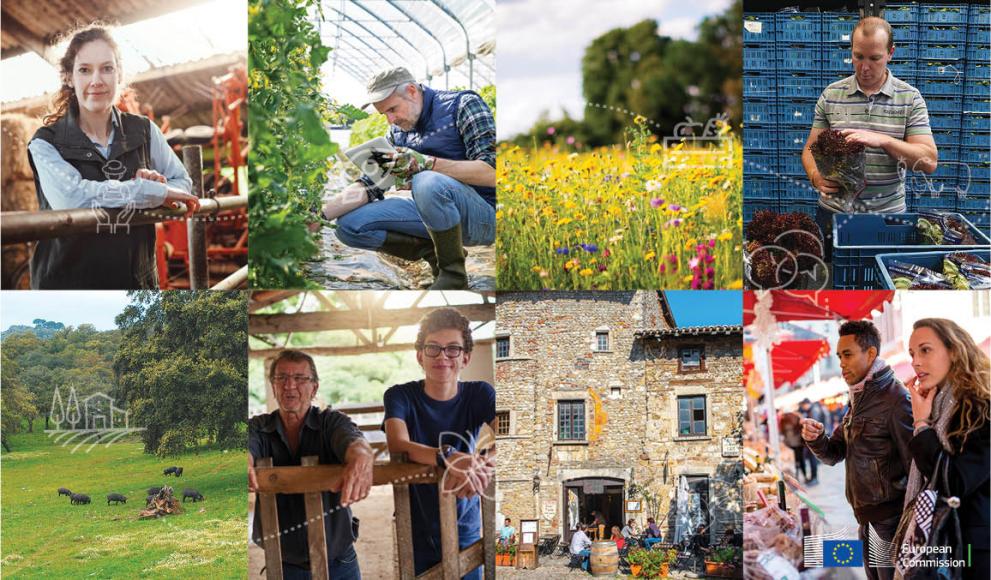
The new common agricultural policy is key to securing the future of agriculture and forestry, as well as achieving the objectives of the European Green Deal.
Today, the European Commission approved the first package of CAP strategic plans for seven countries: Denmark, Finland, France, Ireland, Poland, Portugal, and Spain. This is an important step for the implementation of the new Common Agricultural Policy (CAP) on 1 January 2023. The new CAP is designed to shape the transition to a sustainable, resilient and modern European agricultural sector. Under the reformed policy, funding will be more fairly distributed to small and medium-sized family farms, as well as to young farmers. Moreover, farmers will be supported to take up new innovations, from precision farming to agro-ecological production methods. By supporting concrete actions in these and other areas, the new CAP can be the cornerstone for food security and farming communities in the European Union.
The new CAP incorporates a more efficient and effective way of working. EU countries will implement national CAP Strategic Plans, combining funding for income support, rural development and market measures. In designing their CAP Strategic Plan, each Member State chose from a wide range of interventions at EU level, tailoring and targeting them to address their specific needs and local conditions. The Commission has been assessing whether each Plan builds towards the ten key CAP objectives, which touch upon shared environmental, social and economic challenges. Hence, the Plans will be in line with EU legislation and should contribute to the EU’s climate and environmental goals, including on animal welfare, as set out in the Commission’s Farm to Fork and Biodiversity strategies.
The CAP will benefit from €270 billion in funding for the 2023-2027 period. The seven Plans approved today represent a budget of over €120 billion, including over €34 billion dedicated exclusively to environmental and climate objectives and eco-schemes. This amount can be used to promote beneficial practices for soil, and to improve water management and grassland quality, for example. The CAP can also promote afforestation, fire prevention, restoration and adaptation of forests. Farmers participating in eco-schemes may be rewarded, inter alia, for banning or limiting the use of pesticides, and limiting soil erosion. Between 86% and 97% of the national utilised agricultural area will be farmed under good agricultural and environmental conditions. Substantial funding will also support the development of organic production, with most countries aiming to double or even triple their farming area. Areas under natural constraints, such as in mountains or on the coast, will continue to benefit from specific funding to maintain an agricultural activity.
In the context of the Russian aggression against Ukraine and the ongoing commodity surge, the Commission invited Member States to exploit all opportunities in their CAP strategic plans to strengthen the resilience of their agricultural sector in order to promote food security. This includes reducing dependence on synthetic fertilisers and scaling up the production of renewable energy without undermining food production, as well as promoting sustainable production methods.
Generational renewal is one of the main challenges facing European agriculture in the coming years. It is essential for the agricultural sector to stay competitive and to increase the attractiveness of rural areas. Specific support to young farmers features prominently in each approved Plan, with over €3 billion that will directly reach young farmers in the seven countries. Rural development funds will support thousands of jobs and local businesses in rural areas, while improving access to services and infrastructure, like broadband. In line with the long-term vision for the EU’s rural areas, the needs of rural citizens will also be addressed by other EU instruments such as the Recovery and Resilience Facility (RRF) or the European Structural and Investment Funds (ESIF).
After having approved the first 7 CAP Strategic Plans, the European Commission remains fully committed to a quick approval of the 21 remaining Plans, taking into account the quality and timeliness of reactions following the Commission’s observations.
Background
The European Commission presented its proposal for the Common Agricultural Policy (CAP) reform in 2018, introducing a new way of working to modernise and simplify the EU’s policy on agriculture. Following extensive negotiations between the European Parliament, the Council of the EU and the European Commission, an agreement was reached and the new CAP was formally adopted on 2 December 2021.
The deadline set by co-legislators for Member States to submit their CAP Strategic Plan was 1 January 2022. After receiving the Plans, the Commission sent observation letters to all of the Member States by 25 May 2022. They were published on the Europa website together with the reactions of all Member States, in line with the transparency principle. A structured dialogue between the Commission services and national authorities resumed thereafter to solve remaining issues and finalise the revised CAP Plans. To be approved, each Plan must be complete and compatible with the legislation, and ambitious enough to deliver on the CAP objectives and EU environmental and climate commitments.