
Monday, September 21, 2026
Home Blog Page 160

South Sudan: UN forced to suspend food aid after ‘unacceptable’ attacks on convoy

0
South Sudan: UN forced to suspend food aid after ‘unacceptable’ attacks on convoy

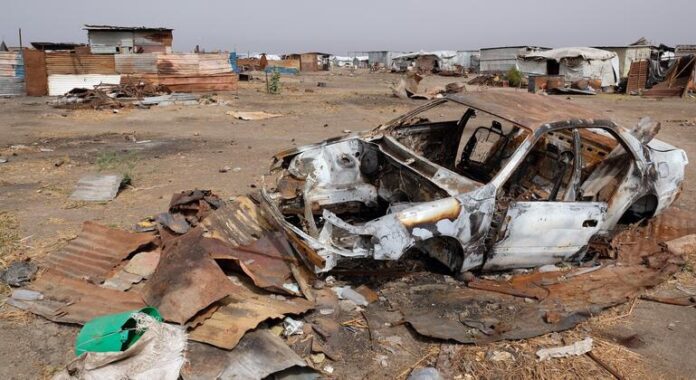
As fighting intensifies there between opposition forces and national troops, there are reports of airstrikes and daily civilian casualties.

UN agencies warn that worsening insecurity is blocking lifesaving aid, while hunger projections deteriorate and cholera treatment centres struggle to cope with an influx of newly displaced people.

The renewed violence comes as South Sudan’s 2018 Revitalised Peace Agreement continue to fall apart amid stalled reforms, rising political tensions ahead of planned elections in 2026, and mounting pressure from more than one million refugees fleeing the brutal war in neighbouring Sudan.

Click here to read a summary of threats to South Sudan’s peace process and the converging political, security and humanitarian crises, and their impact on civilians.

Humanitarian statistics for South Sudan as of December 2025.

WFP convoy attacked, activities suspended

The UN World Food Programme (WFP) on Wednesday suspended all activities in Baliet County, Upper Nile state, following repeated attacks on a convoy carrying humanitarian assistance down river.

Between last Friday and Sunday, a 12-boat convoy transporting more than 1,500 metric tonnes of food and other relief items was attacked several times by armed youth.

The cargo was later looted in multiple locations, despite receiving prior security assurances for the safe passage of aid.

WFP said the suspension would remain in place until the safety of its staff, partners and contractors is assured and authorities take immediate steps to recover the stolen supplies.

Attacks on humanitarians are never acceptable,” WFP said, urging all parties to respect humanitarian workers and safeguard the facilities and resources essential for delivering aid.

Aid access under threat

The convoy attack reflects a broader collapse in humanitarian access, particularly in Jonglei state, where renewed fighting since late December has intensified clashes between the South Sudan People’s Defense Forces and the South Sudan People’s Liberation Army-in-Opposition across multiple counties.

According to the UN relief coordination office, OCHA, fighting and airstrikes have displaced around 280,000 people since late December, including more than 235,000 across Jonglei alone. Many have fled to areas with minimal water, sanitation and health services, sharply increasing the risk of disease outbreaks.

Humanitarian partners report that at least seven aid facilities have been looted or damaged in Jonglei, with assets confiscated and aid workers intimidated, forcing the suspension of operations in several locations.
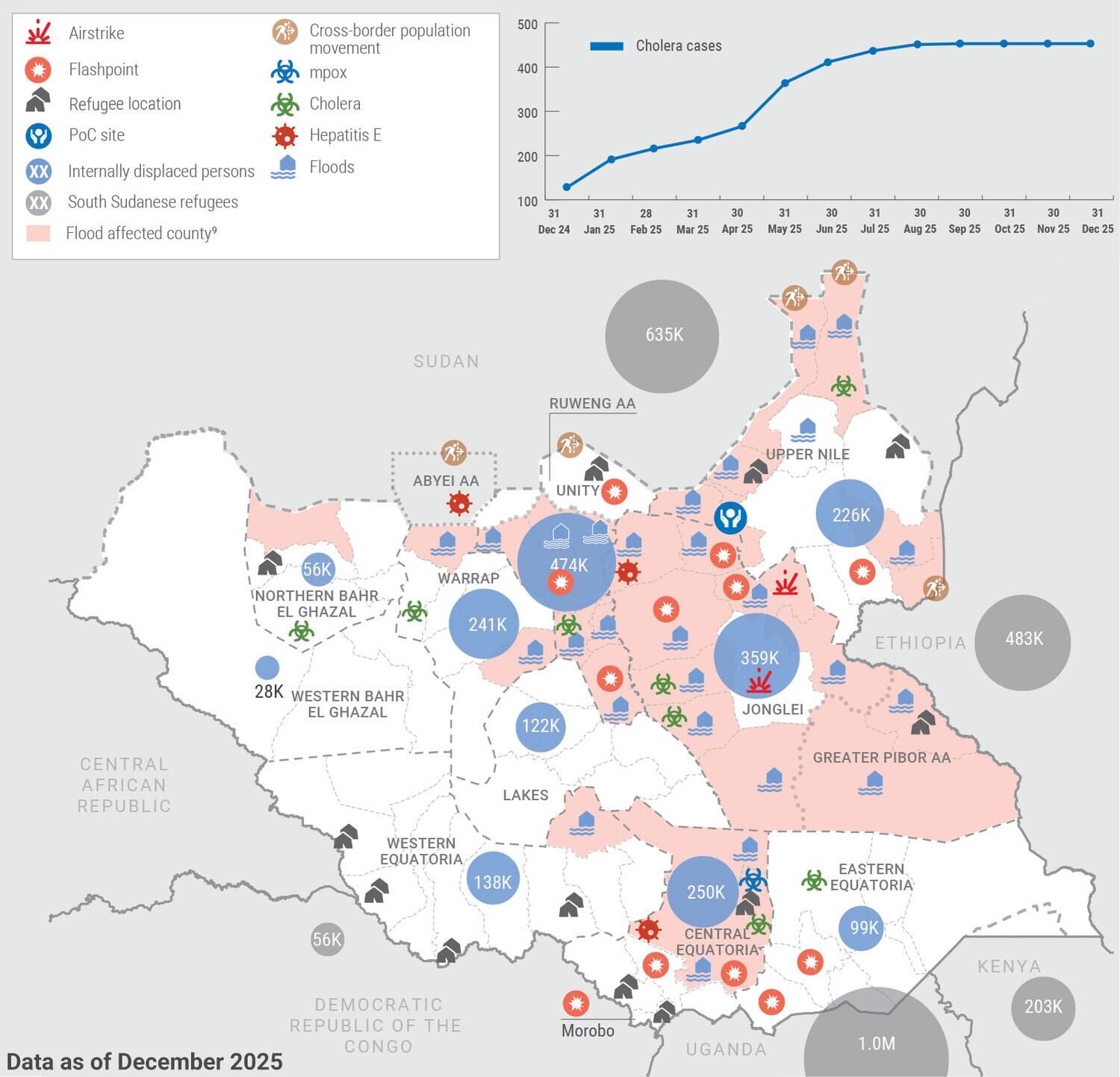
Infographic map of South Sudan showing humanitarian needs as of December 2025, highlighting displacement, cholera cases, and conflict zones in Jonglei and Unity states.

South Sudan: Humanitarian snapshot (December 2025).

Hospitals hit, services halted

The medical charity Médecins Sans Frontières (MSF) reported that Government forces bombarded its hospital in Lankien, Jonglei State, overnight on 3 February, destroying the main warehouse and most critical medical supplies. One MSF staff member suffered minor injuries.

In a separate incident the same day, MSF’s health facility in Pieri was looted by unknown assailants, forcing staff to flee. The NGO said the violence had left around 250,000 people without healthcare, as the organization had been the only provider in the area.

Hunger and disease risks rising

UN agencies warn that escalating conflict is expected to significantly worsen food insecurity, particularly in northern Jonglei and Upper Nile states.

Projections indicate that the number of counties facing emergency-level hunger (IPC Phase 4) between February and May will more than double, with some households at risk of slipping into catastrophic conditions (IPC Phase 5).

Insecurity has already forced WFP to pause plans to pre-position 12,000 metric tons of food ahead of the rainy season in Jonglei, raising concerns that access will further deteriorate once roads become impassable.

Since September 2024, South Sudan has recorded nearly 98,000 cholera cases and more than 1,600 deaths, with Jonglei among the worst affected, overwhelming treatment centres.


Source link

Intensifying threat from ISIL underscores need for stronger counterterrorism measures

0
Intensifying threat from ISIL underscores need for stronger counterterrorism measures

Intensifying threat from ISIL underscores need for stronger counterterrorism measuresAlexandre Zouev, acting assistant secretary-general of the United Nations Office of Counter-Terrorism (UNOCT), presented his latest report which highlights the group’s growing presence in Africa, the Middle East and beyond. He said the threat posed by ISIL, also known by its Arabic acronym Daesh, has “increased […]

Originally published at Almouwatin.com

Ukraine: Civilians injured, miners killed, in separate Russian attacks

0
Ukraine: Civilians injured, miners killed, in separate Russian attacks

Matthias Schmale was “appalled” by the attacks in Dnipro, Kharkiv and Kyiv, noting that many more people in several regions – including Dnipro, Odesa and Vinnitsya – are facing power outages. 

“Systematic attacks by the Russian Federation Armed Forces on critical infrastructure affect the daily lives of millions and cause life-threatening conditions for the most vulnerable, including older people and children,” he said in a statement posted on social media. 

He recalled that international humanitarian law prohibits attacks on civilian infrastructure. 

Keeping families warm 

In the face of the “incessant attacks” on Ukraine’s energy infrastructure, the UN children’s agency (UNICEF) is scaling up efforts to help keep critical services running amid freezing temperatures. 

Since November, UNICEF has delivered 106 mid- and large-capacity generators across the country to support water utilities and district heating companies.  

An additional 149 generators will be released over the coming weeks to further boost operations and strengthen back-up power solutions. 

“Across the country, vital services for children and families are strained and parents are struggling to keep their children warm, prepare hot food, and access regular running water,” said Munir Mammadzade, UNICEF Representative to Ukraine. 

These generators will help the brave technicians on the ground to keep systems running to keep the heating on, hospitals open and water flowing.”  

Miners killed in drone attack 

Meanwhile, UN human rights monitors confirmed that a Russian drone attack on Sunday in the Dnipropetrovsk region near the frontline in eastern Ukraine killed and injured coal mine workers commuting home after completing their shift. 

The attack occurred in the city of Ternivka, and 12 civilians were killed and 16 wounded, according to local authorities. 

“This incident highlights the dangers civilians face when hostilities extend into areas of everyday life, even well beyond the active fighting zone,” said Danielle Bell, Head of the UN Human Rights Monitoring Mission in Ukraine (HRMMU). 

Deadly explosion 

The mine employees were travelling by bus on a regular commuter route through Ternivka, approximately 65 kilometres from the frontline, when multiple Russian drones struck the road near the vehicle over several minutes. 

The bus windows were blown out in the explosion, killing and injuring passengers. Other civilians driving nearby, as well as people who rushed to help, were also reportedly among the casualties. 

Simply trying to return home 

UN rights monitors visited the scene on Monday and interviewed witnesses.  They observed two craters, in front of and behind the destroyed bus, along with remnants of the drones used in the attack. 

One of the injured coal miners described climbing out of a bus window after the first explosion.  He heard screams from inside the bus, and then a second explosion shortly afterwards. 

He told the UN team that “this is all wrong” adding that “we are ordinary coal mine workers. People were simply returning to their homes, to their families.” 

Source link

Data Trends Reshaping Homebuyer and Seller Behavior

0


Residential real estate behavior is increasingly driven by data. Buyers and sellers now make decisions based on analytics,

Source link

Rafah reopening offers lifeline to patients, but aid still far from enough

0
Rafah reopening offers lifeline to patients, but aid still far from enough

Rafah reopening offers lifeline to patients, but aid still far from enoughBriefing journalists in New York on Tuesday, UN spokesman Stephane Dujarric said UN relief chief Tom Fletcher welcomed the reopening but stressed that it must go beyond limited movements of people. “Rafah must function as a true humanitarian corridor so that we can benefit from an increase in […]


Originally published at Almouwatin.com

What is the average salary in Greece?

0
What is the average salary in Greece?

What is the average salary in Greece?Average private sector salaries in Greece last year were 1,362.66 euros gross, up 20 euros from 2024, while the average full-time salary rose to 1,516 euros from 1,478 euros a year earlier (up 38 euros), writes Ekathimerini.com. At […]


Originally published at Almouwatin.com

The Holy Ark – news – Almouwatin.Com

0
The Holy Ark – news – Almouwatin.Com

The Holy Ark – newsThe Ark of the Covenant [Hebrew: κιβωτὸς τῆς διαθήκης]according to the Old Testament, is the most important sacred object symbolizing the presence of God and located in the Tabernacle of the Congregation and the Temple of Jerusalem. The Hebrew word traditionally translated into Russian is [κιβωτὸς τῆς διαθήκης]. The word “ark” in the Old Testament is used in the […]

Originally published at Almouwatin.com

In Washington, Fletcher presses for action as Sudan war grinds on

0
In Washington, Fletcher presses for action as Sudan war grinds on

Speaking at a donor conference in Washington, DC, UN Emergency Relief Coordinator Tom Fletcher warned that the brutal conflict, famine and mass displacement are pushing millions of civilians deeper into crisis, while aid access remains severely constrained.

Fighting erupted between the once-allied Sudanese Armed Forces and paramilitary Rapid Support Forces (RSF) in mid-April 2023, spreading quickly through a country already undergoing political turmoil, increased ethnic tensions, and climate extremes.

Move from words to action

There have been “too many days of famine, of brutal atrocities, of lives uprooted and destroyed,” Mr. Fletcher said, while women and girls have been forced to endure “terrifying sexual violence.”

He stressed that the international community must move beyond expressions of concern to deliver more support and political pressure on combatants for a ceasefire. With that must come extensive humanitarian access.

Mr. Fletcher said the United Nations fully supports diplomatic efforts led by the “Quad” – the United States, Egypt, Saudi Arabia and the United Arab Emirates – aimed at securing a humanitarian truce, including the demilitarization of key areas to allow life-saving aid to reach civilians.

The guns must fall silent and a path to peace must be charted,” he said.

UN ready to deliver

Under its comprehensive 2026 humanitarian response plan, UN agencies aim to reach more than 20 million people across Sudan with emergency assistance. To achieve that target, the Organization requires about $2.9 billion.

Alongside funding, safe and unhindered access for humanitarians and civilians are critical to ensure aid reaches those in need.

Civilians and aid workers must be protected, Mr. Fletcher stressed, urging donors to respond quickly and decisively.

Let today be at last the signal that the world is uniting in solidarity for practical impact,” he said.

Crisis deepens on the ground

Meanwhile, fighting rages on the ground in Sudan.

According to media reports, Government forces on Tuesday entered South Kordofan’s capital, Kadugli, which was under a months-long siege by the RSF. The army had also recently broken the blockade of Dilling, a major town about 110 kilometres north of Kadugli.

The fighting continues to drive thousands from their homes into IDP camps and makeshift settlements, facing critical shortages of food, healthcare, water, sanitation, shelter and education.

According to the Office of the UN High Commissioner for Refugees (UNHCR), nearly 11.7 million people have been forcibly displaced by the conflict, including seven million internally displaced and 4.5 million who have fled to neighbouring countries.

Source link

Overheated and ill-prepared: European survey reveals citizens are concerned about heat and their ability to cope with climate change | Press releases

0
Overheated and ill-prepared: European survey reveals citizens are concerned about heat and their ability to cope with climate change | Press releases

Overheated and ill-prepared: European survey reveals citizens are concerned about heat and their ability to cope with climate change | Press releasespress releasePublished February 4, 2026 Europeans are very concerned about extreme heat and other impacts of climate change like forest fires, according to the results of a Europe-wide survey published today. The study found that many citizens were also ill-prepared to deal with the frequency and […]

Originally published at Almouwatin.com

Overheated and underprepared: European survey finds citizens concerned about heat and ability to cope with climate change | Press releases

0
Overheated and underprepared: European survey finds citizens concerned about heat and ability to cope with climate change | Press releases

Europeans are very concerned about extreme heat and other impacts of climate change like wildfires according to the results of a Europe-wide survey published today.  It found that many citizens were also underprepared to deal with the increasing frequency and magnitude of heatwaves, flooding, or water shortages in their own homes.

The results of the survey were analysed in the report ‘Overheated and underprepared’ published by the European Environment Agency (EEA) and the European Foundation for the Improvement of Living and Working Conditions (Eurofound). The report offers a Europe-wide overview of the perceived implementation of climate resilience measures — both those reported by survey participants at the household level and their observations of measures implemented by authorities.

This report is based on an online survey conducted by Eurofound last year involving over 27,000 respondents from across 27 European countries. It presents their experiences of climate impacts, concerns about future impacts and resilience measures they took at home and those they are aware of where they live.