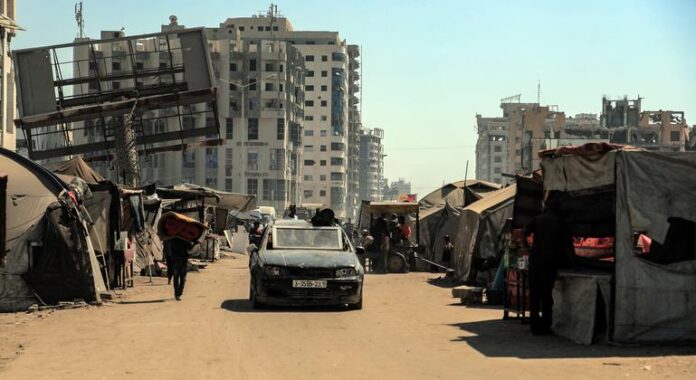
UN Spokesperson Stéphane Dujarric said people are once again on the move after Israel placed the entire city under displacement orders. Aid partners recorded more than 25,000 displacements between Sunday through Wednesday.
Some critical services have already been suspended while some humanitarian facilities have suffered severe damage, disrupting operations and the delivery of essential services.
Aid partners suspend activities
“Our partners working on health, report that some of them have had to suspend activities at primary healthcare centres, while partners working on nutrition say that 12 out of 49 outpatient therapeutic sites have halted services amid the ongoing airstrikes in Gaza City,” he said,
At least two community kitchens have also suspended operations, and three others have had to relocate within the city.
Furthermore, UN partners working on education are concerned that 95 temporary learning sites in northern Gaza serving about 25,000 children may be at imminent risk of closure due to displacement orders and ongoing insecurity.
Child malnutrition worsens
UN child rights agency UNICEF has also warned that child malnutrition in the Gaza Strip continues to worsen at an alarming rate.
The percentage of children identified as acutely malnourished increased to 13.5 per cent in August, from 8.3 per cent in July – or 12,800 boys and girls.
Mr. Dujarric said UNICEF has been working to scale up the entry of essential nutrition supplies and distribute them, alongside nutrition partners, at about 140 sites across the Gaza Strip.
“While stocks of ready-to-use therapeutic food have recently increased, the current quantities of other critical nutrition supplies for infants and pregnant and breastfeeding women are wholly insufficient,” he said.
Meanwhile, almost half of all functioning hospitals are located in Gaza City, including half of all intensive care unit beds for the entire Gaza Strip, according to the World Health Organization (WHO).
With the Israeli offensive already underway, the Gaza Strip cannot afford to lose any of these remaining facilities, the UN agency said.
Impediments to aid delivery continue
These developments are happening as delays and impediments to humanitarian movements inside Gaza continue.
Missions still take long hours to complete, even when they are approved in advance by the Israeli authorities, meaning that teams have no choice but to wait on roads that are often dangerous or congested.
Additionally, the UN Office for the Coordination of Humanitarian Affairs (OCHA) has recently observed an increase in denials of the participation of Palestinian staff in missions, including both drivers and personnel.
Mr. Dujarric noted that denials are often communicated at the last minute, resulting in operational delays as alternatives must be quickly identified.
“What we need is full facilitation of the work and movement of humanitarian actors into and throughout the Gaza Strip. This must include unimpeded access to the north and to the south alike,” he said, adding that “every delay can cost lives.”
Four years after the military coup that filed the democratically elected government, the civilian conflict of Myanmar arises, leaving moved millions and homeless.
“” The suffering of millions of people through myanmar is huge”Said Hcr Chef Filippo grew up. “With air bombings, destruction of goods and forced recruitment, they live in daily fear for their lives.”
He added that “civilian men, women and children must be protected from violence and the solutions found so that they can choose to go home in terms of security and dignity”.
Many crises that need a response
A brutal civil war is not that all myanmar must face.
In March, an earthquake of magnitude of 7.7 struck the country affecting several regions, including the capital, not Pyi Taw. The UN chief of rescue, Tom Fletcher, then declared on X that the humanitarian response “had been hampered by the lack of funding”.
Mr. Grandi, who visited the communities affected earlier this year, urged broader humanitarian access and discussed the solutions for the displaced by force.
“Millions of people have been forcibly moved to the country and as refugees throughout the region, do not want anything more than going home. They ask – and have the right to – security and security that accompany peace. Mr. Grandi said.
Destroyed houses
Thousands of people also destroyed their homes after the floods swept away many regions in July.
“Wars, disasters, displacement, hunger: the forgotten distress of so many people in Myanmar, like the Rohingyas, never ends,” said Grande in an article on X.
During the last year and a half, 150,000 The Rohingyas, a mainly Muslim minority in the majority Buddhist country, fled to neighboring Bangladesh. This has marked the country’s largest exodus since 2017, when 750,000 Rohingyas have sought refuge to the violence of the state of Rakhine.
A call to solutions
UNHCR works with other United Nations agencies, NGO partners and Myanmar communities to meet the basic needs, physical security and well-being of displaced and stateless people.
But many communities still suffer from a lack of access to vital aid. This year’s UN response plan for Myanmar is Currently funded only at 22%.
Later this month in New York, Mr. Grande will attend a high-level conference on Rohingyas and other Myanmar minorities, calling for greater regional and international efforts to fight against the crisis.
“” All parties – with the support of the international community – must engage seriously to find solutions to their fate. This is particularly necessary for the Rohingyas, which have not only been attacked and moved, but deprived of their fundamental rights for too long, “said the UNHCR chief.
President Costa and President von der Leyen received letters of credence from the Apostolic Nuncio and Head of the Mission of the Holy See to the European Union, as well as from thirteen new Ambassadors to the European Union.
Rosemary Dicarlo describe Tuesday’s strike in a residential area of the Qatari capital – which has targeted the political leadership of Hamas killing several affiliates as well as a Qatari security agent – as potentially open a “” “New and perilous chapter of this devastating conflict, seriously threatening regional peace and stability.“”
The attack took place on September 9 in residential compounds which would have the accommodation of the members of the Hamas political bureau, including the son of its chief negotiator, Khalil al-Hayya.
While Hamas leaders have survived, the organization said, the incident disrupted the ongoing negotiations on a cease-fire release agreement and hostage mediated by the United States to end the war in Gaza.
Respect sovereignty
“” The sovereignty and territorial integrity of any country, including Qatar – a precious partner in the advancement of peace creation and conflict resolution – must be respected,Ms. Dicarlo told ambassadors.
It urged all parties to exercise a deduction and reaffirm the need to preserve the negotiation and mediation channels to prevent new suffering in Gaza and in the region in the broad sense.
Israel claimed the responsibility of the strike, Prime Minister Benjamin Netanyahu describing her as “an entirely independent operation” following a fatal attack on civilians in Jerusalem on September 8, which Hamas said he had led.
Qatar, the Gulf Cooperation Council, the Arab States League and the Islamic Cooperation Organization condemned action and expressed their concern in the face of additional escalation.
Mined confidence
Dicarlo told ambassadors that Israel’s strike came “at the height of current consultations”.
“” Any action that undermines the work of mediation and dialogue weakens confidence in the very mechanisms that we depend for the resolution of conflicts,She said, stressing that lasting solutions in the Middle East cannot be carried out thanks to new violence.
She called for a renewal of commitment to diplomacy, warning that the urgency of a release of ceasefire and hostage has never been greater.
“” I call for all stakeholders to show the greatest restraint at this sensitive moment and at that time in diplomacy. The urgency of a ceasefire and hostage release contract in Gaza has never been larger. Conclude an agreement. Release the hostages. End the suffering of the inhabitants of Gaza. »»
Gaza Crisis Spiraling
Meanwhile, the humanitarian and security situation in Gaza and the occupied West Bank remains critical.
Since the conflict in Gaza broke out in October 2023 – after Hamas’ attacks and other Palestinian armed groups on communities in southern Israel, tens of thousands of people died – mainly civilians – infrastructure and basic services are largely destroyed, and enclave alloys in ruins while a new offensive to take the city of Gaza is underway.
The United Nations Security Council meets to discuss the situation in the Middle East in the aftermath of an Israeli strike in Doha, the capital of Qatar.
Press statement of the Security Council
Before Thursday’s session, the Security advice published a press statement expressing the condemnation of strikes in Doha and deeply regrets the loss of civil life.
The declaration has reaffirmed the support of the sovereignty and territorial integrity of Qatar and recognizes the country’s key role in mediation efforts to end the devastating war, alongside Egypt and the United States.
He stressed that the release of hostages – including those killed by Hamas – ending hostilities and ensuring civil protection in Gaza, remain the highest priorities of the Council.
It is also on all parties to seize diplomatic opportunities in progress for peace.
THE UN Secretary General Sentenced an Israeli strike on Tuesday targeting Hamas leaders in Doha, the capital of Qatar, while highlighting the “very positive role” played by the country in the realization of a cease-fire in Gaza and obtaining the release of the hostages.
These measures put vital humanitarian assistance and other essential services to hundreds of thousands of people affected by a recent deadly earthquake in danger, the United Nations assistance mission in Afghanistan (Unama) warned in a declaration.
Sunday, the de facto The security forces prevented women from Afghan staff and entrepreneurs from entering the UN compounds In the capital, Kabul.
More offices assigned
This was extended to field offices across the country, following written or verbal notifications of the Taliban management.
In addition, the security forces are visibly present at the entrances to the UN premises in Kabul, Herat and Mazar-I-Sharif to enforce the measure.
“” This is particularly worrying in order to continue restrictions on the rights of Afghan women and girls“, According to the press release.
Since his return to power four years ago, the Taliban have published numerous edicts with an impact on women’s rights such as the ban on girls from frequenting a secondary school and prohibiting women from most jobs, in particular by working with non -governmental organizations (NGOs).
Also reduced trip
The United Nations also received security forces trying to ban national travelers’ national staff on the ground, in particular to support women and girls as part of the response to the earthquake that hit the east of Afghanistan last month.
They are also prevented from accessing operational sites for Afghan repatriases in Iran and Pakistan.
Lift the restrictions
The UN hires the de factoThe authorities and call for the immediate lifting of the restrictions to continue the critical support for the Afghan people, noting that current actions do not take into account “provisions communicated previously”.
“” Such arrangements have enabled the United Nations to provide critical aid across the country, thanks to a culturally sensitive approach and based on principles Ensure the delivery of women’s help for women, ”said the press release.
In the meantime, UNAA and UN agencies, funds and programs in Afghanistan, have implemented operational adjustments to protect staff and assess the options to continue their essential work.
The declaration concluded by recalling that the prohibition on the movement of UN staff and the obstruction of UN operations are a violation of international rules on the privileges and immunities of the organization’s personnel.
From fancy oat milk lattes to organically grown produce at the local market, organic food has moved from niche to mainstream. But Europe’s farmers, weighing the complex rules and costs of green farming, are struggling to keep pace with demand.
In 2020, the European Commission set a bold goal: 25% of EU farmland under organic management by 2030. Yet by 2023, only 11% of farmland had been converted to organic.
To close that gap, EU‑funded researchers, farmers and policy experts from 10 EU countries and Switzerland are working to identify barriers, test solutions and shape policy for a more resilient organic sector. Their research collaboration, OrganicTargets4EU, is running from 2022 to February 2026.
However, policy alone will not plant seeds or harvest crops. For farmers, adapting land and business models to organic standards brings uncertainty, and they must decide whether the risk pays off.
A shift built on policy, market – and trust
“Farmers need a reason to even consider going organic. And then they need confidence that it is viable,” said Dr Nicolas Lampkin, policy work package leader from the Thünen Institute in Germany, a research body that advises the government on issues related to agriculture, forestry, fisheries, rural development and sustainability.
That confidence, he explained, depends on supportive policy, stable markets and accessible knowledge.
“
Farmers need a reason to even consider going organic. And then they need confidence that it is viable.
“If even one of those is missing, farmers hesitate. We’ve seen that in France and Germany, where conversion rates [to organic] are stagnating, while in Greece and Portugal, where policy support has improved, interest is growing fast.”
In southern Europe, attractive subsidies and better advisory support have helped more farmers commit. But conversion is a deeply personal decision. Some farmers worry about finding buyers for organic goods or fear being exposed if demand dwindles.
Organic farming can also require more manual labour, different machinery and new skills, especially in the early years. Without strong networks or locally adapted advice, many simply do not feel ready.
Lampkin estimates that 16 to 18% organic farmland by 2030 may be more realistic, but insists the target has already set valuable change in motion.
From policy to the fields
Turning strategy into workable solutions requires more than target-setting: it demands collaboration at ground level. That is why the OrganicTargets4EU team is testing solutions directly with farmers.
Eight “practice partners” – organisations in Austria, Denmark, France, Germany, Greece, Hungary, Italy and Romania – run small, local-language workshops to explore real-world opportunities. In Austria and Portugal, where organic farmland already exceeds 25%, researchers are studying the success factors to replicate them elsewhere.
In Germany, the researchers have highlighted how agencies that safeguard drinking water are supporting organic farming in watershed areas — an innovation that could be scaled.
Workshop outcomes feed into a public database of “practice abstracts”, or farmer-friendly summaries in accessible language.
Retention is also a priority. “We can’t just focus on new conversions,” stressed Ambra De Simone, research and innovation associate manager at IFOAM Organics Europe, who coordinates the research team’s work.
“Keeping current organic farmers in the system is equally important.”
Follow-up clinics address real-life challenges, from certification renewals to market diversification, helping to ensure that experienced farmers do not revert to conventional methods.
Research, innovation and a broader vision
But local solutions are only part of the picture. To encourage change across the continent, the OrganicTargets4EU team is also strengthening cross-border research and policy links.
“
Organic farming is not a trend, it is a long-term commitment towards the transformation of agriculture.
Via the CORE Organic Network, led by Ivana Trkulja from the International Centre for Research in Organic Food Systems (ICROFS) at Aarhus University in Denmark, the project connects to national funders, ministries, sectoral organisations and researchers.
“Organic farming is innovation- and knowledge-intensive, which requires continuous research funding and support, both on the national and European level,” Trkulja explained.
She stressed that organics are part of a broader agricultural shift.
“Organic farming is not a trend, it is a long-term commitment towards the transformation of agriculture built on over two decades of collaboration and innovation across Europe.”
Scenarios for the future
This ambition also applies to organic aquaculture. The EU has said it wants to see “a significant increase” in organic aquaculture by 2030, but growth seems to have stalled after an increase of 60% between 2015 and 2020.
Through an EU-wide review and stakeholder workshop, the OrganicTargets4EU team found the main barriers to organic fish farming, including costs, bureaucracy and weak incentives. The team explored different scenarios and supply chain changes to help organic aquaculture grow and guide future policy.
For the organic farming goal of 25%, the team is mapping four scenarios for how Europe might meet the target. Some are driven by EU or national environmental policy, others by market demand or grassroots pressure.
“These scenarios help us think through trade-offs and anticipate which policies might succeed under different conditions,” said De Simone. Their insights will feed into draft policy recommendations to be presented to the European Commission in late 2025.
As Europe’s organic landscape continuously evolves, the initiative’s focus is shifting from action and research to creating a lasting legacy.
Its final conference will take place on 4-5 November 2025, during the TP Organics ‘Organic Innovation Days’ in Brussels. It will coincide with debates on the next common agricultural policy and the EU Organic Action Plan.
“We’ve worked on EU organic policy for decades,” said Lampkin. “Now is the time to turn data into direction.”
Whether or not the 25% target is met, OrganicTargets4EU is laying the groundwork for a stronger, better-connected organic sector built on shared knowledge, smart policy and cross-border collaboration.
Research in this article was funded by the EU’s Horizon Programme. The views of the interviewees don’t necessarily reflect those of the European Commission. If you liked this article, please consider sharing it on social media.
The Parliament strongly condemns the Israeli government’s obstruction of humanitarian aid, which is engineering a famine in Northern Gaza, and calls for all relevant border crossings to be opened. It calls urgently for UNRWA’s full mandate and funding to be reinstated, with robust oversight, and opposes the current aid distribution system.
MEPs are alarmed by the severe food shortages and malnutrition resulting from restricted humanitarian aid and stress the urgent need for full, safe, and unhindered access to essentials such as food, water, medical supplies, and shelter. They demand the immediate restoration of vital infrastructure and call on all parties to respect their humanitarian obligations under international law.
Israel’s right to self-defence
MEPs demand an immediate and permanent ceasefire and the immediate and unconditional release of all Israeli hostages held in Gaza. They urge the EU to exert diplomatic leverage on third countries to pressure Hamas to secure their release.
The Parliament condemns in the strongest possible terms the “barbaric crimes” committed by Hamas against Israel and calls for concrete sanctions against the terrorist group. It reiterates its commitment to Israel’s security and its “inalienable right to self-defence” in full compliance with international law, noting that Israel remains a key EU partner in the fight against regional terrorism.
However, MEPs stress that Israel’s right to defend itself cannot justify indiscriminate military action in Gaza and express concern over the continuous military operations in the Gaza Strip, which have led to unbearable suffering for civilian population, while also denouncing Hamas’ use of civilians as human shields.
Investigation into violations of international law
The resolution endorses the Commission President’s decision to suspend EU bilateral support to Israel, and to partially suspend the EU-Israel agreement as regards trade. MEPs want full investigations into all war crimes and violations of international law and for all those responsible to be held to account. Parliament also supports EU sanctions against violent Israeli settlers and activists in the occupied West Bank and East Jerusalem and calls for sanctions on Israeli ministers Bezalel Smotrich and Itamar Ben-Gvir.
Support for the two-state solution
Parliament urges all EU institutions and member states to take diplomatic steps to ensure commitment to a two-state solution, aiming for progress before the UN General Assembly in September. It stresses the need for total demilitarisation of Gaza and exclusion of Hamas from governance, calling for a reformed Palestinian Authority to be restored as the sole governing body. Hamas and other terrorist groups should lose all political and military control in Gaza, say MEPs, who also encourage EU countries to enforce International Criminal Court arrest warrants.
The establishment of a Palestinian State is key to peace, Israel’s security, and regional normalisation, according to Parliament. Member states should consider recognising the State of Palestine, it concludes, with a view to carrying through the two-state solution.
The resolution was adopted by 305 votes in favour, 151 against, and 122 abstentions.
The Parliament strongly condemns the Israeli government’s obstruction of humanitarian aid, which is engineering a famine in Northern Gaza, and calls for all relevant border crossings to be opened. It calls urgently for UNRWA’s full mandate and funding to be reinstated, with robust oversight, and opposes the current aid distribution system.
MEPs are alarmed by the severe food shortages and malnutrition resulting from restricted humanitarian aid and stress the urgent need for full, safe, and unhindered access to essentials such as food, water, medical supplies, and shelter. They demand the immediate restoration of vital infrastructure and call on all parties to respect their humanitarian obligations under international law.
Israel’s right to self-defence
MEPs demand an immediate and permanent ceasefire and the immediate and unconditional release of all Israeli hostages held in Gaza. They urge the EU to exert diplomatic leverage on third countries to pressure Hamas to secure their release.
The Parliament condemns in the strongest possible terms the “barbaric crimes” committed by Hamas against Israel and calls for concrete sanctions against the terrorist group. It reiterates its commitment to Israel’s security and its “inalienable right to self-defence” in full compliance with international law, noting that Israel remains a key EU partner in the fight against regional terrorism.
However, MEPs stress that Israel’s right to defend itself cannot justify indiscriminate military action in Gaza and express concern over the continuous military operations in the Gaza Strip, which have led to unbearable suffering for civilian population, while also denouncing Hamas’ use of civilians as human shields.
Investigation into violations of international law
The resolution endorses the Commission President’s decision to suspend EU bilateral support to Israel, and to partially suspend the EU-Israel agreement as regards trade. MEPs want full investigations into all war crimes and violations of international law and for all those responsible to be held to account. Parliament also supports EU sanctions against violent Israeli settlers and activists in the occupied West Bank and East Jerusalem and calls for sanctions on Israeli ministers Bezalel Smotrich and Itamar Ben-Gvir.
Support for the two-state solution
Parliament urges all EU institutions and member states to take diplomatic steps to ensure commitment to a two-state solution, aiming for progress before the UN General Assembly in September. It stresses the need for total demilitarisation of Gaza and exclusion of Hamas from governance, calling for a reformed Palestinian Authority to be restored as the sole governing body. Hamas and other terrorist groups should lose all political and military control in Gaza, say MEPs, who also encourage EU countries to enforce International Criminal Court arrest warrants.
The establishment of a Palestinian State is key to peace, Israel’s security, and regional normalisation, according to Parliament. Member states should consider recognising the State of Palestine, it concludes, with a view to carrying through the two-state solution.
The resolution was adopted by 305 votes in favour, 151 against, and 122 abstentions.