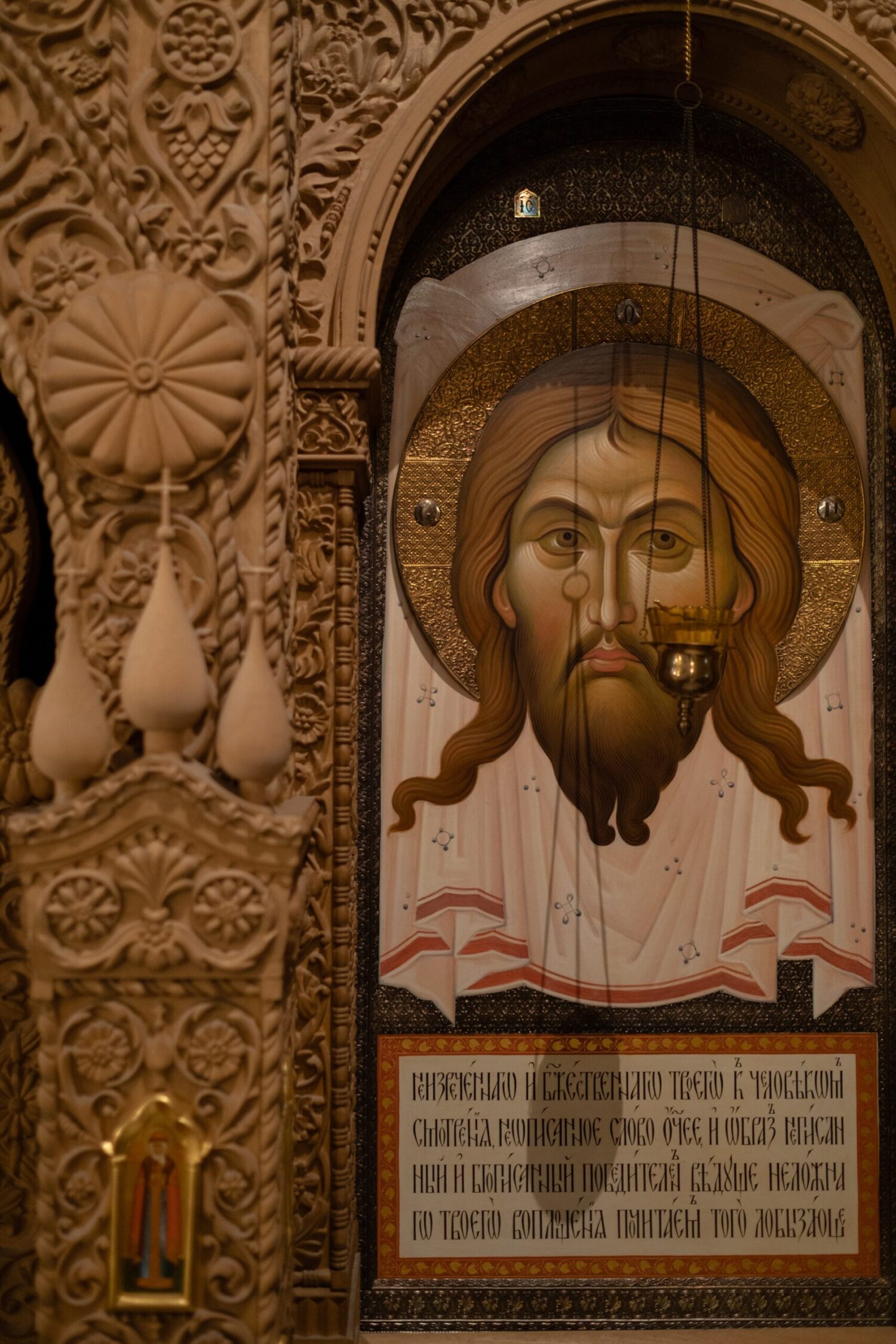
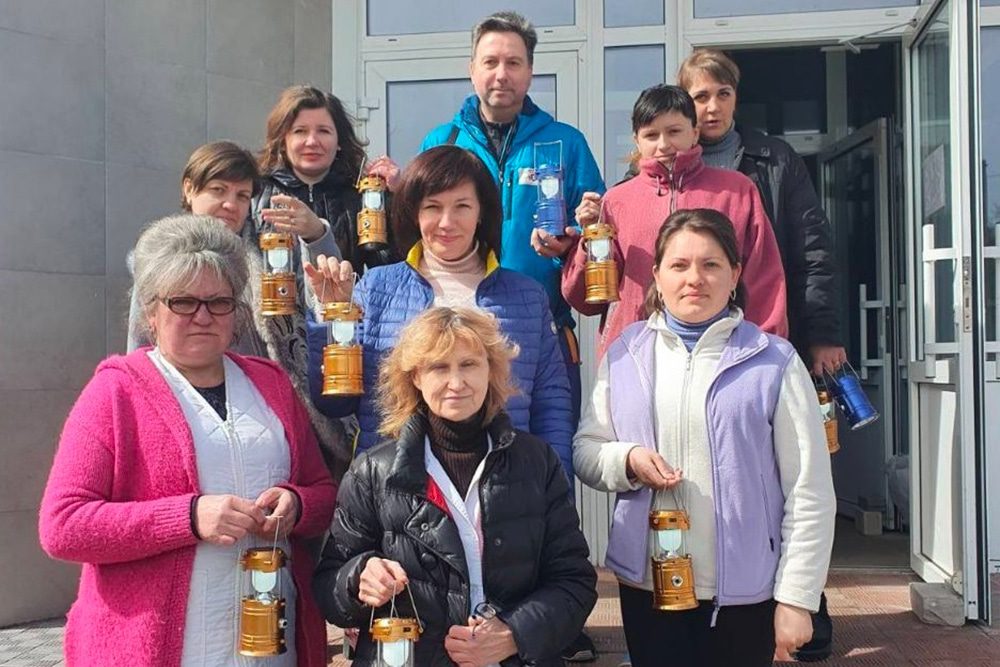
Metropolitan Onuphrius of Kyiv (UPC) met with Russian prisoners of war at the Kyiv-Pechersk Lavra at their request. The meeting was organized by journalist Vladimir Zolkin, known for his interviews with Russian prisoners of war, and Boryspil Metropolitan Antony (Pakanich). After serving a prayer service, Metropolitan Onuphrius addressed the prisoners of war with the words:
“I would like to wish God to bring you back to your homeland, to your families. To see your mothers, sisters, wives, children, brothers, friends. I would like you to say the following words to them: “We don’t want a war like the one going on in Ukraine right now.” We do not want our cities and villages to be destroyed, we do not want our people and your people to perish. We do not want mothers in either Ukraine or Russia to meet their dead sons and weep over them with bitter, inconsolable tears. This must be stopped, it can be stopped.”
“We must find a word of love that will silence the guns, stop the rockets. We want there to be peace. Our Ukrainian Orthodox Church did everything so that the Russian and Ukrainian people could live in peace, understanding and love. However, it happened as it did. But even if evil has happened, it must be stopped! May God give our rulers courage, reason and wisdom to find the word of love that stops all evil. I wish God to protect you and all the people who are on the battlefield. War is not the way to achieve unity between nations, families, people. Violence does not create unity, unity is created by love. And love is God. If one prays and obeys the commandments of God, he is a man of God. May God bless our lands with peace.”
Metropolitan Onuphrius did not bless the Russian soldiers with the cross, but invited them to his office for an informal conversation. There he said:
“I don’t know if you understand or not, but it doesn’t have to be this way. You should not kill each other. Death brings no benefit to anyone, only sorrow to every home. It is a shame that the peoples who came out of the same baptismal font are at war with each other. And we must do everything to put an end to this madness,” he concluded.
Probably, the meeting of Metropolitan Onufriy with the captured Russian soldiers has the character of an intercession to the Kyiv authorities for their exchange with Ukrainian prisoners of war.
“It is a shame that the peoples who came out of the single baptismal font fight each other. And we must do everything to stop this madness,” concluded Onufriy.
In conclusion, he distributed a prayer book, an icon and a chocolate bar to the occupiersand at the prayer service all the prisoners present were named by name sang “many summers”. After a short divine service and an informal conversation in the office, Onufriy personally, face to face, talked with each occupier.
Archbishop Evstratiy, spokesman for the OCU paid attention on the three main theses expressed by Onufrio at the meeting.
1. “It turned out the way it turned out”– these words of the head of the church of the Moscow Patriarchate, says the archbishop, sound “like an excuse to those who came to take us captive.”
2. “I want to wish that God will protect you, all the people who are on the battlefield.”
“Not a word about the evil they brought. Not a word of a call to repent for the murders and destruction. Well, really: if everything happened by itself, then these prisoners of war, like the Russian soldiers, were “taken to the battlefield”, their colleagues are “not guilty “, thinks Eustratius.
3. “It is a shame that the peoples who came out of the single font of Baptism fought with each other.”
The spokesman of the OCU is certain: such words are factual the civil war formula and the Kremlin narrative. In fact, it was Russia that attacked Ukraine and occupied part of our territory.
Many drivers acquire a car first aid kit and fire extinguisher just to pass a MOT. And then they carry them with them without replacing them with new ones. However, this is fundamentally wrong. The same fire extinguisher can last the life of your vehicle and not be needed. However, there may be an accident on the road where a standing fire extinguisher will come in handy. And a fire extinguisher that doesn’t work will result in the total loss of a car or someone’s life. What is the shelf life of the car fire extinguisher, we tell you now.
The shelf life of a fire extinguisher is equal in importance to a first aid kit. The requirements for car fire extinguishers are determined by the ZDP. According to these documents, a fire extinguisher for a car must weigh at least 2 kg and have a volume of at least 2 liters.
For freight transport, the norms are higher – 5 kg, 5 liters. At the same time, each fire extinguisher must contain an active substance that effectively fights the fire and the spread of the fire. As a rule, fire extinguishers are powder or carbon dioxide. There are also aerosol ones, but more often drivers have one of the first two with them.
You should know that powder fire extinguishers are further divided into several types. They are divided according to the types of pressure created, due to which the powder mixture comes out: “pumping”, with a high-pressure cylinder and fire extinguishers that generate gas. The foam from such creates a powerful layer on the source of ignition, which does not allow the passage of oxygen, which is necessary to maintain combustion. And they have one minus – the foam film is very difficult to wash.
Carbon dioxide fire extinguishers work differently. They release a stream of carbon dioxide over the flame, preventing scorching. Extinguishing is not very effective, in addition, there are peculiarities in use – improper handling can lead to gas poisoning and even burns. At the same time, regardless of the type of fire extinguisher, they all have a certain expiration date that must be monitored.
It is scary to imagine a situation where a driver runs with a fire extinguisher to save another from a fire, and when he activates his fire extinguisher, it turns out that it does not work. And sometimes in such situations every second is precious. That’s why you need to know exactly the expiration date of the fire extinguisher that you carry in your luggage compartment.
However, the resource of the fire extinguisher is quite high. If you are guided by the regulatory framework, then the shelf life of the powder fire extinguisher is 10 years for the cylinder and 5 years for its contents. In principle, cylinders can be charged throughout their entire service life. But after its expiration, the fire extinguisher must be replaced with a new one.
Gas fire extinguishers last longer – 15 years. But this is subject to such assistant passing an annual test. It also needs to be recharged every five years. The aerosol type of fire extinguisher lasts as long as the powder type. It doesn’t require reloading, but it’s also good to check.
Spontaneous ignition is considered one of the main problems of electric cars. Tesla CEO Elon Musk regularly reminds that cars with traditional internal combustion engines (ICE) catch fire much more often, but few people believe him. However, you cannot argue with the official statistics.
Authorities in the USA have published official statistics on car fires, and the first 4 times in this negative ranking are for models with internal combustion engines. The data is from the American insurance agency AutoInsuranceEZ, which also used the statistics for recalled vehicles due to fire hazards.
In first place is the Hyundai Elantra, where there was a risk of ignition in 430,000 units. They are followed by Kia Cadenza and Sportage – 308,000 cars, Honda Odissey – 250,000 and Hyundai Genesis and Genesis G80 – 95,000. Only in fifth position is the electric Hyundai Kona – 82,000 units, and in sixth is the Chevrolet Bolt – 70,000 units.
Hybrid versions of the Chrysler Pacifica minivan (27,600 units) and BMW and Mini hybrid models (4,500) followed in the rankings, all of which were models found to be a potential fire hazard. In 2021, Chevrolet, for example, recalled over 140,000 units of the Bolt, but the actual number of ignitions was only 16.
When it comes to the number of car fires, statistics from the National Transportation Safety Board (NTSB) and the Bureau of Transportation Statistics (BTS) show that hybrids are the most at risk, with 3,500 cases per 100,000 vehicles, while the total number of these incidents last year was 16,051.
In second place are cars with an internal combustion engine – 1,500 per 100,000 vehicles (199,533 fires for 2021), while electric cars practically do not burn – 25 cases per 100,000 cars (52 fires for 2021).
The younger generation is drinking less alcohol than their parents, a move that has affected taxes on drinks such as rice wine sake. The national tax agency therefore entered into a national competition for ideas to reverse the trend.
The campaign “Sake viva!” hopes to come up with a plan to make drinking more attractive and boost the industry. The competition invites young people aged 20 to 39 to share their business ideas to boost demand among their peers, whether it’s Japanese sake, shochu, whisky, beer or wine.
The group that runs the contest claims that new habits – partly formed during the covid pandemic and an aging population – have led to a drop in alcohol sales, the BBC reported. She wants contestants to come up with promotions, branding and even cutting-edge plans involving artificial intelligence.
Japanese media say the reaction has been mixed, with some criticizing the proposal for promoting an unhealthy habit. But others have posted strange ideas online — such as famous actresses “playing” as virtual reality hostesses in virtual clubs.
Participants must submit their ideas by the end of September. The best plans will then be developed with the help of experts. Final proposals to be presented in November.
The campaign’s website says Japan’s alcohol market is shrinking, helped by the country’s aging demographics – along with a declining birth rate. The latest figures from the tax agency show that people drank less in 2020 than in 1995, with the number falling from 100g a week to 75g.
Tax revenue from alcohol taxation has also shrunk over the years. According to The Japan Times newspaper, in 1980 they accounted for 5% of total revenue, and in 2020 they are only 1.7%. The World Bank estimates that almost a third (29%) of Japan’s population is aged 65 and over, the highest proportion in the world.
Concerns about the future of sake are not the only problem facing the Japanese economy – there are concerns about the supply of younger workers for certain types of work, as well as about caring for the elderly in the future.
It might seem like adding one more vegetable to your diet won’t make a big difference – but it really can – as long as you make sure you include it in your meals every day. Because vegetables contain so many vitamins and minerals, they can provide your body with healthy nutrients and even prevent some nasty health problems. For example, peppers can keep your skin young and toned.
This is what frequent consumption of peppers helps with:
1. Iron deficiency
Peppers are a good source of iron and are also rich in vitamin C, which helps in its better absorption. Iron deficiency is one of the most common causes of anemia. People who have it may feel tired, weak and short of breath more often. Low iron levels are also a risk factor for restless legs syndrome. So eating bell peppers can help prevent these problems, especially if you eat them with foods high in iron, such as meat or spinach.
2. Eye problems
Peppers are high in vitamin A and carotenoids, specifically lutein and zeaxanthin, which can help keep your eyes healthy. They can protect your retina from oxidative damage and even reduce the risk of age-related eye diseases, cataracts and blindness.
3. Damaged skin
Vitamin C also plays an important role in the production of collagen, which keeps your skin young and healthy. If you don’t get enough of it, you’re more likely to develop dry and wrinkled skin. Vitamin C deficiency can also cause you to bruise easily and your wounds may take longer to heal.
4. Heart problems
Lysopene is one of the carotenoids found in peppers. This component can help improve cardiovascular health and prevent strokes. It keeps your heart healthy by helping to control your blood pressure and regulate your cholesterol levels.
5. Visible veins
Capsaicin is an active component present in peppers. It has antioxidant, antimutagenic, anticarcinogenic and immunosuppressive properties and can help prevent the formation of new varicose veins if you eat peppers regularly.
6. Weak bones
A medium bell pepper contains 6% of the recommended amount of manganese. This element, along with zinc and copper, is essential for bone health. In addition, vitamins C and K have anti-inflammatory properties and may help prevent osteoporosis.
7. Digestive problems
Bell peppers are a good source of dietary fiber. It can help maintain gut health and even prevent some gastrointestinal disorders. Dietary fiber, along with the fact that peppers are about 90% water, can also aid in weight loss.
8. Weak immune system
100 grams of peppers contain 17% of the recommended daily amount of vitamin B6. This vitamin supports your immune system, and not getting enough of it can prevent your body from producing enough antibodies needed to fight infections.
Find out how your favorite flower defines who you are.
1. Roses are classic flowers most associated with romance. Of course, there are both pink and red roses – both are wonderful in terms of romance. People who prefer red roses are hopeless romantics who value beauty and delicacy. People who like pink roses are truly romantic, but they are also independent and don’t necessarily need a partner. In both cases, due to the delicate nature of the flower, people who prefer roses are more delicate. But alas, beware of the thorns of the rose! As delicate and loving as rose lovers are, they are also very sensitive and protective of themselves. The spines represent protection.
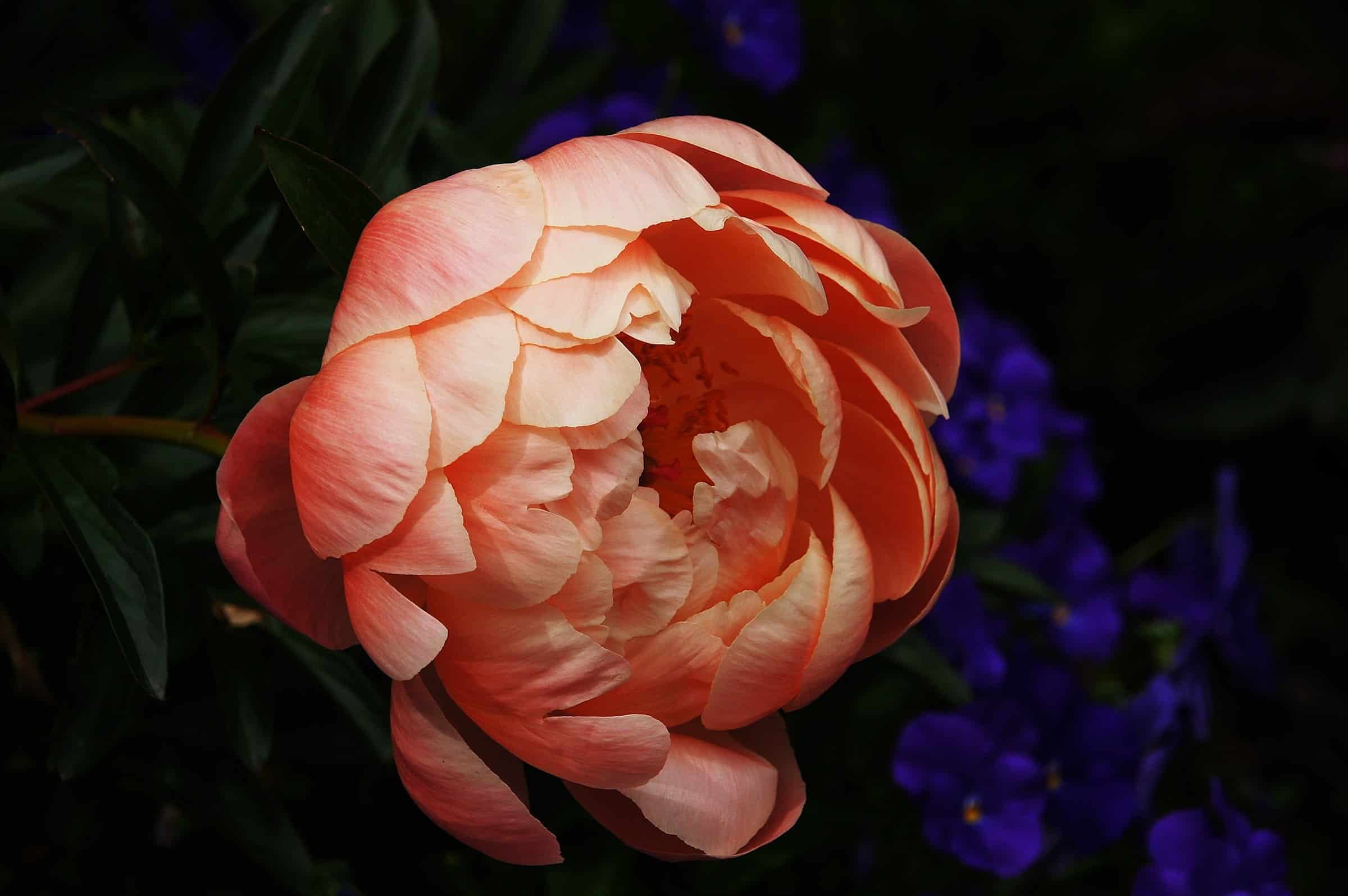
2. Peonies are stunning flowers – more so than the rose, I’d say. Peony lovers have a taste for luxury and have expensive taste. It is one of the most expensive flowers sold in the market. Although they are so expensive, peonies are very hardy and easy to grow flowers. Therefore, fans of peonies are not only luxurious, but also strong-willed, determined and adaptable people.
3. Sunflower We’ve all heard a million songs about sunflowers. From Post Malone to Harry Styles, sunflowers seem to be a favorite when describing women. People who prefer sunflowers are delighted and optimistic. However, their positivity goes further and deeper than conventional motivational phrases. Sunflower lovers have indescribable warmth and are genuine, sane people. Sunflower lovers are also a little weird, but they are uniquely reflective and empathetic. They are weirdos, great friends who support others and make things interesting.
4. Violets are stunning but more subtle flowers. They are not the flowers you would put in a bouquet as they are more natural wild flowers. Pansies are excellent houseplants if you can meet their growing requirements. Violet lovers are strong-willed and determined girl bosses. They have high needs because they know their worth. Violets are known for being native to tropical regions. Therefore, violet lovers are people who love warm weather and natural climate.
5. Orchids are breathtaking and expensive flowers. They are usually sold in single denominations with a beautiful pot. They have a sweet scent and a beautiful pink color. Orchid lovers know how elegant it is to have fresh flowers in their homes. They are also fierce and independent people who can survive on their own. Orchid lovers have a sweet tooth, are more feminine and love classic movies.
6. Poppies Poppies have a vibrant red color that sets them apart more than any other flower. You can spot them from miles away because of their bright coloration. Like violets, they are better known as garden flowers than bouquet flowers. Poppy lovers are complex and introspective people. The poppy has been used as a symbol of death and memory. They also have messages about rebirth, sleep, regeneration and eternal life. Van Gogh himself painted poppies in some of his works. Maca lovers are deep and more introverted. They are very aware of their world and are always looking for deeper meanings. Poppy lovers are not optimists or pessimists – they are realists who understand how things work and look for the most practical solutions to situations.
Divine Goodness was not content with contemplating Itself; it was necessary for the good to overflow, to go further and further. God invents, first, the angelic and heavenly powers. And thought became deed, which is filled with the Word and perfected by the Spirit. Thus came the second lordships, the servants of the first lordship. Since the first creatures were pleasing to Him, he invents another world, material and visible; and this is the harmonious composition of heaven and earth, and what is between them, amazing in the beautiful qualities of each thing, and even more, worthy of admiration for the harmony of the whole.
Wishing to show all the wealth of Goodness, the artistic Word creates a living being, in which the invisible and visible nature are brought into unity, that is, it creates a person, and, taking a body from an already created substance, and putting life from Himself (which is known in the word of God under the name of reasonable soul and image of God), creates, as it were, a second world, great in small things; He sets up another angel on earth, a contemplator of visible nature, a secret of the intelligible creature. Saint Gregory the Theologian (113, 148).
The soul, however, did not originate from earth or air, nor from water, nor from fire, nor from light, nor from the sun, nor from a cloud, nor from any other substance or created entity, visible or intelligible. From the most pure, eternal, incomprehensible, inexplicable, invisible, ugly, immortal, incorruptible, intangible, imperishable and incorporeal nature of God, through divine inspiration, our god-like, God-given, god-like and God-created soul received creation and origin, having originated, as it were, from some source of life. living and life-giving, being created by light, as if from a treasury of light, coming out of the mouth of God and being born, as it were, from some ocean of eternal fragrance, like a breath of fragrance, and dwelling in Adam. Venerable Anastasius of Sinai. Word 3, Sergiev Posad, 1915, p. fifteen.
In this way, therefore, God created spiritual beings: I am talking about the Angels and all the orders in Heaven. For they are obviously of a spiritual and incorporeal nature; incorporeal, however, I call it in comparison with the grossness of matter, for the Deity alone is truly immaterial and incorporeal. God also created sensible nature: heaven and earth, and what lies between them. So, He created one nature related to Himself (for the rational nature is related to God and comprehensible to the mind alone), while the other is very far from Him in all respects, since it is naturally accessible to the senses. It was necessary, as [St.] Gregory [the Theologian], who tells about God, that there should also be a mixture of both of them – an example of the highest wisdom and splendor in relation to both natures, as if some kind of connection between visible and invisible nature. But I say “it was necessary”, denoting the will of the Creator, for it is the law and the most proper ordinance; and no one will say to the Creator: Why did You create me this way? For the potter has power to prepare various vessels from his clay to prove his wisdom.
… God with His own hands creates man from both visible and invisible nature, both in His own image and likeness: having formed the body from the earth, the soul, endowed with reason and mind, giving him through His “breathing” what we and we call it a divine image, for the expression “in the image” means the rational and endowed with free will, the expression “after the likeness” means likeness through virtue, as far as it is possible for a person.
Further, the body and the soul were created at the same time, and not in the way Origen empty-talked that one before and the other after.
So, God created man free from evil, direct, morally good, carefree, free from worries, highly adorned with every virtue, blooming with all sorts of blessings – like some kind of second world, small in a great one – another angel, mixed from two natures, an admirer, a spectator visible creation, initiated into the mysteries of this creation, which is perceived by the mind, king over what is on earth, subject to the King of Heaven, earthly and heavenly, transient and immortal, visible and comprehended by the mind, intermediate between greatness and insignificance, in one and the same time-spirit and flesh: spirit-by grace, flesh-because of pride; one – so that he stays alive and glorifies the Benefactor, the other – so that he suffers and, suffering, is instructed, and, proud of greatness, is punished; a living being here, that is, in the present life, guided in a certain way and passing to another place, that is, to the Future Age; and – the highest degree of mystery! – due to its attraction to God, becoming a god; however, becoming a god in the sense of participation in the Divine Light, and not because it passes into the Divine Essence.
God created him by nature – sinless and by will – independent. But I call sinless not because he was not susceptible to sin, for only the Deity does not allow sin, but because the commission of sin was determined not by his nature, but rather by free will, that is, he had the opportunity to succeed in good, receiving assistance from Divine grace, as well as turn away from the beautiful and find yourself in evil because of the possession of free will, with the permission of God. For virtue is not done under compulsion.
So, the soul is a living essence, simple and incorporeal, by its nature invisible to bodily eyes, immortal, endowed with reason and intelligence, having no form, using a body equipped with organs and giving it life and growth, and feelings, and productive power, having a mind. , not different in comparison with itself, but the purest part of it, for as the eye in the body, so the mind in the soul is one and the same; independent and endowed with the faculty of desire as well as the faculty of action, mutable, that is, possessing a too volatile will, because she was created, having received all this naturally from the grace of Him who created her, from which she received both that which existed and that which was such by nature.
… One must know that a person has in common with inanimate objects, and participates in the life of dumb beings, and has received the thinking of beings endowed with reason. For with inanimate objects, he has in common in his body and because he is connected from the four elements, and with plants both in this respect, and on the part of the power that nourishes and grows, and contains the seed or is able to give birth; with non-verbal beings, it has this in common, and moreover, desires, that is, anger and lust, and the ability to feel, and movements corresponding to impulse.
… Through the medium of reason, a person unites with incorporeal and comprehended only by the mind natures, thinking and pondering, and pronouncing a sentence regarding everything separately, and following the virtues, and loving piety, the pinnacle of virtues – therefore, a person is a small world.
One must know that dismemberment and flow and change are characteristic of the body alone. Change I mean qualitative: warming and cooling and the like. The flow is the one that occurs as a result of emptying, for they are emptying: both dry and wet, and the spirit, and have a need to be filled. Therefore, both hunger and thirst agree with the laws of nature. Dismemberment is the dissociation of moisture – one from the other and the division into form and matter.
The soul is characterized by piety and thinking. But the virtues are common to the soul and the body, and precisely because they are related to the soul, since the soul uses the body.
One must know that reason by nature rules over the unreasonable part. For the powers of the soul are divided into rational and irrational. But there are two parts of the unreasonable side of the soul: one is disobedient to reason, that is, it does not obey reason, the other is obedient and obeys reason. The disobedient and disobedient part is, of course, the vital force, which is also called pulse, also the force that contains the seed, that is, capable of giving birth, also the plant force, which is called nourishing, and this also belongs to the force that promotes growth, which forms the body. For they are governed not by reason, but by nature. The obedient and obedient part is divided into anger and lust. In general, the irrational part of the soul is called capable of feelings and arousing desires. One must know that the movement corresponding to the impulse belongs to the part that is obedient to the mind.
And the power that nourishes and gives birth and sets the blood in motion belongs to that part that does not obey the mind. The vegetative force is called that which promotes growth, and the power that nourishes, and the power that gives birth; vital is the one that sets the blood in motion.
… It is necessary to know that of those forces that are in a living being, some are spiritual, others are vegetative, and still others are vital. And spiritual ones, of course, those that come from free will, that is, movement corresponding to impulse, and feelings. To movement, according to impulse, belongs the ability to move from place to place, and the ability to set the whole body in motion, and the ability to emit sound, and the ability to breathe, because it depends on us to do and not to do this. The vegetative and vital are those which do not depend on free will. And the vegetable, of course, is the force that nourishes and promotes growth, and contains the seed, while the vital force is that which sets the blood in motion. For these forces act both when we desire and when we do not desire. Saint John of Damascus. Exact presentation of the Orthodox faith. SPb., 1894, p. 78-85.
The God of all, having created a sensual and rational creature, finally created man, placing him as a kind of His image among inanimate and animate, sensual and rational creatures, so that inanimate and animate creatures would benefit him as a kind of tribute, and rational natures, by caring for man, proved commitment to Creator.
… When we hear in the story of Moses that God took dust from the earth and formed man (Gen. 2:7), and we look for the meaning of this saying, we find in this a special benevolence of God towards the human race. For, describing the creation, the great prophet notices that God created all kinds of other creatures with a word, but He formed man with His hands. But just as there by the word we mean not a command, but one will, so here too: in the formation of the body, not the action of the hands, but the greatest attentiveness to this matter. For just as now, according to His will, a fetus is born in the womb and nature follows the laws that He prescribed for her from the very beginning, so then the human body, according to His own will, was formed from the earth and dust became flesh …
… The divine Moses says that at first the body of Adam was formed, and then the soul was breathed in from God: “And the Lord God created man from the dust of the ground, and breathed into his nostrils the breath of life, and man became a living soul” (Gen. 2 , 7). This does not mean that any part of the Divine being was “breathed in” … but this word denotes the property of the soul as a rational being. Blessed Theodoret of Kirsky. Creations, part I, M., p. 28-29, 108-109.
Having first revealed the earth and the sky and all that is in them in a proper ornament. God proceeds to create man, whose existence He had in thought before. And every other creature He created at once by His command and brought into being by His word, like God. Since man is a truly good-looking and god-like being, so that it does not seem that he, the likeness of the highest glory, is created in the same way as that which is not the same as him, God honors [the process] of His creation with preliminary advice and personal participation. Forming his body from the earth. He made him a rational animal; so that he stood out from all the rationality of his nature, he immediately marked him with an incorruptible and life-giving spirit: “and he breathed into his nostrils the breath of life, and man became a living soul” (Gen. 2, 7). Saint Cyril of Alexandria. Creations, part 4, M., 1886, p. 11-12.
The power of God is revealed in the fact that He creates from nothing what He wants, just as to give a soul and movement is not characteristic of anyone else but God. Saint Theophilus of Antioch. (Works of ancient Christian apologists. M., 1867, p. 187).
“And breathed into his face the breath of life”
(Gen. 2, 7)… With the word “breathed” the divine Moses points to the simplicity of the soul, to its lack of composition. Saint John Chrysostom (40, 789-790).
The Creator of the universe proceeds to the mere dispensation of man, as it were, with prudence, in order to prepare the substance for its composition, and to liken its image to some kind of primitive beauty, and to determine the purpose for which it will exist, and to create a nature corresponding to its activity, suitable for the proposed goals. Saint Gregory of Nyssa (17, 87).
After all, man was created, who was worthy of greater honor and greater providence, both before creation and after creation; and this sensible world was created before him and for his sake, and then the Kingdom of Heaven, also prepared for his sake before the creation of the world, was created before him. And a special will was manifested concerning him. And by the hand of God and in the image of God, he was created in such a way that he would not have everything from this matter and according to the sensible world, like all other living beings, but only his body would be like that, and he would have a soul from the supermundane, it is better to say, from God Himself through an inexpressible inspiration – as something great and wonderful, and surpassing everything, and contemplating everything, and ruling over everything, and knowing God, and revealing Him – as a perfect work of the artist’s wisdom surpassing everything. Saint Gregory Palamas (65, 70).
The origin of man transcends the origin of everything: God took dust from the earth and created man (Genesis 2:7). He builds our body with His own hand. Not an angel was sent to create. It was not the earth that produced us by itself, like grasshoppers. He commanded not the serving Forces to do this or that, but, taking dust from the earth, He creates with His own hand. Saint Basil the Great (Bishop Macarius (Bulgakov), p. 107).
Animals, cattle and birds, at the very creation, received bodies and souls together. But God honored man in many ways, and, above all, by the fact that he created him, as it is said. With his own hand, breathed into him a soul, gave him power over paradise and over everything that is outside of paradise, clothed him with glory and gave him the gift of speech, reason and knowledge of the Divine.
… By the words: “male and female he created them” (Gen. 1, 27) Moses makes it clear that Eve was already in Adam, in the bone that was taken from Adam. Although Eve was in him not according to her mind, but according to her body, however, not only according to her body, but also according to her soul and spirit. Because God did not add anything to the bone taken from Adam, except for the beauty of the external image. Venerable Ephraim the Syrian. Creations, part 8, M., 1853, p. 273, 268.
The Bible says: “breathed into his nostrils the breath of life” (Gen. 2, 7), into Adam, the original and created by Him from the dust of the earth. Many people interpret that this means that in Adam before that there was no human soul and spirit, but only flesh created from dust. This interpretation is incorrect, for the Lord created Adam from the dust of the earth in the composition about which the holy Apostle Paul speaks: “and your spirit and soul and body, in all its integrity, be preserved without blemish at the coming of our Lord Jesus Christ” (1 Thess. 5, 23). All these three parts of our nature were created from the dust of the earth. And Adam was not created dead, but an active living being, like other animate God’s beings living on earth. But here is the strength: if the Lord had not then blown into his face the breath of life, that is, the grace of the Holy Spirit, proceeding from the Father, and resting in the Son, and sent into the world for the sake of the Son, then Adam, no matter how he was excellently created by Compared with other God’s creatures, as the crown of creation on earth, he would still remain without the Holy Spirit within him, raising him to a god-like dignity. He would be like all other creatures, although having flesh and soul and spirit, belonging to each according to their kind, but not having the Holy Spirit within them. When the Lord breathed into Adam’s face the breath of life, then, in the words of Moses, “man became a living soul,” that is, completely like God in everything and like Him, immortal for ever and ever. Rev. Seraphim of Sarov (S. Nilus. Great in the small. Sergiev Posad, 1911, p. 189-190).
God considered only one thing worthy of his own hands: the creation of man … God created a wife for Adam from his rib. Saint Theophilus of Antioch (Bishop Macarius (Bulgakov), vol. 2, p. 107).
It is not in vain that the wife was not created from the same dust from which Adam was formed, but from the rib of Adam himself: yes, we know that in husband and wife there is one bodily nature, that there is one source of the human race, and therefore not two were created from the beginning – husband and wife and not two wives, but first a husband, and then a wife from him. Saint Ambrose of Milan (Bishop Macarius (Bulgakov), vol. 2, p. 207).
For in the beginning, Adam, having been created from the earth and having taken breath, was made alive on the sixth day (and not on the fifth, as some think, his creation began, but on the sixth it was brought to an end, for the opinion of those who assert this is erroneous). Saint Epiphanius of Cyprus. Creations, part 1, M., 1863, p. 25.
It is told by Divine revelation that the first man was created by God from nothing, created in the beauty of spiritual grace, created immortal, alien to evil. Bishop Ignatius (Bryanchaninov) (109, 98).
Purpose of creation
If everything happened by chance, without a reasonable reason, then everything would have formed at random, without a plan, without order. But in the Deed we see something else: everything in the world is wonderfully ordered and Arranged. And this inevitably makes us assume that the world is Arranged by a Being with the highest mind, that is, God. Saint Athanasius the Great (Bishop Macarius (Bulgakov), p. 11).
The world, as a product of the Living, All-Wise God, is full of life: everywhere and in everything is life and wisdom, in everything we see the expression of thought, both in general and in all parts. This is a real book from which it is possible, although not as clearly as from Revelation, to learn the knowledge of God. Archpriest John Sergiev. vol. 1, M., 1894, p. 282. Saint Epiphanius of Cyprus. Creations, part 3, M., 1872, p. 201.
… Nothing is created in vain and without benefit. For it either serves as food for some animal, or with the help of medical science, it turns out to be healing for ourselves … (4, 71).
…If you begin to consider the very members of animals, you will find that the Creator has not added a single superfluous and has not taken away the necessary. Saint Basil the Great (4, 143).
Why did God command to grow herbs that are unfit for food? There are many kinds of dumb animals – animals, cattle, reptiles and birds. God prepared food for all of them, and created them for the benefit of people, which is why it is said that they eat for us. For it is said: “You bring forth grass for livestock, and grass for the benefit of man” (Ps. 103, 14). Therefore, what is not useful to one is useful to another, and what is unnecessary to people is suitable for those created for the sake of man. In addition, the Lord, foreseeing that people who were sentenced to death for sin would be afflicted with diseases, commanded the earth to grow herbs, not only suitable for food, but also healing.
…Let no one reproach the Creator for the beasts, taking into account only the fact that there are beasts in themselves, but let him find out what is the use of them. And in the human body there is beauty, harmony, mutual correspondence of parts, but there are also excretions of the body. However, no sane person humiliates a living being for this, because it is impossible to live without it … Thus, if someone cuts off one joint of the finger, he will find it completely useless, but this joint, until it is cut off, delivers great benefits. Therefore, we must also act in this way: we should not consider each part of creation separately, what it is in itself, but find out whether it is useful for the whole universe. Blessed Theodoret of Kirsky. Creations, part 1, M., 1856, p. 19-20, 23-24.
The whole world bears witness to God, its Creator, and silently tells us rational creatures about Him: He created me. The great and wonderful building reveals the great and wonderful Creator. Saint Tikhon of Zadonsk. Works, vol. 13, M., 1837, p. one.
I owe you a lot, Lord God. There was no me, and here I am and I live. You, Lord, deigned me to be and be numbered among the works of Your hands … You created me not as a soulless creature, not as cattle, not as a bird, not as another dumb animal, created as a rational being … I cannot live without light, I can act – Your lights , sun, moon and stars, shine to me. I cannot live without fire – Your fire warms me and cooks my food. I cannot live without air – Your air revives me and preserves my life. I cannot be without food and drink – Your generous hand. Lord, gives me food. Thy goodness caused me to fall down springs, rivers that cool and wash people … Oh, what will I reward You, Lord, for everything that You have given me? Saint Tikhon of Zadonsk (113, 158).
“The kingdom of God… peace and joy in the Holy Spirit” (Rom. 14:17)
Peace transcends all feeling and guards the hearts and minds of the saints. This is the clarity and tranquility of a peaceful soul, removing it from all anxieties and turmoil. Love with faith leads to such clarity, which is also given by God the Father and the Son, so that we love God and our neighbors as ourselves from the bottom of our hearts and pray for our enemies. Such peace and such love, which the apostle prayerfully sends to believers, have only those who have the right to be called brothers: “Peace to the brethren and love with faith” (Eph. 6:23). Blessed Jerome.
Creations, part 17, Kyiv, 1903, p. 388-389. The peace of God is both the beginning and the immediate consequence of humility; it is the action of humility and the cause of this action (108, 306).
The peace of Christ is a kind of subtle spiritual coldness—when it overflows in the soul, it abides in high silence, in sacred deadness (111, 520).
The World of God is the spiritual place of God, the spiritual Heaven. People who have ascended into this Heaven become equal in angels. Bishop Ignatius (Bryanchaninov) (108, 275).
“And let the peace of God rule in your hearts” (Col. 3:15).
Peace to you! O sweetest word! O sweetest word! O precious union of the human race and the foundation of its well-being! Without it, no good can exist or be established. Where there is no peace, there is nothing good, there is confusion. And therefore the Church, with all her prayers and actions, considers it necessary.
Firstly, this world happens when people live in love with each other, and such loving treatment between people is called friendship. A friend is, as it were, “a different me”, and friends are two Souls living in unity. And about such and such friends Christ said:
The word “peace” has three main meanings: 1) peace-consent, peace; 2) the world – the totality of God’s creation (Greek – space); 3) the ascetic concept of the same Greek word “cosmos”. In the topic “Peace (1)” the word “peace” is considered in the meaning of harmony, peace, a good spiritual and moral state.-Ed. “There is no greater love than if a man lays down his life for his friends” (John 15:13).
Secondly, peace means living together in the love of relatives, such as husband and wife. There is nothing holier and more necessary for human well-being than this union, and therefore it strictly obliges the spouses to maintain harmony and fidelity among themselves. The prudent management of the house, the good upbringing of children, order in relations with the household depend on this, it pleases and eases worldly worries. And without this, everything is corrupted and the foundations of the blessed monastery are shaken.
Thirdly, it is the peaceful life of the people of any one place, village or city, or an entire region, which is under one government. And this is called peaceful cohabitation and common peace. This peace especially consists in striving for the common good as for one’s own. Where there is no such peace, rich villages become impoverished, merchants go bankrupt, the best cities fall, and entire states are destroyed. Where there is harmony and peace, everything flourishes there.
Fourthly, there is the most necessary and precious world, which can be considered the source and foundation of the manifestations of the world we have named. This world is the world of conscience when it has nothing to reproach itself with, when passions are pacified and do not fight. The apostle calls this state the peace of God, “which is beyond all understanding” (Philippians 4:7). Calls “peace”, for such a person is calm and joyful; “the peace of God”, for no worldly benefits and amusements can bring such peace of mind to the spirit, but only God alone; the world “beyond any mind”, for a person can feel the sweetness of this Divine world in his heart, but he cannot completely embrace it with his mind, much less express it in a word. David asks God for this peace: “Create in me a clean heart. O God, and renew a right spirit within me” (Ps. 50:12). Whoever has acquired this inner treasure is always complacent and joyful. In happiness he is not puffed up, in misfortune he does not weaken, he is not afraid of death, for he is reconciled with God. He awaits His judgment without fear, for he feels the favor of God in himself. Such the sweetest state of the soul of a single property and being with heavenly heavenly comforts, for it is their beginning and anticipation. And that is why Paul calls this world-world “beyond all understanding”: no matter how much they talk about it, no one can understand it with the mind, you can only feel and feel it in yourself.
I zealously wish this peace to all, willingly and joyfully exclaim: peace be with you, peace with you! Peace to parents with children and household members; peace to spouses; peace to rulers and subordinates; peace to old people and babies; peace to men and women; peace to every age, rank and condition. May we be united with each other in the sacred union of peace, let us hate all disagreement, strife and hatred as coming not from God, but from the enemy of the human race. Let us preserve precious peace among ourselves, so that we may be able to offer up holy offerings in the world. And the God of peace will be with us (Philippians 4:9). Platon, Metropolitan of Moscow (105, 400-404),
God is the source of the world
Unanimity originates from the Trinity, since unity and inner peace are inherent in Her by nature. It has been assimilated by the angelic and divine Forces, who are at peace with God and among themselves. It extends to the whole of creation, for serenity serves as an adornment for it. It settles conveniently in us, both according to the soul, when in it the virtues pass one into another and communicate with each other, and in the body, when both the members and the elements have mutual agreement in it, which is why in the first case it happens that is and is called beauty, and in the second – health. Saint Gregory the Theologian (12, 243).
God in the highest, who is in the bosom of the Father, by good will towards people, enters into communion with flesh and blood, so that peace may take place on earth. Saint Gregory of Nyssa (19, 384).
The world is the Son of God, who came to earth and became human. Through Him came good will, or the presence of God in people, because God the Father, through the incarnation of the Son, was satisfied and rested in people, and was pleased through His Son to be reconciled again with a person who became an enemy of God through sin, and again fill him with divine life, which he was deprived through transgression, as the apostle also says: “Being justified by faith, we have peace with God through our Lord Jesus Christ” (Rom. 5:1). “For He is our peace” (Eph. 2:14). “And you, who were once estranged and enemies, in a disposition to evil deeds, now reconciled in the body of His Flesh, by His death, in order to present you holy and blameless and blameless before Him, if only you remain steadfast and unshakable in faith and do not fall away from hope. the gospel which you have heard, which is proclaimed to all the creation under heaven, of which I, Paul, have become a minister” (Col. 1:21-23). Saint Simeon the New Theologian (60, 254).
… Forgive one another, if anyone has grief for anyone, just as Christ forgave you, so that you become sons of the world, and this is the same as saying sons of God. For “He is our peace, who made both one and destroyed the barrier that stood in the middle” (Eph. 2:14) on His Cross. He Himself said to his disciples, and through them to us, that we, entering any city or house, proclaim peace to them. And reconciliation is the whole Work of His coming, and it was for this reason that He bowed Heaven and descended to earth, which is why David foretold about Him. “In his days the righteous will prosper, and there will be an abundance of peace” (Ps. 71, 7), and in another psalm he again says this about Him: “He will speak peace to His people and His chosen ones” (Ps. 84, 9). And the praise of the Angels during His Nativity shows that in order to bring peace, He came down to us from Heaven: “glory to God in the highest, and on earth peace, goodwill towards men” (Luke 2:14). And having already accomplished the salvific Dispensation, He left the world as a heritage for those who were devoted to Him. “Peace I leave you, My peace I give you” don. 14, 27). And again: “Have peace among yourselves” (Mark 9:50), and “By this all will know that you are My disciples, if you have love for one another” (John 13:35). And the last prayer (blessing), which He gave us, ascending to His Father, affirms love for one another: “Let them all be one” (John 17:21). Saint Gregory Palamas (65, 19).
Without the Blood of the Lord Jesus, no one will draw near to God, for He Himself is our Peace, as He says: “Peace I leave with you, My peace I give you” (John 14:27). For just as wisdom creates wise men, righteousness the righteous, sanctification the saints, and life the living, so the world itself makes us reconciled… And if Christ is the world of believers, then whoever lives without the world does not have Christ. Blessed Jerome.
Creations, book. 17, Kyiv, 1903, p. 263.
The sufferings of Christ were before your eyes. In this way, deep and beautiful peace and an insatiable desire to do good were given to all, and there was a full outpouring of the Holy Spirit on all. Saint Clement of Rome (1, 74).
True laborers of Christ, by faith and labor in virtue, reap with unspeakable pleasure, as the fruit of the grace of the Spirit, the blessings that are most natural to them, without difficulty perfect in themselves unfalse and unchanging faith and unshakable peace, true goodness and everything else, as a result of which the soul, becoming better than itself and stronger than the malice of the enemy, prepares from itself a pure abode for the revered and Holy Spirit, having received from Whom the immortal peace of Christ, unites with the Lord and clings to Him. Saint Macarius the Great (33, 341-342).
The peace of Christ is sown in the soul by the Word of God, is born from cultivating the cornfield of the heart with the commandments of Christ, is nourished by this invisible, but not effortless achievement, grows from it. Bishop Ignatius (Bryanchaninov) (111, 5).
Dispenser of Peace-Church
Try to gather more often for the Eucharist and praise of God. For if you gather together often, the powers of Satan are cast down, and by the unanimity of your faith, disastrous works are destroyed. There is nothing better than peace, for it destroys all warfare between heavenly and earthly spirits. Saint Ignatius the God-bearer (1, 275).
Rebuke one another, but not in anger, but in peace, as the Gospel teaches, and with everyone who acts insultingly towards another, let no one speak and no one among you listen to him until he repents. Didakhi (Cited in ZhMP, 1975, No. 11, p. 72).
The Lord says: “Peace I leave with you” (John 14:27), saying, as it were, what harm is it to you from the turmoil of the world, while you are at peace with Me? For My world is not like the world is. This world is often harmful or useless, but I give such a world that will unite you into one body. And that will make you the strongest. Although many will rise up against you, but with unanimity and mutual peace, you will not suffer in the least. Blessed Theophylact of Bulgaria.
The evangelist, or the interpretation of the Holy Gospel. Ed. 2nd, Kazan, 1875, p. 368.
In the doctrine of the Deity, we are of one mind and agree as much as the Deity Itself is with Itself. Saint Gregory the Theologian (12, 216).
If the tsar cares about the church world … then let … a church council be formed far from the palace, where the tsar would not be present, her committee would appear *, the judge would not threaten, but it would be enough only the fear of God and the apostolic decrees, so that in this way it would be better the faith of the Church was preserved in all. Saint Liberius, Pope of Rome (3, 133).
Turn to the path of the Gospel of Christ and hold fast to it, so that your mutual unanimity will forever flourish and be worthy, and the Lord will again turn His face to you, and together with the world the grace of God’s Spirit will descend upon you. Saint Gregory Palamas (65, 18).
If we do good, peace will be established in us
“The fruit of the Spirit: love, joy, peace…” (Gal. 5:22). ; Therefore, if, leaving the images, we perceive the truth and spirit of Scripture, love will immediately be revealed to us first of all, and, passing from it to joy, we will find peace …
… Let us not think that peace consists only in not quarreling with another person: the peace of Christ, that is, our heritage, is with us when a calm thought is not disturbed by any passions. Blessed Jerome. Creations, book. 17, Kyiv, 1903, p. 163, 182-183.
If a person does not put in his heart that there is no one else in the world besides himself and God, then he will not be able to find peace in his soul. Saint Anthony the Great (82, 68).
Until a person loves God with all his strength, until he clings to God with all his heart, until then peace is not granted to him from God (82, 141).
The peace of the soul comes from the obedience of its forces to the mind. Rev. Abba Isaiah (82, 216).
Renounce your will, reject everything that leads to the cares of this world and distraction, and you will find peace. Venerable Sieoy the Great (82, 350).
Let us fulfill the will of the Father, who called us to life, let us strive more for virtue, leaving behind the evil inclinations that precede sins, let us avoid impiety, so that evil does not overtake us. For if we strive to do good, then peace will be established in us. For this reason, it cannot be found by those who bring human fear, preferring the present pleasure to the future promise. Saint Clement of Rome (1, 124-125).
Reject excuses and you will be calm in the short days of your earthly journey (82, 335).
If we seek peace, it will run away from us; if we run away from peace, it will chase after us. Venerable Pimen the Great (82, 334-335).
There is no world of thought in the prayerful doing of slaves; there are no children of rebellious confusion in freedom. Rev. Isaac the Syrian (82, 268).
Whoever, having the fear of God, completely curbs passions, stifles various vicious thoughts and does not allow them to hide inside, he will enjoy the purest and deepest peace. This world was given to us by Christ (John 14, 27), this world and the apostle Paul wished believers, repeating in each epistle: “Grace to you and peace from God our Father” (1 Cor. 1, 3; Gal. 1, 3 and etc.). Whoever has this world is more complacent than all people, is not burdened by poverty, is not exhausted by ailments and illnesses, and is not embarrassed by any other unexpected disasters, because he has a soul capable of enduring all this courageously and very easily, a strong and healthy soul (39, 33).
Depending on the disposition of the recipients, the world can both come to them and again leave. Saint John Chrysostom (41, 357).
The heart can only enjoy blessed peace when it abides in the Gospel commandments, when it abides in them with self-denial (111, 504).
With reverent obedience, give praise to the judgment of God and justify the instruments God has chosen for your punishment. The peace of Christ will descend into your heart (108, 176).
From a living faith in God, complete obedience to God is born, and from obedience to God, peace of thoughts and peace of mind (111, 533).
Only then can sacred peace be found when the mind and heart are immersed in the humility of Christ and His meekness, having learned them from the Gospel (111, 505).
Humility is born from obedience and maintained by obedience. Humility brings the peace of God into the soul. Bishop Ignatius (Bryanchaninov) (108, 275).
Action of Christ’s Peace
The world is the result of a good order, and from the world light is born in the soul, from the light and the world the mind is clarified. To the extent that the heart, after being removed from this world, approaches spiritual wisdom, it receives joy from God and feels the difference between spiritual wisdom and worldly wisdom, because in spiritual wisdom silence takes possession of the soul, and in worldly wisdom it is the source of soaring thoughts. Rev. Isaac the Syrian (55, 401).
In the world of Christ there lives such a spiritual power that it tramples down every earthly sorrow and misfortune (109, 221).
Holy peace enters the heart… behind the words of humility! He… brings a cup of spiritual consolation both to the sickbed and to the prison… to the persecuted by people… and demons (108, 540).
The holy world, with its abundant action, brings silence to the mind and attracts both soul and body to blissful tasting. Then any movement of blood stops, all its influence on the state of the soul – there is a great silence (109, 221-222).
The peace of Christ is the source of unceasing intelligent, heartfelt, soulful, spiritual prayer, prayer brought from the whole human being by the action of the Holy Spirit; the peace of Christ is a constant source of the grace-filled … humility of Christ (109, 226).
Humility is an incomprehensible action … of God’s peace, incomprehensibly comprehended by one blessed experience (109, 226-227).
By means of holy peace, a Christian, having completed the field of repentance, is reconciled with God, with all circumstances, with all his neighbors, with himself; he becomes a son of God by grace (108, 522).
When your heart is overshadowed by holy, grace-filled peace to all mankind, then you are at the very doors of love. Bishop Ignatius (Bryanchaninov) (108, 130).
The world is true and the world is false
Let some people not think that I am saying that every world should be valued. For I know that there is a beautiful disagreement and the most pernicious unanimity. But one must love the good world, which has a good purpose and unites with God. In short, it is not good to be both too sluggish and excessively ardent, so that you either agree with everyone out of gentleness of disposition, or disagree with everyone out of stubbornness. Just as lethargy is inactive, so the readiness to agree with everyone is not useful. But when it comes to obvious wickedness, it is better to go to fire and sword, not to look at the demands of the times and rulers, and in general at nothing, than to partake of the leaven of wickedness and join those infected with lies. The most terrible thing is to be afraid of something more than God, and because of this fear, the servant of truth becomes a traitor to the teachings of faith and truth. But if we are grieved by suspicion and afraid without examining the matter, then patience is preferable to haste and indulgence is better than perseverance. It is much better and more useful, without separating from the common body, as members of a common body, to correct each other and correct oneself, than, having prematurely condemned by one’s excommunication and thereby destroying the power of attorney, then imperatively demand correction, as is characteristic of rulers, and not brethren. Saint Gregory the Theologian (11, 237-238).
It would be ridiculous to conclude the good of the world in the mere naming of the world… If, however, agreement with harmful people makes those who enter it under the guise of the world act hostilely, then… do they not belong to those who do not have [church] communion with me? (10, 182).
A peacemaker, pleased by the Lord (Matt. 5, 9) – a companion of the Lord, according to the apostle: “We are messengers on behalf of Christ, and as if God Himself admonishes through us; on behalf of Christ we ask:” be reconciled to God “(2 Cor. 5:20), and again: “Being justified by faith, we have peace with God” (Rom. 5:1). not as the world gives, I give” (John 14, 27). St. Basil the Great (8, 267).
The Lord Himself commanded us to seek peace in order to acquire it. Let us thoroughly understand the meaning of God’s peace and strive for it, just as the Lord said: “Peace I leave you, My peace I give you” (John 14:27), so that no one can reproach us that our peace is the peace of sinners. Saint Anthony the Great (82, 18).
Peace, mixed with truth, is a divine work. If one is without the other, it will damage virtue, because both robbers and wolves have peace among themselves, some to harm people, others to the death of sheep. But such a world, not adorned with truth, I will not call a world; only if it agrees with the truth, it will in the true sense be called the world. Why did Christ say: “Do not think that I came to bring peace to the earth; I did not come to bring peace, but a sword” (Matt. 10, 34). And what forbids not every world, but associated with vice, speaks of this in another place: “My peace I give you” (Jn. 14, 27). For in the true sense the world is one that is adorned with righteousness and piety (51, 272).
There is holy warfare, and there is a world worse than any irreconcilable warfare, according to what is said: “I envied the foolish, seeing the prosperity of the wicked” (Ps. 72, 3). For even robbers make agreements among themselves, arming themselves against those who have done them no harm, and wolves gather in a pack when they thirst for blood, and an adulterer with an adulteress, and a fornicator with a harlot live in peace. Therefore, do not think that peace is good everywhere; it is often worse than any war. When someone puts up with slandering Providence and concludes agreements with people of an unworthy life, who build intrigues and harm the common life, then he lives somewhere outside and far from the limits of the world. Therefore, [the apostle] Paul said: “If it is possible for you, be at peace with all people” (Rom. 12, 18), for he clearly knew that sometimes this is impossible (51, 424).
Unanimity is the beginning and foundation of all good things for a person, and no one should give rise to strife and quarrel. But if you see that piety has been harmed or the weak offended, do not prefer peace to truth; on the contrary, become courageous and fight to the point of bloodshed, “struggling against sin” (Heb. 12:4). That is why the apostle said: “If it is possible for you, be at peace with all people” (Rom. 12:18). For sometimes this happens and is impossible when, as was said above, piety is at stake, or when it is necessary to stand up for the offended. And what is surprising if this is not always possible in relation to other people, when the apostle even allows to break the necessary connection between husband and wife, who are one flesh, saying: “If an unbeliever wants to get divorced, let him get divorced” (1 Cor. 7, 15 )? Rev. Isidore Pelusiot (51, 304).
“Do not think that I came to bring peace to the earth; I did not come to bring peace, but a sword” (Matthew 10:34). How then did He Himself command them, entering every house, to greet them with peace? And why did the Angels sing: “Glory to God in the highest, and on earth peace” (Luke 2:14)? Why did all the prophets preach the same thing? Because then, especially, peace is established when that which is infected is cut off, when the hostile is separated. Only in this way is it possible for Heaven to connect with the earth. After all, the doctor then saves the body when he cuts off an incurable member, and the military leader restores peace when he destroys the agreement between the conspirators. So it was with the pandemonium. The bad world is destroyed by good disagreement, and peace is established. So [the apostle] Paul sowed discord among those who agreed against him (Ac. 23, 6). And agreement against Naboth was worse than any war (1 Kings ch.21). Like-mindedness is not always good: even robbers sometimes agree. So, the scolding was not a consequence of Christ’s determination, but a matter of the will of the people themselves. Christ Himself wanted everyone to be of one mind in the matter of piety, but people were divided among themselves and there was a fight. However, He did not say so. But what does he say? “I did not come to bring peace,” which consoles them. Do not think, says that you are to blame for this; I do it because people have such dispositions. So, do not be embarrassed as if this scolding arose unexpectedly. That is why I have come, to make war; this is my will. Therefore, do not be dismayed that there will be warfare and slander on earth. When the worst is cut off, then Heaven will be united with the best. So Christ speaks in order to strengthen the disciples Against the bad opinion of them among the people. Moreover, he did not say “scold”, in, which is much more terrible, – “sword”. If what is said is too heavy and menacing, do not be surprised. He wanted to accustom people’s ears to cruel words so that they would not hesitate in difficult circumstances…
But if some find this painful, let them remember ancient history. And in ancient times it was the same – and this is especially shown both as the unity of the Old Testament with the New, and what the same one says here. Who then gave the commandments. And among the Jews, it was precisely when they poured out the calf and when they joined Baal-Peor (Ex. 32, 8; Numbers 25, 2), as soon as each one killed his neighbor, God stopped anger against them. So, where are those who claim that that God was evil, and this one is good? So this God filled the universe with the blood of relatives. However, we say that this is also a work of great mercy. Therefore, showing that He Himself approved of what was in the Old Testament, He also recalls the prophecy, uttered, although not on this occasion, but explaining the same thing. What is this prophecy? “The enemies of a man are his household” (Mt. 10:36). Something similar happened to the Jews. And they had prophets and false prophets; there were also disagreements among the people, and houses were divided. Some believed in one, others in another. Therefore, the prophet admonishes: “Do not believe a friend, do not rely on a friend; from the door of your mouth lying on your bosom … the enemies of a man are his household” (Micah 7, 5-6). And he said this in order to put those who accept the teaching above everything else. Not death is evil, but a bad death is evil. That is why he said: “I have come to bring fire down on the earth” (Luke 12:49). Saying it. He showed the strength and ardor of the love that he demanded. Since He Himself loved us so much, He wants us to love Him just as much. And such words strengthened the apostles and uplifted the spirit. If your disciples, He said, will leave their relatives, children and parents, then what, think, should you teachers be like! These calamities will not end on you, but will be transferred to others. Since I came to bestow great blessings, I demand great obedience and diligence. “Whoever loves father or mother more than Me is not worthy of Me, and whoever loves son or daughter more than Me is not worthy of Me; and whoever does not take up his cross and follow Me is not worthy of Me” (Matthew 10) , 37-38).
What? Doesn’t this contradict the ancient law? No, on the contrary, I agree with him very much. And there God commands not only to hate idolaters, but also to stone them, and in Deuteronomy he praises such a zealot, “who says of his father and mother:” I do not look at them, “and does not recognize his brothers, and does not recognize his sons knows” (Deut. 33:9), keeping the words of God. But if [the apostle] Paul commands many things about parents and commands to obey them in everything, do not be surprised. He commands to obey them only in that which is not contrary to piety. It is a holy thing to give them any other respect. When they demand something more proper, they should not be obeyed. Therefore, the Evangelist Luke says: “If anyone comes to Me and does not hate his father and mother, and wife and children, and brothers and sisters, and, moreover, his own life, he cannot be My disciple” (Luke 14, 26). He commands not only to hate, because this is completely illegal, but: if one of them wants you to love him more than Me, then hate him for this, for such love destroys both the beloved and the one who loves …
“He who saves his life will lose it; but he who loses his life for My sake will save it” (Matthew 10:39). Do you see how harmful it is to love a more proper soul, and how beneficial it is to hate it? Since Christ’s demands were heavy, since He commanded them to rise up against parents and children, against nature and kinship, against the universe, and even against their own souls, He promises the greatest reward for this. Saint John Chrysostom (41, 384-387).
RECONCILIATION
Acquire peace in yourself, and heaven and earth will have peace with you. Rev. Isaac the Syrian (82, 280).
If your brother is angry with you, then the Lord is angry with you. And if you were reconciled to your brother on earth, then you were also reconciled to your Lord in Heaven. If you receive your brother, you will also receive your Lord. Therefore, be reconciled to Him in the face of the offended; rejoice in Him in the face of the hungry. In the face of a weary traveler, prepare a soft bed for Him, wash His feet, seat Him in the first place at the meal, break your bread and give Him, give Him your cup as well. He showed you much greater love: He scooped up water, sanctified it and washed your iniquity with it, crushed His Body for you and gave you His Blood to drink. Rev. Ephraim the Syrian (28, 212).
To the words “if … you remember that your brother has something against you” (Matt. 5:23), the Savior did not add anything, that is, he has it justly or not, reconcile. At the same time, it is not said: if you have something against it, but: if he “has something against you”, try to reconcile him with yourself. “Leave your gift there before the altar, and go first Be reconciled…” (Matthew 5:24). God also renounces his own honor, if only we keep love … And he commands to leave the gift in order to put you before the need for reconciliation, because if you still want to bring your gift, you will have to reconcile. But at the same time, He shows that love is the true sacrifice. Blessed Theophylact (115, 553).
The Lord commands that worship of Him should be abandoned for the sake of love for one’s neighbor (Matt. 5:23-24). …Let, He says, the service to Me be interrupted, if only your love is preserved, because this is also a sacrifice when someone reconciles with his brother. That is why He does not say: be reconciled after the offering or before the offering of the gift, but sends to be reconciled with the brother when the gift lies before the altar and the sacrifice has already begun. He does not order to take with him the gift brought, he does not say: reconcile before you bring it, but he commands you to run to your brother, leaving the gift before the altar (41, 184).
If you bring a prayer with a hostile disposition, then it is better for you to leave it and go to reconcile with your brother and then already make a sacrifice (Matt. 5, 23-24). For this, after all, everything was arranged, for this, too, God became a man and completed the entire Work of Redemption in order to gather us together. Here is Christ. sends the offender to the offended, and teaching prayer, leads the offended to the offender and reconciles them; here he says: if “your brother has something against you” (Matt. 5:23), go to him, but there he says: forgive “people their sins” (Matt. 6:14). However, here, I think. He sends the offended, because he does not say: ask your brother to be reconciled to you, but simply: “be reconciled” (Mt. 5, 24). And although the speech here, apparently, is addressed to the offender, but everything refers to the offended. If you, He says, reconcile with him out of love for him, then I will also be merciful to you, and you can offer sacrifice with full boldness. If anger still burns in you, then imagine that I Myself willingly agree that you leave the sacrifice for a while, if only you become friends. May it subdue your anger. Moreover, He did not say: reconcile when you are greatly offended, but: do this even when the insult is of little importance – if “it has something against you.” And he also did not say: when you are angry justly or unjustly, but simply: if “he has something against you,” even if your anger was just, and then there should not be enmity. So Christ, despite the fact that His anger against us was righteous, gave Himself up for us to the slaughter, not imputing our sins to us (41, 184-185).
How much evil comes from irritation and anger! And what is especially difficult: when we are at enmity, we ourselves do not want to initiate reconciliation, but we expect others; each is ashamed to come to the other and be reconciled. Look: to disperse and be divided is not ashamed, but he himself initiates this evil, and to come and unite what is divided is ashamed … Haven’t you yourself caused a great offense and been the cause of enmity? Justice requires that you yourself come first and reconcile as the cause of enmity. But if the other offended … in this case, you should begin reconciliation for you, so that you are more surprised, so that you have primacy both in one and in the other: just as you were not the cause of enmity, so it is not for you to be the cause of its continuation; perhaps even he, realizing his guilt, will be ashamed and come to his senses. But is he arrogant? Moreover, do not hesitate to come to him. He suffers from two illnesses: pride and anger… You are healthy, you can see, and he is in the dark – such is anger and pride. You are free from them and healthy; come to him, as a doctor to a sick person… isn’t pride and anger worse than any illness? Is not anger like a strong fever, and pride like a developed tumor? Go, put out his fire, you can do it with the help of God. Stop his swelling like a lotion. But what, you say, if he becomes even more proud of this? You don’t need it before; You do your job and let him take care of himself. If only our conscience would not reproach us that this happened from the omission on our part of something due… trembled and feared these blessings more than insults. For the enemy, the enemy who has harmed him is not so dangerous as the benefactor who does good to him, because the vindictive one harms both himself and him, and the one who does good gathers coals of fire on his head. Therefore, you say, and should not do him good, so as not to collect coals on him? But do you really want to collect them on your own head? .. And what if I further intensify the enmity? No, you will not be guilty of this, but he, if he is like a beast; if and when you do good and do him honor and desire to reconcile, he stubbornly continues the enmity, then he gathers fire on himself, burns his own head, and you are not at all guilty (43, 435).
“Let not the sun go down on your anger” (Eph. 4:26). In the course of the day, many can both distract and tear us away from anger, but at night, when a person is left alone and indulges in his thoughts, the waves rise stronger and the storm rages with greater fury. Warning this, Paul also wants us to meet the night reconciled, so that the devil does not take advantage of our solitude and kindle the furnace of anger more strongly (41, 185).
Do not say: what should I do if they offend me, if they take away my property and drag me to court? Even in this case, Christ forbids hostility, taking away every reason and pretext for it. Since this command was especially important, the Lord convinces to fulfill it by pointing not to future blessings, but to present benefits, which can rather curb rude people than promises of the future. You say: he is stronger than me and hurts me? But won’t he hurt you even more if you don’t reconcile with him? and not a consequence of coercion (41, 186).
If we sincerely want to reconcile, then we will not retreat (from the enemy) until we defeat him with our intensified requests, until we attract him to ourselves and force him to stop hostility against us. Are we doing him a favour? No, the fruits of a good deed pass on to us; by this we attract the favor of God upon ourselves, we acquire the forgiveness of sins, we receive great boldness before the Lord (38, 283).
The more someone sinned against us, the more we should hasten to reconcile with him, because for this we will be forgiven more sins. Saint John Chrysostom (36, 239).
If the brother opposed the first time, be generously patient; if the second time, do not lose hope, there is still time for healing; if the third time, be a philanthropic farmer, still beg the master not to cut down and not subject the barren and useless fig tree to anger, but take care about her and to fertilize the soil around her (Luke 13:8), that is, to heal a brother by confessing his shameful deeds and disgraced life. Who knows if this fig tree will bear fruit and nourish Jesus returning from Bethany? Endure the real or apparent bad smell of your brother’s deeds, you who are anointed with the spiritual world, composed according to the art of chrismation, in order to convey your fragrance to your brother. Sin is not the poison of a viper, from which excruciating pain or death immediately befalls, so that you would be excused to run away from the snake or kill it. On the contrary, if you can, heal your brother, and if not, at least you yourself will not be in danger of any Participation in his depravity (116, 155).
For a lasting peace, the haste of reconciliation alone is not enough if it is not backed up by reason and God Himself does not assist reason, from Whom every good thing receives a beginning and comes to perfection, therefore, by prayer and reflection, let us try to confirm our reconciliation in strength. Saint Gregory the Theologian (11, 229).
And we, as the doers of their [apostles’] teaching, have just come to you, proclaiming peace, and together with Paul we say to you:
“Strive to have peace with everyone and holiness, without which no one will see the Lord” (Heb. 12:14). If, without having peace with everyone, no one will see God, then will he see God in the Age to Come, who does not even live in peace with his fellow citizens? On the contrary, will he not then hear: “If the wicked be shown mercy, he will not learn the truth” (Isaiah 26:10)?! Saint Gregory Palamas (65:20).
And with enemies, when they ask for peace, one must reconcile. For whoever does not reconcile, but torments, without curbing anger with mercy, even those who ask for reconciliation … he will lose the advantage of victory, will suffer reproach from everyone, like one who has become like a beast, and will not escape punishment from God (50, 320).
It is impossible to be irreconcilable with those who are reconciled, but even as far as it depends on us, we must be reconciled with the irreconcilable, if only piety does not suffer harm. St. Isidore Pelusiot (51, 425.)
One brother was in grief against another brother, who, having learned about this, came for reconciliation. The first did not open the door for him. The second went to the elder and told him about it. The elder answered: “Look, is there a reason in your heart? Don’t you admit that you are right? Don’t you have the intention to accuse your brother and justify yourself? For this reason, God did not touch his heart and he did not open the doors for you. I’ll tell you right: even if he was guilty before you, put in your heart that you are guilty before him, and justify your brother, then God will put in his heart the desire to be reconciled with you. He acted according to the word of the elder and again went to his brother. He immediately opened the door and, before the visitor asked for forgiveness, embraced him heartily, and the greatest peace settled between them. Fatherman (82, 517-518).
There was a nobleman in Alexandria who, despite all the admonitions of St. John the Merciful, did not even want to hear about reconciliation with his enemy. Once the saint invited him to his house church for the Divine Liturgy. The nobleman has come. There were no pilgrims in the church; the patriarch himself served, and there was only one singer on the kliros, whom the nobleman began to help in singing. When they began to sing the Lord’s Prayer, the saint also sang it, but at the words: “Give us our daily bread today,” Saint John suddenly fell silent himself and stopped the singer, so that the nobleman alone sang the words of the prayer: “And forgive us our debts, as if we leave our debtors.” Then the saint said to him: “Look, my son, at what a terrible hour and what you are saying to God: leave it to me, just as I leave it! Are you telling the truth? Are you leaving it?” These words struck the grandee so much that he, covered in tears, threw himself at the feet of the archpastor and exclaimed: “Whatever you command, master, your servant will do.” And he did: on the same day he made peace with his enemy and from the bottom of his heart forgave him all his offenses. Prologue in the Teachings (81, 588-589).
Parkinson’s disease is a brain disorder that results in unintentional or uncontrolled movements including trembling, stiffness, and issues with balance and coordination.
Researchers from Osaka University discover an unexpected alteration in the brain during the autopsy of a patient with clinically typical Parkinson’s disease: an accumulation of TDP-43 proteins rather than alpha-synuclein.
Parkinson’s disease (PD) currently has no known cure, and one of the major challenges in creating effective treatments is that we are unsure of how or why the disease develops. Most experts agree that a buildup of Lewy bodies, which are cellular inclusions mostly made up of the brain-specific protein alpha-synuclein, causes cell death in important brain regions and results in the typical PD symptoms. But according to a new study by Osaka University researchers that was published in the journal Movement Disorders, this may not be the only way that PD-related cell death can take place.
A patient described in the paper exhibited what seemed to be standard PD and had neither a family history of the condition nor any gene alterations that may have contributed to it. He had classic PD motor symptoms such as stiffness, sluggishness, and balance issues. He also exhibited low dopamine (which helps cells communicate with one another) in the striatum of the brain and reacted well to treatment with the drug levodopa, both of which are frequent in patients with Parkinson’s disease.
Schematic presentation of alpha-synuclein (1) or TDP-43 (2)-induced PD. Credit: 2022 Yamashita R, et al., TDP-43 proteinopathy presenting with typical symptoms of Parkinson’s disease. Movement Disorders
The patient’s brain was carefully investigated after he passed away from pneumonia. The substantia nigra, a crucial PD-related brain area, showed increased inflammation and lost brain cells, among other common PD abnormalities, but some other typical PD-related changes were not seen. The researchers were unable to locate Lewy bodies harboring alpha-synuclein in any of the normally PD-affected areas.
“This was unusual,” says the lead author of the study Rika Yamashita. “When we looked further, we realized that the patient had inclusions containing another type of protein: transactive response DNA-binding protein of 43 kDa, or TDP-43.”
Accumulation of TDP-43 protein occurs in other neurodegenerative diseases like amyotrophic lateral sclerosis and frontotemporal lobar degeneration, but it is not usually associated with PD. However, this new report suggests that its accumulation may cause cell loss in the substantia nigra as well as the typical motor symptoms of PD.
“This report has implications for how we think about the development of PD,” explains Goichi Beck, senior author of the report. “Much of the current research looking for PD treatments is very focused on alpha-synuclein—but it may not be the only protein that causes the disease. Our findings indicate that TDP-43 accumulation may be a cause of PD separate from alpha-synuclein accumulation.”
Future studies need to take TDP-43 into consideration when investigating the mechanisms causing PD in the brain. The findings from this research suggest a new pathway for developing PD and may lead to the discovery of new treatments that slow or cure the disease, which is currently lacking.
Reference: “TDP-43 Proteinopathy Presenting with Typical Symptoms of Parkinson’s Disease” by Rika Yamashita MD, Goichi Beck MD, Ph.D., Yuki Yonenobu MD, Kimiko Inoue MD, Akihiko Mitsutake MD, Ph.D., Hiroyuki Ishiura MD, Ph.D., Masato Hasegawa Ph.D., Shigeo Murayama MD, Ph.D. and Hideki Mochizuki MD, Ph.D., 9 May 2022, Movement Disorders. DOI: 10.1002/mds.29048
The study found that each of the risk factors led to a decrease in cognitive performance of up to three years.
A new study finds that dementia risk might be more determined by lifestyle rather than age.
According to recent Baycrest research, adults without dementia risk factors like smoking, diabetes, or hearing loss had brain health comparable to that of those who are 10 to 20 years younger than them. According to the research, only one dementia risk factor can age a person’s cognition by up to three years.
“Our results suggest lifestyle factors may be more important than age in determining someone’s level of cognitive functioning. This is great news since there’s a lot you can do to modify these factors, such as managing diabetes, addressing hearing loss, and getting the support you need to quit smoking,” says Dr. Annalise LaPlume, Postdoctoral Fellow at Baycrest’s Rotman Research Institute (RRI) and the study’s lead author.
The research is one of the first to look at lifestyle risk factors for dementia across the entire lifespan.
“While most studies of this nature look at mid- and older-adulthood, we also included data from participants as young as 18, and we found that risk factors had a negative impact on cognitive performance across all ages. This is crucial as it means risk factors can and should be addressed as early as possible,” says Dr. Nicole Anderson, Senior Scientist at the RRI, Associate Scientific Director of Baycrest’s Kimel Family Centre for Brain Health and Wellness, and senior author of this study.
The study, recently published in the journal Alzheimer’s & Dementia: Diagnosis, Assessment, and Disease Monitoring, a journal of the Alzheimer’s Association, included data from 22,117 people aged 18 to 89 who completed the Cogniciti Brain Health Assessment, developed by Baycrest. Participants took the test in their own homes by going to the Cogniciti website. The test takes around 20 minutes to complete and consists of a background questionnaire and four cognitive tasks.
The researchers examined how eight modifiable risk factors for dementia—low education (less than a high school diploma), hearing loss, traumatic brain injury, alcohol or substance abuse, hypertension, smoking (currently or in the past four years), diabetes, and depression—affected participants’ performance on memory and attention tests.
Each factor caused a reduction in cognitive function that was equivalent to three years of age, with each additional factor having a similar effect. For instance, having three risk factors could result in a decline in cognitive function that is comparable to nine years of aging. As individuals aged, the consequences of the risk variables and their prevalence also rose.
“All in all, our research shows that you have the power to decrease your risk of cognitive decline and dementia,” says Dr. LaPlume. “Start addressing any risk factors you have now, whether you’re 18 or 90, and you’ll support your brain health to help yourself age fearlessly.”
Reference: “The adverse effect of modifiable dementia risk factors on cognition amplifies across the adult lifespan” by Annalise A. LaPlume, Ph.D., Larissa McKetton, Ph.D., Brian Levine, Ph.D., Angela K. Troyer, Ph.D. and Nicole D. Anderson, Ph.D., 13 July 2022, Alzheimer’s & Dementia Diagnosis Assessment & Disease Monitoring. DOI: 10.1002/dad2.12337
This study was funded by the Alzheimer Society of Canada, and the Natural Sciences and Engineering Research Council of Canada.
With additional funding, the researchers could look further into the differences between normal agers and “super agers” – people who have the identical cognitive performance to those several decades younger than them.
Ukrainian Prism NGO
- Hospitals are receiving solar lamps from IOM in Chernihiv Region.
In a dark, overcrowded cellar in Kharkiv, Ukraine, 40-year-old Natalia is hiding from almost constant air raids nearby. Together with her son, niece, uncle and mother, she lives in one of the most dangerous areas of the city. Sleeping on a cold floor alongside dozens of others, sometimes she does not see the sky for several days.
“We were under very fierce shelling. We had nowhere to run, so we went down to the shelter,” she explains. “We have experienced a lot of things here – births, caring for pregnant women, children, and a person suffering a heart attack.”
The second largest city in Ukraine, Kharkiv remains under attack by the Russian Federation. As the death and injury toll in this region increases daily, assistance from the International Organization for Migration (IOM) is being delivered to help those living in shelters that were not initially designed to accommodate people.
Beyond the necessities like food and medicine, they are desperate for news from their families. Solar lamps provided by IOM are helping displaced Ukrainians charge their mobile phones, enabling them to hear their loved ones’ voices once again.
Roman Shalamov/ Source of Revival NGO – Heavily damaged villa in Kharkiv region.
Delivering aid to a besieged city
In Chernihiv, the country’s northernmost regional capital, 70 per cent of the city lacked electricity due to infrastructure damage caused by heavy shelling from late February to early April. Almost half of the city’s 300,000 population left and hundreds of civilians were killed, according to local authorities. Even now, chaotic shelling puts the lives of people in the region at risk.
“It was very scary to live in the darkness, but the worst thing was the lack of communication with relatives. People turned on their phones just for a while and rationed the charge as their treasure,” explains Olga, a staffer of the IOM partner NGO “Ukrainian Prism” that has been delivering the solar lamps and other aid to the most affected areas.
“We transported the first batch of solar lamps from IOM in rubber boats across the frosty Desna River, along with the most important cargo for the residents of Chernihiv, when the city was still besieged,” recalls Olga.
Source of Revival NGO – IOM’s assistance is reaching people in shelters in Ukraine
An unprecedented operation
From the onset of the war, IOM has been delivering much-needed assistance to affected areas of Ukraine, including mattresses, blankets, kitchen and hygiene sets, containers, and tools for minor repairs. Such items are provided through the humanitarian supply chain that ensures continued delivery of necessary goods like food, shelter, blankets, medicines, and others during a disaster.
When the war broke out in February, a massive supply chain operation, unprecedented in its size and scale, was set up by IOM, establishing a complex cross-border operation to bring life-saving items to the most conflict-affected regions of Ukraine. These items have been tailored to meet the urgent needs of people and correspond to the environment in which war-affected communities are living.
IOM’s local partner, the charitable foundation “Source of Revival” is doing everything possible to help people who remain in Kharkiv as well as those staying in hard-to-reach cities and villages of the region. Because of the shelling, they often travel to deliver humanitarian aid in bulletproof vests and protective helmets.
Solar lamps have become one of the most sought-after items. “The lamps are a real help for us – we can charge phones and use them for lighting,” says Kateryna, a mother of two.
Over time, humanitarian aid began to reach locals, supporting them on their way to recovery, but trauma is still fresh in their minds. “The village suffered a lot”, recalls Kateryna. “Airstrikes, tanks, shelling… We survived the most terrible moments: executions of civilians, violence, and death.”
Ukrainian Prism NGO -Chernihiv Region resident next to the ruins of his destroyed house.