Four Catholic nuns were abducted by unknown persons in Nigeria’s south-eastern state of Imo on Sunday.
The nuns, Sisters Johannes Nwodo, Christabel Echemazu, Liberata Mbamalu and Benita Agu, were seized on their way to Mass.
The kidnapped sisters belong to the Congregation of the Sisters of Jesus the Savior, which announced the sad incident in a statement signed by Sr. Zita Ihedoro, the Secretary-General.
A part of the statement read: “Dear brothers and sisters in Christ, it is with great pain that we bring to your notice the kidnapping of four of our sisters mentioned above.”
“The sad event of their abduction occurred around Okigwe-Umulolo area this morning shortly after the sisters were on their way to the thanksgiving Mass of our sister.
The congregation implored “an intense prayer for their quick and safe release” and prayed Our Lord and the Blessed Virgin Mary “for the unconditional release of our dear sisters.”
Kidnappings
Nigeria has seen an upsurge in kidnapping incidents in recent months, with reports of several citizens abducted, often for ransom, by bandits and armed persons across Africa’s most populous country.
The abductions have also targeted priests and religious leaders of different denominations.
Just last week, a Catholic priest and a seminarian were kidnapped on the road between Okigwe and Umunneochi. Two days later, they were released.
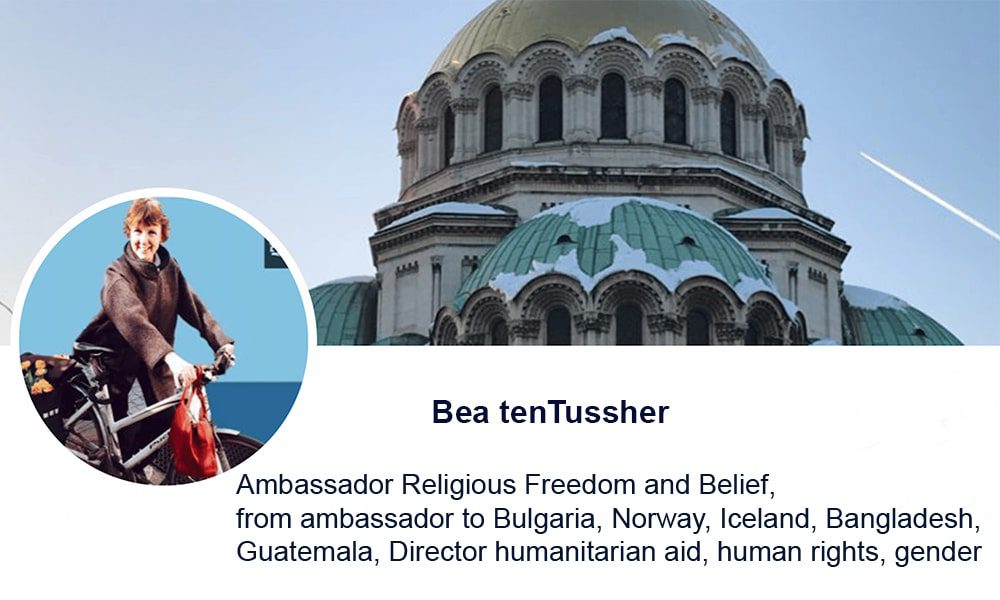
According to the Twitter account of Former ambassador Bea ten Tusscher, she has now become the new Dutch Special Envoy (or Ambassador for Freedom Religious Freedom and Belief as published in her profile.
Bea ten Tusscher (62) will succeed Jos Douma in September. Douma had been doing a good job in opening his communication lines to all religions, bigger and smaller, older and newest, an openness and dialogue that especially religious minorities expect the new Ambassador to maintain and increase. Douma became the first Special Envoy of Religion in the Netherlands in 2019. The position was created to protect religious freedom worldwide.
Dutch efforts to promote freedom of religion and belief worldwide
The website of the Dutch Ministry of Foreign Affairs says that they protect this right and others by:
ensuring freedom of religion and belief is a top priority at various international organisations including the European Union (EU), the United Nations (UN), the Organization for Security and Co-operation in Europe (OCSE) and the Council of Europe (CoE);
highlighting the importance of freedom of religion and belief in various settings. For instance in talks with the government of the country in question or in dialogues with religious leaders;
financing projects through the Human Rights Funds. For an up-to-date overview of projects see the Human Rights Report which is submitted to Parliament each year;
having the Human Rights Ambassador raise the issue in countries where these freedoms
The new protector of FoRB on the block
The new Ambassador or Special Envoy has built up herself much experience within the Dutch diplomatic world having served in several positions at the Ministry of Foreign Affairs since 1986.
Ten Tusscher served as an ambassador in Guatemala, Bangladesh, Norway and most recently in Bulgaria (2017-2021). From 2009 to 2021, she was the head of the department of Human Rights, Gender, Good Governance and Humanitarian Aid.
“In my career, I have built up much experience in protecting human rights”, Ten Tusscher explains her decision in a short written response, reported by the Dutch daily. “I want to contribute, together with Dutch and international partners, to freedom of religion and conviction for everyone, without fear or discrimination.”
FoRB, a commitment that has not yet been fulfilled
Ten Tusscher shows to be aware that the commitment of democratic societies to Freedom of Religion or Belief is still not fulfilled, especially, as she tells to the Dutch daily Reformatorish Dagblad, when “There are still countries in the world where you can get the death penalty for apostasy or blasphemy.”
Like many advocates of FoRB and many diplomats, Ten Tusscher noticed during her career that many people found “inspiration and support” in their religion. “The relevance of religion for society and politics, in diplomacy and development is often bigger than we think in our relatively secular Europe.”
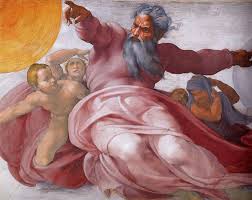
Holy Scripture, in relating the origin of the first man, says:
God said: let us create man in Our image, (and) according to Our likeness (Gen. 1:26).
About the creative act itself, the writer of Genesis narrates:
And God created man in His image, in God’s image He created him: male and female He created them (Gen. 1:27).
The image of God in man, according to the words of St. Apostle Paul, is “in righteousness and holiness of truth” (Eph. 4:24), i.e. in the actual perfection of man’s spiritual powers directed to God, as it was with Adam and Eve until their fall. And when they sinned, the image of God darkened among them, although even after the fall, the spiritual powers that God gave him at creation remained in man, namely: the mind, which always strives to know the truth, the heart, which thirsts for love, and the will that wills the good.
Due to the close connection of the soul with the body, the image of God is also reflected in the human body. The body of the first man corresponded to his soul and was a reflection of its godlikeness. It is said in the New Testament that the bodies of regenerated Christians are temples of the Holy Spirit who dwells in them, and that we should glorify God not only in our souls but also in our bodies (1 Cor. 6:19-20).
The likeness of God in man consists in the corresponding development and improvement of man’s spiritual powers. So we receive the image of God from God together with our being, and the likeness to a significant extent must be acquired by ourselves.
Hence the following differences between the image and likeness of God in man:
a) there is an image of God in every person, even in those corrupted by sin (Gen. 9:6), but the likeness of God does not belong to everyone;
b) the image of God cannot be destroyed even at the lowest stage of the human fall, because even in this state, reason, freedom and feeling remain in man, even though they obtain a false direction in him. The image of God in man may not be there at all;
c) finally, the image of God is a constant, unchanging aspect of the human soul, and the likeness can change, sometimes exalting, then obscuring the image of God in the soul. The infinite goal indicated to our soul, so that it becomes completely like God, was given to us by the Savior in the words:
Be perfect, as your heavenly Father is perfect (Matt. 5:48).
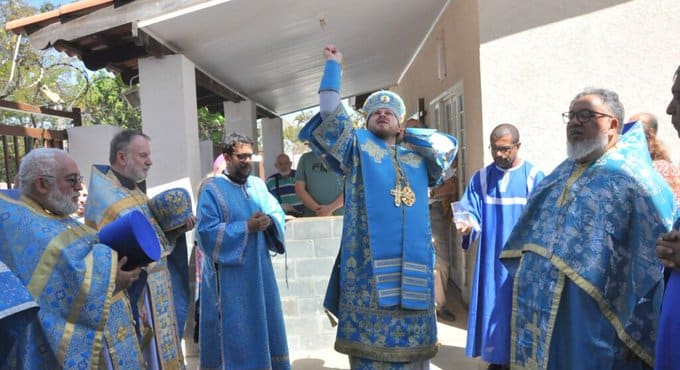
On August 14, 2022, on the 9th Sunday after Pentecost, the feast of the Origin (wearing) of the Honest Trees of the Life-Giving Cross of the Lord, the celebration in honor of the Smolensk Icon of the Mother of God “Hodegetria” (moved from August 10 to August 14), Bishop Leonid of Argentina and South America performed the Divine liturgy in the temple in honor of the icon of the Mother of God “Hodegetria” of the city of Brasilia (Brazil), reports the website of the South American Diocese of ROCOR.
After the dismissal of the Liturgy, the rite of consecration of the newly built cross and the dome of the temple took place, then Bishop Leonid addressed the faithful with an archpastoral word:
“Today, on the first day of the Dormition Fast, the Holy Church presents to us the memory of the Honorable and Life-Giving Cross of the Lord.
In the life of any person there are many trials, especially for those who try to live like a Christian, who try to fulfill the commandments of God, who try to go to church and approach holy fasts responsibly.
The Lord tells us: “Whoever wants to follow me, deny yourself, and take up your cross, and follow me” (Mark 8:34).
In Christianity, there is a concept of a personal cross that we carry throughout our lives, whether we like it or not, whether we believe or not. Our cross can be big or small, heavy or light, one way or another the Lord gives it according to our strength. Even if it seems to us that the cross is heavy and we cannot bear it at certain moments of our lives, in fact it is not so. This often happens when we want to do or do some good deeds, when we try to pray and go to church, because dark forces – evil spirits always take up arms against people who are trying to live like a Christian. But the Lord is always with us, and He always helps to carry our cross. Therefore, the Church once again turns our gaze to the Cross of the Lord, which the demons fear. And we, in turn, must more often make the sign of the cross over ourselves to help and protect our lives.
Today, the church in which we prayed is celebrating the patronal feast. Each of us has patron saints, and we celebrate the name day on the day on which the Church celebrates the memory of our saint. So every temple is consecrated in honor of some saint, and he has his own name day.
This temple is dedicated to the icon of the Mother of God, called “Smolensk” or “Hodegetria”, which in Greek means “Guide”. When one of us is going on a journey, especially a dangerous one, we usually take a guide or guide with us to get to our destination safely. Our life on earth is a great journey that ends with the attainment of eternal life. And in this earthly journey of ours, we have a Guidebook that shows the right path to eternal life.
I wish all of you, dear fathers, brothers and sisters, to bear your personal crosses with patience and hope in God, to resort to the help of our Guide, the Intercessor of the Zealous, Most Holy Theotokos, and to move firmly towards eternal life in the Kingdom of Heaven. Amen.”
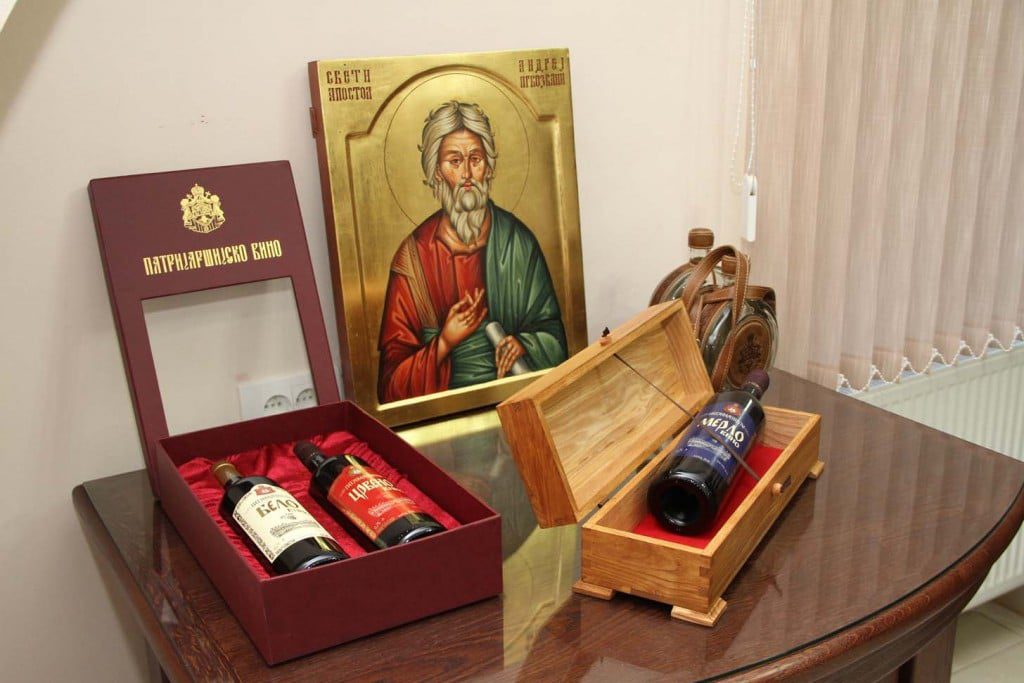
Serbian Orthodox Church produces its own brand of wines and brandies – Patriarcheski. Her cellars in Sremski Karlovtsi continue a centuries-old tradition. The cellars are located in the Old Palace, and the vineyards are located in the vicinity of Fruškogorsko village. The patriarchal cellars keep, as ever, excellent wines: patriarchal red, patriarchal white, as well as dessert wines, of which, in any case, the most famous is bermet. Of course, wine is also produced for liturgical purposes, as a Eucharistic gift, because of all the works of human hands, the production of bread and wine requires the most labor.
The winemaking tradition in the Serbian Orthodox Church dates back to its foundation and its first spiritual leader, St. Sava Nemanic. Around 1230, Archbishop Sava concluded a contract with the “Protat” of Svetogorje regarding the boundaries of the Hillendar vineyards. St. Sava personally places and supervises the boundary stones. “I also personally covenant that when this place shall be made into vineyards, to hold and govern these vineyards undeniably, undisturbed, and irrevocable during my sojourn among the living, and after the end of my life one half of the vineyards I bequeath to my cell , which is dedicated to our venerable Father Sava and is located near Careia, and which I have built from the ground up, and the other half – to the collegiate church in Careia…” – this is the will and testament of St. Sava in this particular case .
The town of Sremski Karlovtsi, located northeast of the main Fruska Gora massif (mountain), near the Danube River, is a place with important historical traditions and a rich cultural and spiritual heritage. Due to its geographical position – on the road from Central to Eastern Europe, from Vienna to Istanbul – it was an important place throughout all centuries of the new Serbian history. Sremski Karlovci is 57 km from Belgrade and 12 km from Novi Sad. It is the administrative seat of the Karlovy Vary, the ecclesiastical unit that united the Serbs in the Austro-Hungarian Empire. In the political and cultural life of the Serbian people north of the rivers Sava and Danube, Sremski Karlovci occupies the most prominent place. In this municipality, thanks to the natural conditions, viticulture is also developed, improved even more under the sacred wing of the Serbian Orthodox Church.
Fruška mountain is extremely suitable for viticulture. Wine in Sremski Karlovci also had a special role, especially in the liturgical life of Sremski Karlovci as a church center.
The librarian of the Hungarian king Matthias Corvinus (1458-1490) Galeotti, a man of taste and scholar in his environment in the 16th century, wrote after tasting the Srem wine that “there is none like it in the whole earth.”
The geographical advantages of Sremski Karlovci in terms of growing vineyards are highlighted by the travel writer Anton Vrancic, who traveled by the town in 1553 and 1557 and says that Sremski Karlovci “despite the reduced number of houses and population, of all the surrounding towns is relatively the least damaged, and the most populated and there are abundant fields and vineyards, and Srem wine has been known since time immemorial, while in other places viticulture is neglected”. The travel writer Hans Löwenklau, who accompanied the prince of Liechtenstein on his way to Constantinople in 1584, pointed out that Karlovci was mostly inhabited by Christians and that it was a place “where good wine is born”. In the same year, 1584, Melchior Bezolt also passed through Karlovtsi, who remembers his stay there because on the way from Vienna his group “did not drink better wine”, i.e. that Karlovtsi is a place “where good wine is born , often with a nice color too”. Maximilian Prandstetter mentions that the crabs, i.e. the Serbs, gave him three large barrels of wine and many animal products on the way to Constantinople in 1608, because in Karlovci “there are many vineyards and good wine”. At the same time, the Polish poet Janko Kohanowski used “Srem wine” in his poems as a metaphor for abundance and luxury. All this shows that both Sremsko and the wine from Sremski Karlovtsi had a good reputation in Central Europe at the end of the 16th and the beginning of the 17th century.
Patriarch Arseniy IV Jovanovich Shakabenta (1737-1748) built a chapel dedicated to St. Tryphon next to the southern wing of the new archbishop-metropolitan residence. The construction lasted in the period 1740-1742, and the commemorative plaque testifying to the construction of the church is today located in the vestibule of the Old Palace, since the chapel burned down in a fire in 1788. The very fact that the church was dedicated to a saint, patron of winegrowers, speaks volumes about how much the production and sale of wine was present in the economy of the population of Sremski Karlovci and how much the Serbian Orthodox Church cared for them.
Winemaking and viticulture in the Karlovy Vary have enjoyed special attention. European technological development was followed, assimilated and written about by official church representatives and figures.
The encyclopedic spirit of Zacharia Stefanovich Orfelin (1726-1785) gave birth in 1783 to the handbook “Experienced Selection”, which went through four additional editions in 1808, 1817, 1874 and 1885. Enumerating the famous European wines, Zacharia Orfelin concluded: “In Srem , and especially in Karlovtsi and in some monasteries there are also good and stable wines that are dark red and relatively strong. The wine they make during the harvest from fresh red must and call “schiller” is an exceptional drink that is also healthy. It acquires a reddish tint, and when aged for three or four years it acquires an incredibly fine taste, and after eating it you don’t need more than a glass or two, just like medicine and bliss, because it is very strong.”
Until the middle of the 19th century, more red than white wine was drunk in Karlovtsi. This is evidenced by the inventory of the will of Metropolitan Jovan (Djordjevic; 1769-1773). According to this document, white wine is only one fifth of the total amount.
In the 18th century, Karlovy Vary wine was exported to Austria, Switzerland and Poland. A particularly large consumer of it is the Vienna Palace headed by its ruler. The royal-royal envoy to the Serbian Church-People’s Assemblies, Friedrich Wilhelm von Taube, describing the life of the Serbs in the Austro-Hungarian Empire, Sremski Karlovci, the Orthodox churches there and the metropolitan building, also points out the making of the then-famous bermet: “Behind the metropolis a house rises , in which the Illyrian People’s Secretary lives, and directly opposite this old residence – a new farm building, decorated with stone pillars and soaring arches, which barely covers the square and is 24 fathoms (45.5 meters) long, but has only a ground floor. In it and the adjacent three rear buildings are located both the apartments of the metropolitan officials and servants, as well as a bakery, a barn, a shed for cars (phaetons), stables for horses, etc. Here also a certain bermet is made in large quantities ( Tropf-Wermuthwein) and vats (measurement unit about 50 l.) of it are sent far away. The best bunches are put uncrushed into cloth sacks, from which the juice begins to drip and flow of itself, and then it is boiled once with aromatic herbs and strong roots, and thus a wonderful bitter wine is obtained.’
Among the dessert wines mentioned during this period, we note Karlovy Vary Bermet, Bermet Kaplaš and Samotok. Bermet is also known as Serbian wine (Raiyischer Wermut), Bermet Kaplaš (Tropf-Wermut) and Samotok (Ausbruch). These Serbian wines, among other things, affect the mood and reduce tension. Karlo Buyanovich from Vienna sought out Karlovci singletok in order to obtain the favor of a Viennese lady by giving it as a gift, and it seems that it was the favorite drink in the palace under Metropolitan Vikentii (Jovanovich Vidak; 1774-1780). Metropolitan Pavel (Nenadovic; 1749-1768) is known to have often managed to bring about a favorable outcome to Serbian national-ecclesiastical issues in the Vienna Palace by giving gifts of Karlovy Vine and brandy. Letters of thanks by the First Count von Rittberg to the metropolitan for “two akkas (about 100 l) of bermet and a few akkas of other wines” have been preserved.
At the end of the 18th century, both the economic life and the viticulture of Sremski Karlovci came to a standstill. The reasons for this were different, firstly, a fire occurred in 1799, which consumed the village of Gorni Kraj, where the richest residents lived, and the same year, the cold destroyed the vineyards of Karlovy Vary. In 1801 bad weather attacked the settlement, a cyclone tore down the roofs and heavy rain flooded the cellars. The damage to the vines is enormous. The Austrian and Napoleonic wars also hindered the export of wine, and during that time only Karadjordjeva Serbia imported wine and brandy from Srem.
Procopius (Bolich; † 1818), archimandrite of the Rakovitsa monastery in Fruška gora (Frushka mountain), left behind Orphelin an even more complete viticultural manual. And he made a compilation, translated from the Latin, of the then living French oenologists Abbé Rozier, Count (chemist) Chaptal, and the academic oenologist Paramantier.
The Archimandrite of Rakovac points out that the climate in Srem and Slavonia is very favorable, because there “the sky leans more” towards the middle between the coldest and the warmest. “And indeed in Srem such a wine is born, which in olden times was very glorious and famous for its prosperity and stability, for its long duration, its extraordinary taste, for its peculiar smell and its very beautiful appearance…”.
Phylloxera, the disease of European vineyards in the second half of the 19th century, began to attack the vineyards of Fruškogorsk in 1881. When its first deadly waves passed, a renewal of viticulture began, based on the so-called “American foundations”, with the transfer of new varieties of grapes that were brought to the Old Continent from their transoceanic homelands. In Sremski Karlovtsi, there are changes in the grape varieties: red wines are decreasing at the expense of white wines. It also leads to a reduction in the amount of wine produced. Efforts are also being made to renew viticulture in Srem and beyond. Theoretical knowledge was collected by Jovan Zivkovic, a professor at the Karlovac Seminary, who at the beginning of the 20th century made systematic manuals for Viticulture and Viticulture.
Drinks for the enthronement ceremony of Patriarch Dimitri, the first head of the united Serbian Orthodox Church, were also delivered from the Karlovac cellars. The ceremony took place in Pécs in 1924, and the types and quantity of wine are known in detail: 1,000 bottles of dessert wine (Karlovački bermet), 1,000 liters of white, 500 liters of red wine, 500 bottles of champagne and 100 liters of brandy.
Today, the patriarchal cellars in Sremski Karlovtsi are continuations of the tradition and inheritors of the knowledge and skill of making wine, which has been cared for for centuries.
The Serbian Patriarchate owns modernly equipped cellars, in which branded wines and brandies in various cuts are now produced and sold.
Source: According to information from the official page of the Serbian Orthodox Church
The Church Fathers also understood salvation as salvation primarily from sins. “Our Christ,” says St. Justin the Martyr, “redeemed us, immersed in the gravest sins committed by us, through His crucifixion on a tree and through the sanctification of us with water, and made us a house of prayer and worship.” “We,” says St. Justin, “while still being given over to fornication and to every vile deed in general, have drawn within ourselves the grace bestowed by our Jesus according to the will of His Father, all the unclean and evil things in which we have been clothed. The devil rises up against us, always acting against us and wishing to draw everyone to himself, but the Angel of God, i.e. the power of God sent down to us through Jesus Christ, forbids him, and he withdraws from us. sins, and from the torment and flame that the devil and all his servants are preparing for us, and from which again Jesus the Son of God delivers us. Thus, St. Justin does not forget the consequences of sin, but deliverance from them appears to him as a consequence of salvation, and not his essence and main goal (“saves again”). The essence of salvation lies in the fact that the Lord Jesus Christ gave us the power by which we overcome the attacks of the devil attacking us and remain free from our former passions.
“I,” says St. Ephraim the Syrian, “saved from many debts, from a legion of sins, from the heavy bonds of iniquity and from the nets of sin, I was saved from evil deeds, from secret iniquities, from the filth of corruption, from the abomination of delusions. I arose from this mud, came out of this pit, came out of this darkness; heal, O Lord, according to Your unfaithful promise, all the infirmities that you see in me. In these words, Rev. Ephraim not only expresses the essence of salvation from the point of view of its content, but also makes it possible to understand its very form, the way in which it is accomplished: it is not some external judicial or magical action, but a development gradually taking place in a person by the action of God’s grace, so that there may be degrees of redemption. “The perfect Christian,” the Holy Father expresses the same thought, “produces every virtue and every perfect fruit of the spirit that surpasses our nature … with delight and spiritual pleasure, as natural and ordinary, already without fatigue and easily, no longer struggling with sinful passions, as one who has been completely redeemed by the Lord.”
The same thought can be found in a very clear form in St. Athanasius of Alexandria, “Because,” he says, “human nature, having undergone a change, left the truth and loved iniquity, then the Only Begotten became a man in order to correct this in Himself, to inspire human nature to love the truth and hate lawlessness.”
Christ “is called, according to St. Gregory the Theologian, “Deliverance” (1 Corinthians 1:30), as he frees us who are held under sin, as he gave himself for us as a ransom, as a cleansing sacrifice for the world.”
The Essence of Salvation
So, from the Orthodox point of view, the essence, meaning and final goal of a person’s salvation is to deliver him from sin and to give him eternal holy life in communion with God. The Orthodox does not forget about the consequences of sin, death, suffering and other things, is ungrateful for deliverance from them to God – but this deliverance is not for him the main joy, as it is in the legal understanding of life. Like the Apostle Paul, the Orthodox lament not so much that he is threatened with punishment for sin, from which (sin) he cannot be freed in any way, but that he cannot “get rid of this body of death,” in which lives “other law who opposes the “law of the mind” that pleases him (Rom. 7:22-25). Not fear for oneself, but the desire for holiness, life according to God, makes the true ascetic of piety grieve.
If this is the essence of salvation, then the very method of it becomes certain for us.
If one thinks only of delivering a person from suffering, then it makes absolutely no difference whether this deliverance is free or not free on the part of a person. But if a person needs to be made righteous, it is necessary to be freed precisely from sin, then it is not at all indifferent whether a person will be only a suffering subject for the action of supernatural power, or whether he himself will participate in his deliverance.
Salvation is accomplished without fail with the participation of human consciousness and freedom; it is a moral matter, not a mechanical one.
That is why, in the Holy Scriptures and in the works of the Fathers of the Church, there is a constant desire to convince a person to work out his own salvation, because no one can be saved without his own efforts. Holiness, if it is an involuntary property of nature, will lose its moral character and turn into an indifferent state. “You can’t be kind out of necessity” (I. Chrysostom).
Therefore, it is equally wrong to conceive of salvation as a deed both externally sane to a person and occurring in a person apart from the participation of his freedom. In both cases, a person would turn out to be only a weak-willed subject of someone else’s influence, and the holiness received by him in this way would not differ in any way from innate holiness, which has no moral dignity, and, therefore, not at all the highest good that he seeks. human. “I,” says St. I. Chrysostom, “I heard many who said: “Why did God create me autocratic in virtue?” But how to raise you to heaven, dozing, sleeping, betrayed by vices, luxury, gluttony? You are there too would not lag behind vices? “A person would not accept the holiness forcibly imposed on him and would remain the same. Therefore, although the grace of God does a lot in saving a person, although everything can be attributed to her, however, she “also needs a believer, like a writing cane or an arrow in an active one” ( Cyril of Jerusalem.) “Man’s salvation is prepared not by violence and arbitrariness, but by persuasion and good nature. Therefore, everyone is sovereign in his own salvation “(Isidore Pelusiot). And this is not only in the sense that he passively perceives the impact of grace, so to speak, gives himself to grace, but in the fact that he meets the salvation offered to him with the most ardent desire that he “zealously directs his eyes to the light” (of God) (Irenaeus of Lyons). Ephraim the Sirin, – is always ready to give you His right hand, and raise you from the fall. For as soon as you are the first to stretch out your hand to Him, He will give you His right hand to raise you up.” only his own salvation, but “helps the grace that works in him.” Every good thing that happens in a person, every moral growth, every change that happens in his soul, necessarily does not take place outside consciousness and freedom, so that not someone else, but “man himself changes himself, from the old turning into the new.” Salvation cannot be some external judicial or physical event, but must be a moral act, and, as such, it necessarily presupposes as an inevitable condition and law that a person he himself performs this action, although with the help of grace. Grace, although it acts, although it does everything, is without fail within freedom and consciousness. This is the basic Orthodox principle, and it must not be forgotten in order to understand the teaching of the Orthodox Church about the very method of human salvation.
Source: with abbreviations that do not distort the meaning, from the work of Archbishop (Finland) Sergius: “The Orthodox Doctrine of Salvation”. Ed. 4. St. Petersburg. 1910 (pp. 140-155, 161-191, 195-206, 216-241) – in Russian.
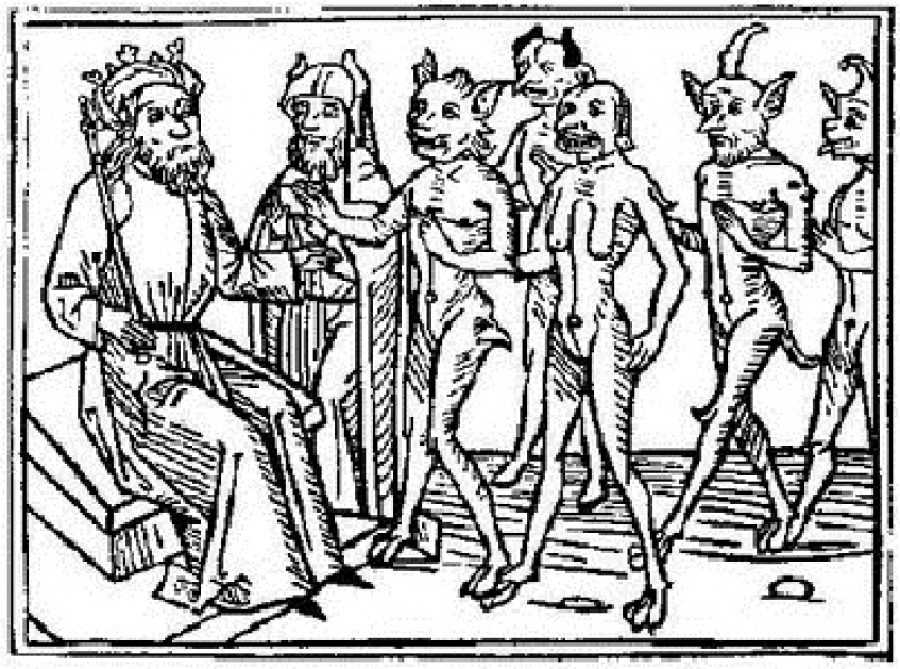
An image in the German edition of Jacob de Teramo’s book The Consolation of Sinners, or the Trial of Lucifer against Jesus Christ (Jacobi de Ancharano (alias de Teramo): Litigatio Christi cum Belial), shows an imaginary court presided over by King Solomon. Lucifer started a case against Jesus Christ because he illegally entered his domain – the underworld. The prophet Moses is Christ’s defender at the trial, and the demon Belial represents the prosecution. But on the heads of the opponents – Moses and Belial – identical small horns are depicted. How is it that the greatest of the Old Testament prophets, who led the Jewish people out of Egyptian slavery and received the tablets of God’s ten commandments, looks so much like Lucifer’s lawyer?
This is not an artist’s fault or some quirk. On the famous statue of Moses, created by Michelangelo Buonarroti around 1513-1515 as part of the tombstone of Julius II in the church of San Pietro in Vincoli, two strange “bumps” are also visible on the prophet’s head, and in the Middle Ages the horned “portraits “they had no respect for Moses at all.
According to the most common version, the horns on his head appeared in Christian iconography as a result of a mistake made by Jerome of Stridon (345–420) when translating the Old Testament from Hebrew into Latin. According to the book of Exodus, Moses climbed Mount Sinai twice. The first time God gave him two tablets with commandments. But coming down, the prophet found that his people had fallen into idolatry and began to worship the Golden Calf. “And when he drew near to the camp, he saw the calf and the games; and Moses’ anger was kindled, so he threw the tablets from his hands and broke them under the mountain” (32:19). After that, at God’s command, he himself made two stone tablets and with them ascended Sinai for the second time, where God again dictated to him the commandments that the people of Israel were to follow.
If we open “Exodus”, we will read that “while Moses was coming down from Mount Sinai and holding the two tablets of revelation in his hand, when he came down from the mountain, Moses did not know that the skin of his face was shining, because he had talked with God” ( 34:29). But in the Latin translation (Vulgate) made by Jerome, this place looks quite different: there it is written that Moses did not know that his face had become “cornuta”. In the Greek translation of the Old Testament, the so-called The Septuagint (3rd century BC), from which the Church Slavonic translation was later made, no longer has horns. Jerome was certainly familiar with the Greek translation of the book of Exodus. How then could he have made such a strange mistake? Many believe that he confused the similar words “radiance” and “horns”. In the Hebrew text, the verb “qāran” stands in this place (based on the root, קָ֫רֶן qeren, which often means “horn”); which is now interpreted to mean “shining” or “radiating”). But there is another point – the “horn” was one of the ancient metaphors for earthly and divine power, which in the biblical text refers not only to different kingdoms, but also to the Lord himself. The influential theologian and encyclopedist Isidore of Seville (c. 560–636) compared two parts of Scripture—the Old and New Testaments—to two horns. The Old Testament Book of the prophet Daniel (8:3-22) describes his vision: a ram with two horns of different sizes and a goat with a single one above the eyes appeared on the bank of the river. The goat broke both of the ram’s horns, but after the victory, his own huge horn turned into four smaller ones.
Archangel Gabriel explained to Daniel the meaning of his revelation. The large horn of the ram denoted the Persian kingdom, and the small horn denoted the Median. “The wild goat is the Greek king; and the great horn between his eyes is the first king. And where he crumbled and four came forth in his stead, it means that four kings will arise from that people, but not with power like his” (8: 21-22). The first images of Moses with horns appeared only in the 11th century – 600 years after the death of Jerome. Previously, Christian masters did not separate the first and second ascent of Sinai and did not try in any special way to depict the transfiguration that took place there with the prophet. According to the American historian Ruth Melinkoff, the oldest example of the horns of Moses appeared in England – in the illustrations to one of the manuscripts of the Hexagram by the learned monk Aelfric the Grammaticus. Starting from the Latin text of the Vulgate, he, following Jerome, wrote that Moses returned the second time from Sinai “horned”, and the miniaturist who illustrated his story painted the prophet.
From the twelfth century, the horns became a standard attribute of Moses, which was reproduced in thousands of images. Although around the same time Satan and demons were also increasingly depicted as horned, the similarity between the mark of the chosen and the mark of the rejected was clearly in the order of things, and none of the clergy raised much objection to this. However, this did not exclude confusion. The situation began to change only at the end of the Middle Ages, when artists, trying to correct the “mistake” of Jerome, sometimes began to depict the horns as rays or tried to “rationalize” them.
Moses was not the only holy man depicted with horns in the Middle Ages. Miniatures are known in which they appear in the Old Testament ancestors Noah and Abraham. It’s not clear exactly why. Probably, after the horns became a symbol of the chosenness of Moses, to whom God himself addressed on Mount Sinai, the same sign began to be sometimes applied to other characters of the Old Testament who were worthy of communion with the Lord. However, there is also a more prosaic explanation – a mistake: it is possible that medieval masters, confusing such scenes, depicted Noah or Abraham as Moses.
Photo: A woodcut of Belial and some of his followers from a German edition of Consolatio peccatorum, seu Processus Luciferi contra Jesum Christum (1473) / Public Domain
Six medical and SPA centers in the country welcome tourists from Germany, whose restorative and rehabilitation procedures in Bulgaria are paid for by the German health insurance funds. Among the tourists there are Bulgarian citizens who work and secure themselves in Germany. Mitko Vassilev, chief manager of the German-Bulgarian Chamber of Industry and Commerce, announced this on August 21 for the “Horizon” program on the Bulgarian National Radio.
In September 2019, the German National Association of Health Insurance Funds expanded the list of 14 countries in which it recognizes the provision of medical and outpatient services for prevention. Now there is a need for a targeted campaign to popularize information about prevention opportunities in Bulgaria, stressed Mitko Vasilev:
“Germany has 16 federal states and it takes a lot of effort to spread this information, especially since there are 109 funds there, some of which are state funds, some of which are private funds, and our task is as much as possible to cover them and convince them that they can send their patients to Bulgaria”.
There are enough modern centers in our country that meet the requirements. On the lines of the Bulgarian Union of Balneology and Spa Tourism and the German-Bulgarian Chamber of Industry and Commerce, consultations and training are offered to the sites in our country in order to increase their chances of receiving tourists from Germany. Together with the Ministry of Tourism, high-level meetings were held to promote the possibilities of Bulgarian medical and spa centers. Bulgaria’s competitive advantages are related to climate and nature, emphasized Mitko Vasilev.
Paola Husein’s interview with Yakov Djerasi for 24chasa.bg (06.11.2021)
Our country can definitely teach the “enlightened” European society what human behavior and tolerance mean, says the chairman of the International Foundation “Bulgaria”.
While the whole of Europe during the Second World War handed over its Jews for quick extermination, we Bulgarians managed to stop both of our forced deportations to the death camps
The best choice I have made in my life is to come to Bulgaria
A few days ago, Yakov Djerassi sent a letter to Katarina von Schnurbein, the new EU coordinator for efforts to combat anti-Semitism, in which he proposed that the European Commission declare Bulgaria Day for saving the Jews.
– Mr. Djerassi, you suggest that the European Commission declare Bulgaria Day to honor the merits of our country for the rescue of the Bulgarian Jews. You made your proposal in a letter to Katharina von Schnurbein, the new EU coordinator for efforts to combat anti-Semitism. Why should there be such a day?
– I know that ultranationalists and devoted communists will hardly agree with me, as well as all other people who believe that Bulgaria is responsible for the evil fate of the Macedonian (Yugoslav) and Thracian (Greek) Jews, but nevertheless we as Bulgarians must let’s be honest with ourselves because it’s time for Cheshbon hanefesh. This biblical term literally means “reckoning of the soul.” In the Jewish calendar, Cheshbon hanefesh is done every year because if one doesn’t take stock, how can one know what needs to be changed.
In this line of thinking, we must admit that apart from the unique Bulgarian folklore, the savory and the historical “moment” of saving our entire Jewish community
during World War II, we as a nation did not give Europe great philosophers, scientists, sculptors or athletes. We had some, but they didn’t want to be associated with their homeland. Take the late laureate Elias Canetti for example. Fleeing his Bulgarian roots, he preferred his British citizenship, although he was born in Ruse, Bulgaria. Or the world-famous artist Hristo Yavashev – shortly after his death, his long-awaited wish to pack the Arc de Triomphe in Paris came true. And when years ago he was politely asked to join world names in support of Sofia University, he refused with the sharp statement that he did not want any association with his homeland.
While the whole of Europe during the Second World War handed over its Jews for quick extermination, we Bulgarians managed to stop both of our forced deportations to the death camps. In the second attempt, the king hid in the mountains so that he would not be available in case he was forced to sign deportation papers. Where in Europe would a head of state flee the capital just to avoid betraying his Jews? They were the cheapest and most insignificant human resource in those years. Their lives were worth nothing except in Bulgaria.
Take Hungary – 12,000 Jews a day were sent to the Nazi extermination machine. Or the largest death camp in the Balkans, just hours away from Sofia – Jasenovac, Croatia, where almost 400,000 Gypsies were brutally murdered.
I remember attending a seminar about the Holocaust in Athens some time ago. There I witnessed a Greek Jewish survivor of the Holocaust state bluntly, “I was betrayed by my own Greek neighbors,” he did not even mention the Germans.
– How did Bulgaria manage to save its Jews?
– Bulgaria has acted differently. I base my statement on the personal experience of my own family living in the country during those years. But you can hear similar experiences from the families of all 45,000 Bulgarian Jews who preferred Israel to living in communist Bulgaria.
Let me make some clarifications about this historical period.
Yes, there was a curfew. Yes, the Jews wore the yellow star to set them apart from everyone else. The Jews of Sofia, for example, were asked to move to the countryside.
Yes, there was a Law for the Protection of the Nation and mass mobilization of Bulgarian Jewish men to build unnecessary roads in labor camps, but these formations were not of a strict regime. Do you know where during World War II Jews organized and participated in camp operas and operettas? Zico Graziani, probably the most famous Israeli-Bulgarian of all time with a street named after him in Sofia, could answer this question for you with: “Here in Bulgaria”. Jews could come and go. On weekends, they were even allowed to visit their families. In what other European camps did something like this happen? Indeed, it was no “picnic”, but nevertheless every Polish Jew would like to be in the place of the Bulgarians
And this is understandable, because where during World War II in Europe were Jews allowed to attend universities for example? The Law for the Protection of the Nation forbade their access to higher education institutions!
– In your letter to Katarina von Schnurbein, you convince her that declaring Bulgaria Day has an educational and moral value. Why?
– Do we realize that after World War II, the Bulgarian Jews who immigrated to Israel in 1949 laid the foundation of the medical corps there?! During those years, 60% of the medics in the newly formed country were of Bulgarian origin. Do we realize what a great contribution Bulgaria has made to the creation of the new Jewish state?! This was hardly consistent with the Defense of the Nation Act.
Also, I should mention that my parents, their peers, and me as the second generation were decidedly unaffected by the Holocaust complex.
Who else in Europe during World War II, except perhaps Monsignor Roncalli, the Vatican’s representative in Turkey, stood up for the Jews as did the entire Holy Synod of the Bulgarian Orthodox Church?
In which other European country did pro-German MPs sign a petition against the deportation of the Jews? Where in Europe has the entire society, from the simple farmer who could not even write his name to the head of state, stood so boldly behind its Jewish citizens?
Did you know that fleeing Jews from other European countries, reaching the borders of Bulgaria, were welcomed and escorted by the Bulgarian Red Cross? Tell me in which other country something like this has happened.
It’s a shame because after all these years, we haven’t learned to recognize the good. Or as they say in Israel – Le’hakir et Hatov (“Recognize the good”). We weep and commemorate the evil, but we must also remember and repeat the good.
Everything has its time: “A time to weep, and a time to laugh; a time to mourn, and a time to rejoice,” Ecclesiastes.
Yes,
Bulgaria represents this WELL
and it can definitely teach the “enlightened” European society what human behavior and tolerance mean. That is why I think that the EU owes us Bulgaria Day!
– How did the idea of proposing the creation of Bulgaria Day come about?
– My whole life has been spent in support and defense of this historical truth. So such an idea should not surprise anyone.
People by nature have the innate handicap of judging each other, especially in difficult times, and we Bulgarians have proven to the world that we are a different “breed”. I am proud to be Bulgarian. My friends in Israel even formed an association “I am Bulgarian first”. Imagine, Israeli Jews – the soldiers of the Israeli army, who cannot even read and write in Bulgarian, are proud of their heritage, brought by their grandmothers with Bulgarian roots. Check out their Facebook page if you don’t believe me.
– Do you already have an answer from Mrs. Schnurbein, how did she take your proposal?
– In truth, I don’t expect an answer. I think I “excited” her more than necessary.
But here is the moment to say that it is time for our MEPs to show unity and attitude at least on this topic. I will not hide the fact that I hope that the Bulgarian Commissioner Mrs. Maria Gabriel will also show interest. It also depends on the way our head of state looks at the subject, and I believe he can do wonders.
– There is already an International Day of Remembrance to honor the memory of the Jews who died in the Holocaust. Why will the Day of Bulgaria be different?
– I mentioned the biblical book of Ecclesiastes. There is time for everything. There is time for the world to understand that we are different. I’m sure the EU will want to honor Denmark if such a day is created. But I don’t believe that she deserves it as much as Bulgaria. See, we have not sent our Jews to another country, as the Danes did, nor have we required them to pay with their most valuable possessions to be taken away in fishing boats quietly in the dark of night. The Danes have simply transferred the “problem” elsewhere, away from their country, so that their king will not feel either the sense of responsibility or the discomfort of a burgeoning conflict of interest in making a firm decision in defense of his Jews, as ours did Tsar. And let’s also not forget that they “turned” over to the Gestapo every Jew who tried to cross into Denmark. There was no Danish Red Cross at the borders.
– Just a month ago – on October 5, the European Commission adopted the first ever EU strategy to combat anti-Semitism and promote Jewish life. The reasons are that anti-Semitism is on the disturbing rise in Europe and beyond. Do you see manifestations of anti-Semitism in our country?
– Although some Bulgarian Jews loyal to the communist system of the past would use the term “monarcho-fascism”, my parents spoke only of the deep love and respect they received from their Bulgarian neighbors and ordinary citizens, especially after the introduction of the yellow star.
I will return again to Zico Graziani, the famous Israeli-Bulgarian musician, born in Ruse and a graduate of the Music Academy “Pancho Vladigerov” in Sofia. He said that when he showed up to his class with the yellow star, all his classmates put yellow stars on their coats in solidarity
I don’t believe that filling out surveys about the degree of anti-Semitism in Bulgaria, containing ridiculous questions like: “Are Jews more loyal to Israel than the country they live in?” or “Do Jews have influence on the world’s financial institutions?” can to give accurate statistics on the rate of anti-Semitism today. It’s just frivolous. Such type of questions are not only misleading and meaningless, but are the main reason for the creation of conspiracy theories with a very negative and quite dangerous flavor in the first place.
Not every swastika is a sign of anti-Semitism. Some of “my people” fuel this type of incident which only widens the gap in understanding.
Yes, there is a rise in anti-Semitism in many European countries. In my opinion, its percentage increase is directly related to the uneasy and unpredictable relations between Israel and Palestine, as well as the rest of the Arab world.
I am a member of a closed society, the Jewish people are by nature a closed group of people in which others have no place. I think the Jewish communities need to open up more and become the “light of the nations” again. Invite others to share in our success and traditions.
And yes, I have been in Bulgaria for almost thirty years. Just imagine – I came supposedly for only six months. In my entire life I have never experienced any form of anti-Semitism exercised upon me.
Exactly the opposite. I admit that probably because of my Jewish background I even received more attention and love. That’s how six months turned into 30 years and it was the best choice I’ve made in my life – to come to Bulgaria.
– Israel is one of the first countries in the world to successfully fight the coronavirus. How far did they go, did they take off their masks? What can we learn from their experience?
– Israel was probably among the first countries whose citizens were thoroughly “educated” on the importance of the vaccine. It’s really not hard to explain to Israelis how essential it is to their health.
The reality in Bulgaria is radically different. Even the doctors here are against the vaccine. In my opinion, mainly because of all the rumors and half-truths that roam the media and public space. And our doctors very often like to play the role of God. Time to take action against this type of medical staff.
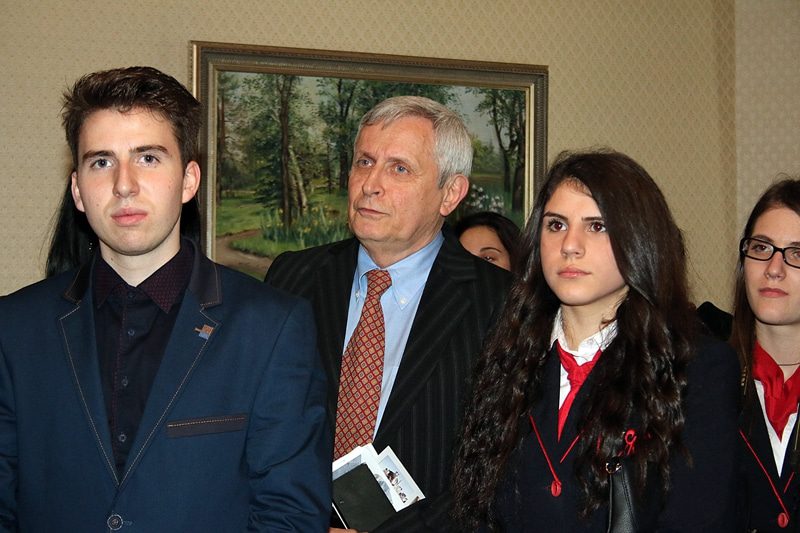
Photo by Paraskeva Georgieva: At the reception of His Majesty Tsar Simeon II at Vrana Palace – Sofia for the winners of the annual essay competition on the topic of tolerance, organized by the Israeli-Bulgarian Institute of Yakov Djerassi. The young people write their essays inspired by Michael Bar-Zohar’s book “Beyond Hitler’s Grip”, which tells about the rescue of Bulgarian Jews during the Second World War.
The Bulgarian-Macedonian dispute is also being carried over to Albania, BNT reported. Another misunderstanding arises over the possible separation of two regions in Albania – Golo Burdo and Gora, into separate municipalities. The Bulgarian minority, recognized by the Parliament in Tirana in 2017, is concentrated in these areas. However, organizations close to Skopje claim that the population in these areas is Macedonian. Bulgarians there demanded an urgent meeting with the Bulgarian President Rumen Radev.
The Bulgarian-Macedonian dispute is also being carried over to Albania, BNT reported. Another misunderstanding arises over the possible separation of two regions in Albania – Golo Burdo and Gora, into separate municipalities. The Bulgarian minority, recognized by the Parliament in Tirana in 2017, is concentrated in these areas. However, organizations close to Skopje claim that the population in these areas is Macedonian. The Bulgarians from Albania requested an urgent meeting with President Rumen Radev.
The Bulgarian community in Albania lives in the regions of Mala Prespa, Golo Burdo and Kukushka Gora. They number several tens of thousands and were officially recognized as a minority by the Albanian Parliament in 2017. According to experts, our compatriots have been living there for centuries.
Now the areas of Golo Burdo and Gora are expected to be separated again into separate municipalities, which will allow the compact Bulgarian population there to more easily attract investments, prove their Bulgarian origin and seek Bulgaria’s help.
“Our territory – all the roads are dirt roads, we don’t have a single road with asphalt. It is very difficult to enter our territories. We don’t have a single deputy. And in the municipalities we don’t have a single person from our people.”, dissatisfied Hadji Pirushi from a company “Prosperity” in Golo Burdo, Albania.
Apart from the lack of representatives in power, no official Albanian document indicates where our community lives. And it is becoming more and more difficult for our compatriots to prove their origin on the basis of their birth certificate.
“In the past, Golo Burdo was an independent municipality, that is, in the birth certificate it was written that the person was born there, and since it is a compact Bulgarian population, that is, there are no other people there besides Bulgarians, it was very easy to establish the Bulgarian origin of the candidate in question. These days, when these municipalities have been liquidated, we lose all traces purely administratively,” says Associate Professor Spas Tashev from the Institute for Population and Human Research at the Bulgarian Academy of Sciences.
“Many problems, documents are delayed, 3-4 years. There are people who give up. Why?” asks Hadji Pirushi from Golo Burdo.
In October, a census is coming up in Albania and the parallel movement with the issue of the separation of municipalities is, however, threatened by the organizations of the Macedonians there, who have their own MP.
Vasil Sterovski is the man who claims that there are only Macedonians and not Bulgarians in Albania, and that Sofia is Bulgarianizing Tirana. Sterovski wants to make it clear that the municipalities of Golo Burdo and Gora have a Macedonian population.
“Bulgaria’s efforts, abusing its membership in the EU, for the negation and assimilation of Macedonians in Albania with the aim of creating a Bulgarian minority in the places where Macedonians live, are unacceptable to us. Today, Bulgaria is committing aggression with the aim of assimilating Macedonians in Albania.” says Sterovski in a post posted on his social media account.
The Bulgarians in Albania respond to all this with an ironic sneer.
“Please, don’t bother with these people who say it. Our Constitution says that every person should tell himself who he is. And what kind of nation he is. Sterovski doesn’t need these Macedonians – we have nothing to do with them,” said Hadji Pirushi. .
In Mala Prespa, Golo Burdo and Kukus, however, Macedonian propaganda has been active for years, according to experts. And Bulgaria should do more for its minority there.
“Bulgarians need support – especially for Bulgarian schools. We have several thousand Bulgarians from Albania who completed their higher education in Bulgaria. These people can be a bridge of cooperation. There are many options, but someone has to coordinate this activity so that Bulgaria can protect its compatriots,” says Prof. Spas Tashev, Institute for Population and Human Research – Bulgarian Academy of Sciences.
The Bulgarians in Albania requested an urgent meeting with the President Rumen Radev via the Bulgarian National Television.