DISCLAIMER: Information and opinions reproduced in the articles are the ones of those stating them and it is their own responsibility. Publication in The European Times does not automatically means endorsement of the view, but the right to express it.
DISCLAIMER TRANSLATIONS: All articles in this site are published in English. The translated versions are done through an automated process known as neural translations. If in doubt, always refer to the original article. Thank you for understanding.
Interview with Christine Lagarde, President of the ECB, conducted by Su Liang on 12 June 2025
14 June 2025
I was in the audience in 2018 at the opening ceremony of the first China International Import Expo in Shanghai. You said in a speech there that China built a bridge to the world, built a bridge to prosperity and is building a bridge to the future – the three bridges, which is famous in China. Has anything changed in your mind – is China building new bridges?
I haven’t been back to China for six years – that was my last visit, six years ago. From what I have seen so far, I can tell you that this bridge to the future is clearly an enterprise that China is working hard on. The combination of robotic artificial intelligence, hard work by the Chinese people and the strategic approach to it are contributing a lot to that bridge to the future. Development will occur fast on a threefold basis: robotic artificial intelligence, hard work and all of that focused on the industries of the future, which are going to change the Chinese economy even faster and better.
How does the ECB see China’s role in the global economic recovery, especially amid this increasing fragmentation in global supply chains? What kind of dialogue or cooperation would you like to see between the ECB and Chinese financial institutions?
The main cooperation and dialogue that we have at the ECB with China is with the People’s Bank of China (PBOC), because we are both central banks for a large region. We share some of the same concerns, some of the same challenges and we have a strong and deep dialogue on those issues. We are both very attached to the regulatory framework and supervision that will sustain financial stability. Our primary responsibility at the ECB is price stability, and this is clearly defined in our strategy. We are within reach of the 2% medium-term inflation target that we have defined as price stability. But we cannot have price stability if we do not have financial stability. And that’s the reason why we – and I think the PBOC is on the same page – are very attached to a solid regulatory environment and strong supervision so that our financial sector is stable and solid, because it is in the interest of the people that we serve.
This year marks the 50th anniversary of the establishment of diplomatic relations between China and the European Union, the then European Economic Community. As President of the ECB and previously a politician in Europe, how do you see the cooperation between China and the EU over the past 50 years?
The cooperation between the European Union and China has been beneficial to both sides. We have increased the level of trade between our two regions, and we have seen increased direct investment over the course of the last few decades.
And what will that cooperation look like in the future?
I very much hope, in the interest of financial stability and price stability, that China and the European Union will continue to cooperate, will continue their dialogue, will be candid with each other and will play by the rules that they both agree to. I’m thinking of the WTO rules, for instance, as rules that both regions have agreed to support and have signed up to. I think that determination for dialogue, cooperation and working on win-win solutions is something that will continue to be shared.
You talked about stability and about the rules. Do you think what the United States government is doing now is kind of a risk to stability and the rules? They are raising tariffs and creating uncertainty in the world economy.
I would focus on your last point. The level of uncertainty caused by the announcements or the threats of decisions is dampening investment. It is leading all institutions to reduce their growth projections for the global economy, for the United States, for China and for Europe. It’s really a lose-lose situation that we have at the moment. The sooner the uncertainty can be removed and agreements can be found between the parties – on tariffs in particular, but on other issues as well, such as non-tariff barriers – the better off we will all be. Economic players, investors and employers have great difficulty dealing with uncertainty. The same applies to us as central banks because when we need to forecast, anticipate the evolution of the economy and project the level of prices, if we have this great uncertainty, it makes our lives really difficult.
So when the delegations of China and the United States in London said they had made progress, that’s good news.
I hope progress goes in the direction of removing as much uncertainty as possible. If it reaches a new equilibrium, which is beneficial for all countries, then it’s a positive.
It is impossible to talk about China-EU relations without talking about China-US relations. You worked both in Washington and Europe. How do you see current China-US relations and how do you think China-US relations will impact China-EU relations?
I don’t want to make any projections or anticipate what the outcome of the discussions will be between the Chinese authorities and the US authorities. This is for political leaders, for trade and commerce secretaries to discuss and to take forward. But what I observe is that all our countries – European Union Member States, China, the United States and many other countries – are intrinsically bound by supply chains. When you start dissecting a product and you realise what the origin of the product is, where the spare parts are coming from, what journey it takes to travel from one place to the other, it is amazing how countries are linked to each other. What will impact one will impact others, and if the situation is not resolved satisfactorily and the uncertainty is not removed, the corporate world will rethink their supply chains. They will rethink their supply and their sourcing, and that will cause more fragility and a period of uncertainty, during which growth will probably be impaired, during which we could have inflationary pressure as a result. And I think this is not in the interest of any country. As I said, it’s not just the United States, China and Europe, it’s many other countries as well.
I remember you once said you stand by Adam Smith, you stand by liberalism. Do you think what we are witnessing in the world is a kind of failure of liberalism, the rules of free trade?
We have to acknowledge what the benefits have been and where there have been downsides. The benefits have been incredible when you look at how much additional activity has prospered, how much growth has increased, how many people have been taken out of poverty, particularly in this country, in China, how the well-being of people has improved. There have been many benefits as a result of international open trade and free markets, but there have also been some negative consequences. There are areas in the world where industrial activity has died, where people have lost jobs and where measures have not been taken to deal with that. So we have to be mindful of that. We have to look at that very honestly and decide how we want to remedy those situations. It has a lot to do with reducing the disequilibrium, reducing the imbalances that we see both on an international but also on a domestic basis.
Like you said, China has had a lot of benefits from globalisation, and China is now the second-largest economy in the world, and we have heard some concepts like de-risking from China in Europe. What is your opinion on this concept?
The principle of de-risking is not surprising, and I think it has been accentuated by the COVID-19 period. You know, during the pandemic, countries and regions suddenly realised that they no longer had manufacturing facilities to produce some pharmaceutical goods (e.g. masks) that were needed, and they were dependent and vulnerable as a result. This desire not to be vulnerable, not to be exclusively dependent on one single source of supply, is completely legitimate to the extent that those products – not necessarily masks – are considered strategic. It’s completely normal that countries think they need to have alternative sources of supply. We need to have a degree of security of supply so that we are not at the mercy of a failure, or a unilateral decision that would expose the security of our people. So I don’t find anything surprising about it. It is legitimate, but it does not stop cooperation. It does not stop international trade.
When it comes to financial innovation, people always focus on digital financing and green financing. The ECB is actively exploring a digital euro. How will this influence the future of finance from the perspective of European bankers? And on green innovation in financing, how can the ECB and the PBOC cooperate in the future?
Firstly, both the PBOC and the ECB are working on a digital currency. China was ahead, it started earlier. We started six years ago, and we are getting to the point where, if the legislature supports the proposal, we should be ready to launch. Why are we doing that? Simply because of client demand, to put it very simply. Because many Europeans – not all, but many – like to pay electronically, digitally, without cash. Many Europeans still like cash. I like cash. So we will continue to have cash, and we will be issuing new banknotes in a few years’ time. But we need, as a sovereign expression on the financial stage, to be able to respond to the demand of our customers, Europeans. If they want cash, we should be able to print secure banknotes. If they want digital cash, we should be able to offer a digital euro. We want to make sure that we have a European offer that is available, so that within the entire euro area there is a means of payment and a solid currency that can help you transact both online, peer-to-peer, business-to-business, and that’s the purpose of the digital euro.
And what about green financing?
Green financing is an activity that is conducted by commercial banks or international institutions. The European Investment Bank, which is a public institution, also has a role. And as you know, Europe has approved a green bond framework that is available, which I think China has observed very carefully in order to issue its own framework. But it’s a matter for commercial banks.
My final question is the following: you were the second most powerful woman in the world according to Forbes in 2019, 2020, 2022, 2023 and 2024. You have a life experience envied by women around the world. Do you have any advice for them on how to be successful?
Women have inside them the potential to thrive in whichever domain they choose. And I think that they should always draw on that confidence and energy without which things do not happen, and they should cultivate that and never be intimidated or refrain from achieving what they can. They have to believe in themselves. I hope they get the support that I was lucky to receive from family members and friends, as that is extremely helpful to continue doing what you want to do.
DISCLAIMER: Information and opinions reproduced in the articles are the ones of those stating them and it is their own responsibility. Publication in The European Times does not automatically means endorsement of the view, but the right to express it.
DISCLAIMER TRANSLATIONS: All articles in this site are published in English. The translated versions are done through an automated process known as neural translations. If in doubt, always refer to the original article. Thank you for understanding.
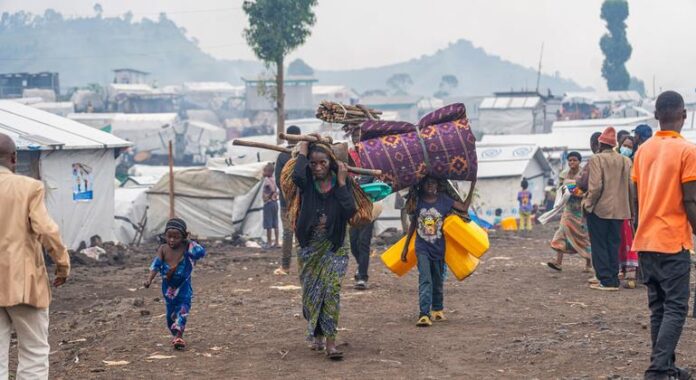
Since the beginning of the year, Rwanda-backed M23 fighters have swept across eastern DRC, taking key cities including Goma and Bukavu. The violence has displaced more than one million people in Ituri, North Kivu and South Kivu provinces.
Speaking from the village of Sake in North Kivu, UNDP Resident Representative Damien Mama described meeting a woman whose house had been destroyed after she fled the advancing fighters in January.
Cut off from livelihoods
“You know, with five children, you can imagine what this represents,” Mr. Mama said. “She was telling me that [her family] were given food and temporary shelter; but what she needs is to go back to her farm to continue farming, to continue her activities, and also have her home rebuilt.”
All those newly displaced by the M23 rebel advance are in addition to the five million people already living in displacement camps in eastern DRC.
Health workers have repeatedly warned that the crowded and unsanitary conditions provide ideal conditions for the spread of diseases including mpox, cholera and measles.
Given the scale of need it is urgent that small businesses get the help they need to get up and running again “providing income-generating activities for the women and the youth creating jobs”, the UNDP official insisted.
“The economy has suffered a lot,” he explained. “The banks have closed, businesses have been destroyed, and many are now operating under 30 per cent of their capacity, which is a major blow to their businesses.”
Support for women and girls
At the same time, the UN agency remains committed to helping the many women and girls impacted by alarming levels of sexual violence.
This echoes an alert issued last month by the UN Children’s Fund (UNICEF), that during the most intense phase of this year’s conflict, a child was raped every half an hour.
In the next five months, UNDP intends to support the creation of 1,000 jobs and restore basic infrastructure, benefiting about 15,000 people.
To do this, the UN agency will need $25 million.
“We have so far secured $14 million thanks to [South] Korea, Canada, UK as well as Sweden; and our call will be to encourage other countries and donors to provide us with [the] $11 million gap.”
The UN is participating alongside more than 150 countries and organizations during the World Rally, which carries the prospective theme: Design future society for our lives.
The United Nations pavilion is divided into four zones; A calendar in the first field explains the history of the UN and its agencies, while the second-the so-called Orb room-describes the range of diverse work of the organization through a series of everyday objects displayed on the walls.
An immersive video in the third field offers an overview of what a future world could look like if the development takes place in a sustainable way, while the fourth is a rotary exhibition which highlights specific agencies.
Here is what some visitors to the United Nations pavilion have thought of their experience.
Kaneko Sayaka (left) and his sister have exhibitions promoting the SDGs.
Kaneko Sayaka: I liked the video because I felt that I was in a forest surrounded by trees and animals. It showed me that environmental protection is very important.
Mikako Takeuchi: I was sucked in the immersive experience of the video presentation. He was really engaging and, although he explained the problems that the world faces, he also presented the solutions and gave hope.
Phil Malone (left) and his companion visit the United Nations pavilion.
Phil Malone: The message of immersive video on sustainability and rights and responsibilities of people towards the environment was clear and easily understandable by the young and older public.
It is difficult to explain the Sustainable development objectives (SDD) In a short video, although I think that Japanese public generally knows the goals. SDGs are highlighted by Japan institutions, and I have never seen this level of promotion in certain African countries where I worked for a development organization focused on agriculture.
SDGs are frequently promoted by the private sector in Japan, in this case in Tokyo. the capital.
Tomoyuki Kadokura: I learned a lot about the ODDs of the interactive quiz while I was lining up to enter the pavilion. In Japan, we focus more on the objectives that focus on the environment and sustainable consumption, so I wanted to know more about other objectives, for example poverty and human rights, which do not get much attention here.
I was also surprised by the number of United Nations agencies working on the SDGs.
Agaka Sato (left) and Takato Ishida explore the Orb room in the United Nations pavilion.
Takato Ishida: At school, we learn the SDGs, so many Japanese are interested in objectives, but I did not know that progress towards them was so slow in many regions of the world.
I appreciated the special projects section that highlighted the role UN volunteers Play around the world to support sustainable development.
Agaka Sato: I did not know that there were so many different United Nations agencies and I learned a lot about them thanks to the interactive display of objects in the Orb room.
The touch screen which explains the role of these agencies is linked to objects lining the wall of the room. I think it’s fun for young children to make the link between objects such as phones, firearms and health kits and UN work.
Masako Yukita: The United Nations pavilion made me think about the changes that people have to make to contribute to the SDGs and world peace. When I come home, I will think about what I can do more as an individual.
The President of the European Council, António Costa, will travel to Kananaskis, Alberta (Canada) to take part in the G7 summit from 15 to 17 June 2025. Hosted by Canada as the rotating G7 presidency, the Summit will bring together the leaders of the seven G7 countries, as well as the European Union and other invited countries to discuss pressing global issues, including international peace and security, the global economic outlook and energy security.
The Council has erased its initial schedule to fight against the rapidly evolving crisis, also hearing the chief of the international nuclear surveillance dog supported by unrofit, who warned against serious risks for regional stability and nuclear security.
Night from Thursday to Friday, Israeli military strikes targeted nuclear installations across Iranincluding the Natanz enrichment site. Media relationships indicate that Hossein Salami, the head of the body of the Islamic Revolutionary Guard (IRGC), as well as several eminent nuclear scientists, were one of the people killed.
Strikes have also caused significant damage, including dozens of civilian victims. The region’s airspace has been widely closed and the security forces are on a high alert.
Additional Israeli strikes were reported on Friday evening to local time on Friday evening as well as ballistic missile launches by Iran which would have struck parties of Israel, including Aviv.
Avoid conflagration at all costs: Dicarlo
Rosemary Dicarlo, under-secretary general of the United Nations for political affairs, told ambassadors that the repercussions of the attacks are already reflected.
“I reaffirm the Secretary general Condemnation of any military climbing in the Middle East“She said, urging both Israel and Iran to show maximum restraint and”Avoid at all costs a descent into a deeper and wider regional conflict».
She also noted that military climbing came at a time when “certain important diplomatic developments” took place, in particular the planned takeover of the American-Iranian talks to Oman this weekend. The latest reports indicate that Iran will no longer witness it.
Ms. Dicarlo urged the parties to suspend the diplomatic course.
“” A peaceful resolution through negotiations remains the best way to ensure the peaceful nature of the Iranian nuclear program“She said.
“We must at all costs avoid an increasing conflagration which would have enormous global consequences.”
The nuclear surveillance dog head urges the protection of atomic sites
Briefing of the Council, Rafael Grossi, Managing Director of the International Atomic Energy Agency (Aiea) said his agency was in constant contact with the Iranian nuclear regulatory authority to assess the state of affected installations and determine the larger impacts on nuclear safety and security.
Rafael Grossi (on the screen), managing director of the IAEA, briefs of the Security Council.
He stressed that nuclear sites should never be targeted – in no case.
“” Such attacks have serious implications for nuclear security, nuclear security and guarantees, as well as regional and international peace and security“Said Mr. Grossi.
He is ready to go to the region as soon as possible, he added, to assess the situation and support the efforts of security, security and non-proliferation in Iran.
“It is clear that the only lasting path to follow for Iran, for Israel, the whole region and the international community is one based on dialogue and diplomacy to ensure peace, stability and cooperation. “”
Mr. Grossi concluded by offering the IAEA as a neutral platform where “the facts prevail over rhetoric” and where technical commitment replaces climbing.
“I reaffirm my personal will and the agency to facilitate dialogue and support efforts that promote transparency, security and peaceful resolution of nuclear problems in Iran.”
Broadcast of the Security Council meeting.
Russia “strongly condemns” Israeli actions
Russian ambassador Vassily Nebenzia warned that Israel’s actions in the Middle East “push the region to a large-scale nuclear disaster”.
“This completely uninsured attack, regardless of what Israel says on the contrary, is a blatant violation of the Charter of the United Nations And international law, “he said, expressing the” strong condemnation “of Russia of strikes.
He accused the “Western members” of the 2015 Iranian nuclear agreement – officially known as Complete full action plan (JCPOA) – To contribute to the current crisis through their policies towards Iran and its nuclear program.
“They did everything to fuel climbing and essentially prompted it,” he told ambassadors.
Mr. Nebenzia concluded by exhorting renewed diplomatic efforts. “Once again, the settlement of problems related to the Iranian nuclear program is only possible if a peaceful, political and diplomatic journey is followed,” he said.
“Iran has the right to defend itself”: Pakistan
Pakistan Ambassador Asim Iftikhar Ahmad has told the Council that Israel’s “blatant provocations” constitute a serious threat to regional peace and stability.
“Iran has the right to defend itself under article 51 of the Charter of the United Nations,” he said, alleging that the actions of Israel in Gaza, Syria, Lebanon and Yemen “reflect a continuous model of unilateral militarism”.
“The fact that these attacks on Iran have occurred in the midst of a negotiation process aimed at finding a peaceful diplomatic solution to the Iranian nuclear issue makes it even more repugnant and against international standards,” he added.
Mr. Ahmad urged all parties to avoid additional escalation and to prioritize the dialogue. He also called the Security advice “Keep the attacker responsible for his actions. This council must refuse Israel the free hand and the impunity with which it continues to operate in defiance of international law and international opinion. “
Iran should not acquire nuclear weapons: United States
Speaking for the United States, McCoy Pitt, a senior State Department official, accused Iran of having launched “uninsured, direct and proxy attacks” against Israeli civilians and propagation of terrorism, instability and human suffering in the region.
“As President Trump said on several occasions, this dangerous regime cannot be authorized to have nuclear weapons,” he said.
Mr. Pitt noted that the United States had been informed of Israeli strikes in advance but was not militarily involved.
“Our absolute and most important priority is the protection of citizens, staff and American forces in the region,” he said.
He also declared that the United States would continue to seek a diplomatic resolution which guarantees that Iran never acquired a nuclear weapon or will be a threat to instability in the Middle East.
“Iran’s management will be wise to negotiate for the moment,” he said.
Iran calls for responsibility
The Iranian ambassador, Amir Saeid Iravani, told the Security Council that he was addressing the organization on behalf of his government and his people “with the greatest urgency and the serious alarm”.
“We condemn the barbaric and criminal attack strongly and unequivocally, a series of targeted assassinations against senior military officials, nuclear scientists and innocent civilians,” he said.
“These deliberate and systematic murders were not only illegal and inhuman, a frightening demonstration of calculated aggression. These atrocities constitute a clear act of state terrorism and the blatant violation of international law, “he added.
He said that Israel’s attacks on protected nuclear installations have challenged not only the fundamental principles of international law, but also “common conscience”, warning that damage to these sites could release catastrophic radiological consequences in the region and beyond.
“Only a regime devoid of humanity and responsibility would endanger millions of lives in the pursuit of its destructive ambitions,” said Iravani.
“Those who support this regime, with the United States at the forefront, must understand that they are accomplices. By helping and allowing these crimes, they share the full responsibility of the consequences. ”
Israel defends “the act of national preservation”
Israeli ambassador Danny Danon began his remarks by reminding members of the Security Council that – while they were talking – Iranian ballistic missiles struck Israeli cities and injured civilians.
He said that the strikes of Israel were preventive and carried out with “the most advanced precision, goal and intelligence”.
The mission, he added, was clear, “dismantling the nuclear program of Iran, eliminating the architects of its terror and its aggression and neutralizing the capacity of the regime to follow its repeated public promise to destroy the state of Israel”.
Mr. Danon accused Iran of taking measures towards the construction of a nuclear arsenal. He also criticized the international community for omitting to act and reinstate in Tehran.
“Israel did not act recklessly-we have waited,” he said.
“It was an act of national preservation. It was the one we undertook alone, not because we wanted it, but because we were not left. ”
The President of the European Council, António Costa, will travel to Kananaskis, Alberta (Canada) to take part in the G7 summit from 15 to 17 June 2025. Hosted by Canada as the rotating G7 presidency, the Summit will bring together the leaders of the seven G7 countries, as well as the European Union and other […]
A decade ago, the United Nations General Assembly adopted the rules of Nelson Mandela-a set of 122 directives establishing minimum standards for the treatment of prisoners, inspired by one of the most influential former political prisoners in the world-the South African Civil Rights icon, Nelson Mandela.
These rules aim to guarantee security, security and respect for human dignity, offering clear benchmarks for prison personnel.
Despite this, penitentiary systems around the world continue to face deeply rooted challenges. The General Assembly met on Friday to discuss the way of better protecting companies against crime by focusing on rehabilitation and preparing prisoners for life after prison.
Overcrowded cells
“Prison cells are overflowing,” said Ghada Waly, executive director of the United Nations Drugs and Crime (Unodc), noting that 11.5 million people are currently imprisoned worldwide.
“” Overcrowding deprives people of their most fundamental rights, including access to health care, drinking water and sanitation“She warned. However, the penitentiary services remain underfunded, sub-priorized and undervalued.
These systemic failures not only put detainees and staff, but also weaken efforts to reintegrate former prisoners – posing risks for the community in the broad sense, added President of the General Assembly Phillémon Yang.
Women behind bars
The number of women in prison has increased by 57% in the past 20 years, almost the rate of men.
Most systems are not equipped to meet their specific needs. “” It’s not sure. And it’s not human“Said Ms. Waly.
Women in detention are particularly vulnerable, faced with greater risks of sexual violence, limited access to reproductive health care and the separation of their children.
Time for daring reform
“” We need a daring vision-the one that goes beyond bricks and bars to focus on people and their potential“Said Ms. Waly, urging governments to reinvent how prisons are managed.
Managed in responsibility, prisons can support public security, justice and the rule of law. But today’s penitentiary environments are often dangerous and counterproductive.
UN officials stressed that rehabilitation should be at the heart of reforms, including support systems that reduce the probability of recurrence and help former prisoners to reintegrate into society.
“The real measure of justice is not the way we punish,” concluded Mr. Yang, “but how we protect, rehabilitate and build a better future for everyone, everywhere. »»