Monday, September 28, 2026
Home Blog Page 591

ESMA publishes data for quarterly bond liquidity assessment

0
ESMA publishes data for quarterly bond liquidity assessment

As indicated previously quarterly publication of systematic internalisers (SI) have been (see ESMA’s news item).

Bonds quarterly liquidity assessment 

ESMA has published the latest quarterly liquidity assessment for bonds available for trading on EU trading venues. For this period, there are currently 1,342 liquid bonds subject to MiFID II transparency requirements. 

ESMA’s liquidity assessment for bonds is based on a quarterly assessment of quantitative liquidity criteria, which includes the daily average trading activity (trades and notional amount) and the percentage of days traded per quarter. ESMA updates the bond market liquidity assessments quarterly. However, additional data and corrections submitted to ESMA may result in further updates within each quarter, published in ESMA’s Financial Instruments Transparency System (FITRS), which shall be applicable the day following publication.   

The full list of assessed bonds is now available through FITRS in the XML files with publication date from 31 January 2024 (see here) and through the Register web interface (see here).  

ESMA also publishes two completeness indicators related to bond liquidity data. 

The transparency requirements for bonds deemed liquid today will apply from 17 February 2025 to 18 May 2025. The application dates reflect the provisions of the RTS 2 (see ESMA news item for more details). 


Further information:

Cristina Bonillo

Senior Communications Officer
press@esma.europa.eu

Source link

UNRWA ‘continues to deliver’ as Israeli ban comes into effect

0
UNRWA ‘continues to deliver’ as Israeli ban comes into effect

“UNRWA continues to deliver assistance and services to the communities we serve,” the agency said in a post on the social media platform X.

“Our clinics across the occupied West Bank including East Jerusalem are open while the humanitarian operation in Gaza continues.”

No official word

Last October, the Israeli parliament, known as the Knesset, passed two laws that called for ending UNRWA’s operations in its territory and prohibiting Israeli authorities from having any contact with the agency.

Israel ordered UNRWA to vacate all premises in occupied East Jerusalem and cease operations in them by 30 January of this year.

In a separate post on X, UNRWA said it had not received any official communication on how the bills will be implemented.

Fears of impact

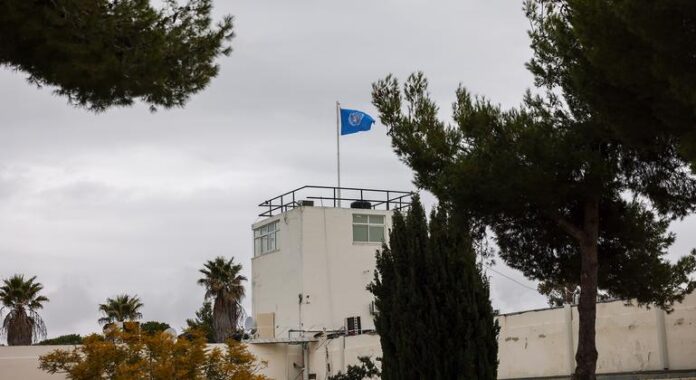
Speaking to The Guardian, UNRWA Communications Director Juliette Touma said its headquarters in East Jerusalem “is still there” and the flag is still flying.

“We don’t have plans to close our operations,” she said. “But we are in the dark.”

Since 1950, UNRWA has been assisting Palestine refugees in Jordan, Lebanon, Syria, Gaza and the West Bank, including East Jerusalem.

The ban threatens life-saving aid, education and healthcare for millions in the OPT, and the UN has repeatedly warned of the consequences.

Palestinians in Gaza are also worried, including Iman Hillis, who is currently staying in an UNRWA school with her family.

“We will have nothing to eat or drink, and this will affect us greatly,” she told UN News on Wednesday. “All the people will be destroyed and will not have food, water or flour.”

Source link

Dreams of returning home dashed by reality in Gaza City

0
Dreams of returning home dashed by reality in Gaza City

Tess Ingram, Communications Manager for UNICEF Middle East and North Africa, is in the northern city where she witnessed people moving through the streets on donkeys, in cars, or by bicycle.

“There’s a lot of people with shovels trying to remove rubble, and of course you can see people setting up makeshift shelters or tents on what I’m guessing used to be their homes,” she told UN News. 

Hope and heartache

Ms. Ingram believes that many people were filled with hope and joy as they were finally able to come back to the place they had hoped to return to for more than 15 months.

“But now, as I speak to people, I think that joy is being replaced somewhat by a sense of heaviness as they discover the reality of what has happened here in Gaza City,” she said.

“They were hoping to return to a home that is not there, or to a loved one who has been killed, and I think that that heaviness is really sinking in for people.”

Living conditions also remain very difficult. Ms. Ingram visited a school-turned-shelter which is housing returnees along with people who had been living there throughout the war.  

She met a mother and her five children who desperately need winter clothes and food, but mostly a place to stay because the home where they had hoped to return is gone.

This story is not uncommon. “It is not one person. It is not 100. There are probably thousands of people who are in a similar situation,” she said.

Danger on the way

Ms. Ingram noted that families are making long, treacherous journeys to get back to Gaza City.

On Wednesday she travelled from Al Mawasi, located in the central Gaza Strip, which took 13 hours. However, some families took as long as 36 hours to make the trip.

“And of course the journey itself over those 36 hours is incredibly dangerous,” she said.

“We’ve heard reports of people being killed by unexploded remnants of war on the way, because these very dangerous unexploded ordnance are buried underneath the rubble.”

Support for returnees

UNICEF is supporting returning families with the basics that they need to survive.  The agency is bringing in nutrition supplies, medical supplies, fuel to run bakeries and hospitals, and water pumps so that people have access to clean water.

On Wednesday, UNICEF and other UN agencies brought in 16 trucks of fuel that will be provided to water wells, hospitals and bakeries to get essential services back up and running again.

They are also providing services for mental health and psychosocial support for children to help them deal with the trauma they have experienced over the past 15 months. Nutritional screening and immunization services are forthcoming. 

Keeping families together

Hundreds of children have also reportedly been separated from their families while making the journey to the north, and UNICEF is responding to the situation. 

Staff have been providing children under the age of four with identification bracelets that have their names, their families’ names and phone numbers, on them.

“So, if in the worst case they did get lost in the wash of people there would be some hope of reconnecting them soon with their loved ones,” Ms. Ingram said.

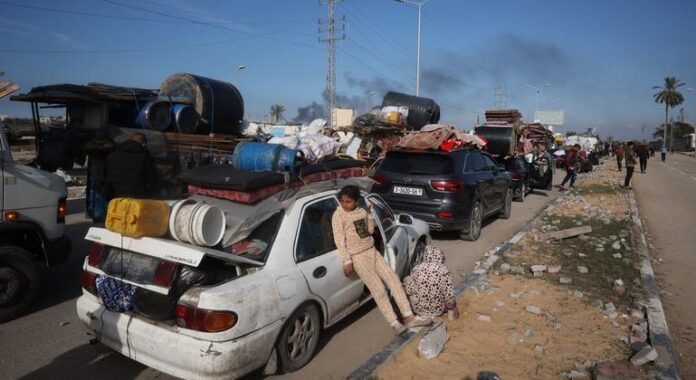
Displaced Palestinians walk along a street in Rafah, in the southern Gaza Strip.

People on the move

Humanitarians report that more displaced families are returning to northern Gaza as the ceasefire continues to hold. 

More than 462,000 people have crossed from the south since the opening of the Salah ad Din and Al Rashid roads on Monday.

The UN and partners are providing water, high-energy biscuits and medical care along the two routes, while the World Food Programme (WFP) plans to set up more distribution points in the north this week.   

Displaced Palestinians are also moving from north to south, though in smaller numbers, with about 1,400 people making the journey as of Thursday. 

Restoring critical services

Across Gaza, extensive efforts are underway to restore critical services, including civilian infrastructure, which the UN and partners are supporting.

WFP has delivered more than 10,000 metric tonnes of food to the enclave since the ceasefire took effect.

On Thursday, 750 trucks entered Gaza, according to information obtained by the UN on the ground through interactions with the Israeli authorities and the guarantors for the ceasefire deal.

The previous day, UNICEF distributed 135 cubic metres of water to communities in Jabalya, Beit Lahiya and Beit Hanoun, located in North Gaza governorate.  These areas had been besieged for over three months.  

Furthermore, 35,000 litres of fuel were delivered to northern Gaza to sustain the operations of water, sanitation and hygiene facilities, while water trucking in Rafah is being scaled up.

Humanitarian partners are also coordinating with the Gaza Electricity Distribution Company to repair the damaged power line that feeds the South Gaza desalination plant, which is currently running on fuel.

West Bank violence continues

Meanwhile, in the West Bank, Israeli military operations in northern areas have expanded beyond Jenin and Tulkarm to the nearby governorate of Tubas. 

Ten people reportedly were killed on Wednesday when an Israeli air strike hit a group of Palestinians in Tammun, a village in Tubas governorate. 

This brings the death toll from the ongoing Israeli operation in the northern West Bank to 30, including two children.   

Overall, more than 3,200 families have been displaced from Jenin refugee camp in the context of Palestinian Authority and Israeli operations since December, according to local authorities. 

Humanitarian partners continue to deliver aid, including food parcels, kitchen kits, baby supplies, hygiene items, medicines, and other essential supplies.  

Source link

DR Congo: Hospitals overwhelmed, food running out: Goma faces ‘devastation’

0
DR Congo: Hospitals overwhelmed, food running out: Goma faces ‘devastation’

The World Food Programme (WFP) warned on Thursday that food supplies are running dangerously low, as water and electricity outages exacerbate the crisis.

The seizure and closure of Goma’s airport by Rwanda-backed M23 rebels has further interfered with aid delivery, while the blocking of roads and lake transport restrictions have left thousands stranded.

The rebel group has taken control of most of Goma since entering the city on Monday in the biggest escalation of a decades-long conflict springing from the Rwandan genocide against the Tutsis, and a continuing struggle for control of rich mineral resources in the region among a plethora of armed groups.

Fleeing by boat

Families attempting to flee the violence across Lake Kivu are resorting to unsafe makeshift boats, putting their lives at risk.

At the same time, the UN aid coordination office, OCHA, reports that humanitarian workers have been unable to leave their shelters in Goma for over 24 hours due to the insecurity, severely affecting emergency response efforts.

Tom Fletcher, the emergency relief chief, has allocated $17 million from the UN’s Central Emergency Relief Fund (CERF) to support lifesaving assistance – yet access to those in need remains uncertain.   

Hospitals overwhelmed

Medical facilities in Goma – and second city Bukavu to the south – are overwhelmed, with over 2,000 injuries reported since the beginning of January, including many from gunshot wounds. Hospitals lack adequate medical supplies, fuel and staff to manage the growing influx of patients.

The World Health Organization (WHO), International Committee of the Red Cross (ICRC), and Médecins Sans Frontières (MSF) are urgently working to bolster healthcare services, but with supply chains disrupted and facilities at capacity, response efforts are severely strained.

Additionally, health authorities warn of an increasing risk of disease outbreaks, including cholera, measles and mpox, due to mass displacement, unsafe water sources and inadequate sanitation.

Escalating insecurity in North Kivu

In the village of Kiziba, on the outskirts of Goma, civilians are reporting armed men in military uniforms carrying out widespread looting, extortion and sexual violence, according to Radio Okapi, the station run by UN peacekeeping mission in DRC, MONUSCO.

Meanwhile, Stéphane Dujarric, the Secretary-General Spokesperson reported that other armed groups in the east, including Zaïre and the CODECO militias, have increased attacks against the population in Djugu territory in the past month, robbing civilians.

At least six people have been killed since last weekend and as a result, many have stopped using roads in the area, which also prevents them from going to their fields or to markets.

Reports indicate that some roads have reopened, but mass displacement continues, with at least 700,000 people now internally displaced within North Kivu and South Kivu.

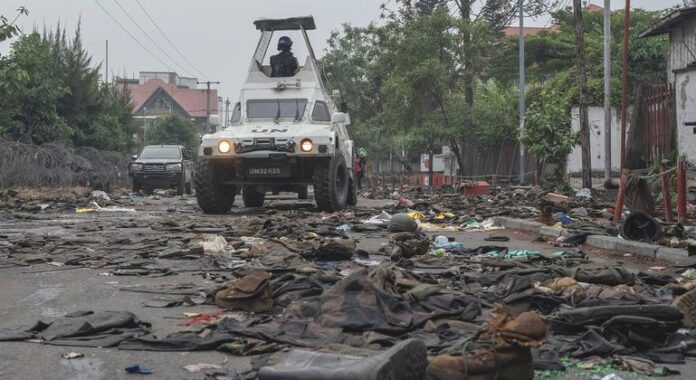
Military uniforms and personal possessions litter the streets of Goma in the eastern DR Congo following an attack by a rebel armed group.

Peacekeepers’ response

Peacekeepers with (MONUSCO) have launched the second phase of an operation called Horizon of Peace in Djugu territory, aiming to contain an escalation of violence by armed groups, according to Mr. Dujarric.

MONUSCO peacekeepers have stepped up patrols on several roads in the territory to support the free movement of people and goods.

Calls for international action 

Bruno Lemarquis, the UN’s Humanitarian Coordinator for DR Congo, has issued a strong plea for immediate international support. “I call on the international community to step up its support in the face of a worsening humanitarian crisis,” he stated.

Emergency food agency WFP has reiterated its readiness to resume food distributions as soon as security conditions permit, but without immediate access, thousands remain at risk of starvation and disease.

UN peacekeepers return to base after patrolling the streets of Goma.

UN peacekeepers return to base after patrolling the streets of Goma.

Source link

World News in Brief: Deadly virus outbreak in Uganda, $500 million human rights appeal, Thailand’s lèse-majesté laws in spotlight

0
World News in Brief: Deadly virus outbreak in Uganda, 0 million human rights appeal, Thailand’s lèse-majesté laws in spotlight

Health authorities in Kampala confirmed that one patient has died – a nurse who had sought treatment at various other medical facilities after developing fever-like symptoms.

In response to the outbreak of the often deadly and infectious haemorrhagic fever which is transmitted through contact with bodily fluids and tissue, WHO is mobilising efforts to support national health authorities in swiftly containing and ending the outbreak.

Senior public health experts and staff from WHO’s country office are being deployed to support key outbreak response measures.

Additionally, WHO has allocated $1 million from its Contingency Fund for Emergencies to accelerate early action. Medical supplies, including personal protective equipment, are being readied for delivery from WHO’s Emergency Response Hub in Nairobi.

Race to develop a vaccine

Although there are no licensed vaccines for Sudan virus disease, WHO is coordinating with developers to deploy candidate vaccines once all necessary approvals are obtained.

Regarding the deceased man, no other health workers or patients have shown symptoms, said WHO.

A total of 45 contacts, including health workers and family members are under close monitoring. The identification of the case in a densely populated urban area necessitates a rapid and intense response, the agency stressed.

Dr Matshidiso Moeti, WHO Regional Director for Africa, welcomed the prompt outbreak declaration saying the agency was supporting the Government and partners “to scale up measures to quickly identify cases, isolate and provide care, curb the spread of the virus, and protect the population.

“Uganda’s robust expertise in responding to public health emergencies will be crucial in ending this outbreak effectively.”

There have been eight previous outbreaks of Sudan Ebola Virus Disease, with five in Uganda and three in Sudan. Uganda last reported an outbreak in 2022.

UN rights chief launches $500 million global appeal

The UN human rights chief on Thursday launched a $500 million funding appeal for 2025 to address a multitude of crises threatening to reverse decades of progress.

The appeal aims to support critical human rights efforts, including rights mainstreaming, advisory services and technical cooperation, alongside field offices of the UN human rights office, OHCHR.

It will also boost special trust funds, such as those supporting victims of torture, Indigenous Peoples, or those impacted by slavery.

Launching the appeal in Geneva, UN rights chief Volker Türk, reiterated the importance of these efforts: “During conflicts and in peacetime; in developing countries and advanced economies; from historic grievances to emerging risks – my Office is holding the line for humanity.

Low cost, high impact

“Human rights are a low-cost, high-impact investment to mobilize people for peace, security, and sustainable development; and to build social cohesion based on the contributions of every individual,” he added.

The appeal is in addition to the OHCHR’s regular budget of $238.5 million as part of UN’s overall budget that was approved in late December 2024. That amount is not sufficient to cover all of its mandated work and the requests for assistance it receives.

Mr. Türk underscored the need to ensure OHCHR has sufficient resources to carry out its vital work.

“I am very concerned that if we do not reach our funding targets in 2025, people who should otherwise be free, may remain in prison,” he said.

“Women and girls may lose out on opportunities, ignored by the world. Violations and abuses may go undocumented, leading to a lack of accountability and increased impunity. And human rights defenders may lose the little protection they have,” he warned.

Independent rights experts urge Thailand to end lèse-majesté prosecutions

A group of independent UN human rights experts condemned Thailand’s continued use of lèse-majesté laws to imprison activists and human rights defenders, calling for the repeal or significant revision of the country’s criminal code.

In a news release on Thursday, the experts – who are mandated and appointed by the Geneva-based Human Rights Council – warned that Article 112 of Thailand’s Criminal Code, which punishes criticism of the monarchy with up to 15 years in prison, violates international human rights standards.

Free speech rules

“Under international law, individuals have the right to criticise public officials, including a King, and to advocate peacefully for the reform of any public institution, including the monarchy,” the experts said.

They described the law as “harsh and vague”, highlighting that it grants excessive discretion to authorities and courts, leading to widespread misuse.

Since 2020, more than 270 people have been prosecuted under Article 112, many receiving lengthy consecutive sentences.

“Lèse-majesté laws have no place in a democratic country,” the experts said, warning that their use stifles political expression and silences activists, journalists, and opposition members.

They urged the Thai Government to amend the country’s criminal code to align with international human rights laws and called for an immediate moratorium on prosecutions and imprisonments under lèse-majesté laws.

Source link

EU invests €1.2 billion in cross-border energy infrastructure

0
EU invests €1.2 billion in cross-border energy infrastructure

To help achieve the EU’s goals of integrating energy markets and decarbonising the energy system, the EU is allocating more than €1 billion in grants to 41 cross-border energy infrastructure projects. The projects will help develop hydrogen and offshore electricity grids in the EU.

Source link

EU next generation defence technologies get €1 billion in funding

0
EU invests €1.2 billion in cross-border energy infrastructure

More than €1 billion has been allocated by the European Defence Fund for the development of critical defence technologies and capabilities. Around €100 million each is set aside for critical fields such as ground combat, space, air and naval combat, energy resilience and environmental transition.

Source link

Thousands of fake medicines seized by EU-supported criminal investigation

0
Thousands of fake medicines seized by EU-supported criminal investigation

Europol investigated some 52 organised crime groups as part of a global effort to crack down on the trafficking of fake medicines and illicit doping substances. More than €11 million’s worth of fake medicines were taken off the markets, as a result of the investigation.

Source link

EIB Group invested €314 million in Hungary last year

0
EIB Group invested €314 million in Hungary last year

©Caroline Martin/ EIB
  • EIB Group financing in Hungary totalled €314 million last year, with major investments to improve rail services, deliver power for local manufacturers and support small and medium enterprises
  • Latest annual figures bring total EIB Group investments in Hungary to more than €25 billion since 1991

The European Investment Bank (EIB) Group’s new financing in Hungary last year amounted to €314 million, supporting projects to improve rail services, meet electricity demands from major local manufacturers and support small and medium enterprises (SME).  This includes financing from both members of the EIB Group – the EIB and the European Investment Fund (EIF).

“Our 2024 results are good news for Hungary and the EU,” said EIB Vice-President Teresa Czerwinska. “They are a testament to our ability to support national and EU priorities and ensure our citizens and businesses can thrive, contribute towards a globally competitive, sustainable and green future and ensure equal opportunities and a higher quality of living.  With more than €25 billion invested in the country since 1991, the EIB Group has established itself as one of the most reliable sources of financial and advisory support for Hungary. We are ready to pursue this role in the years ahead.”

Modern rail and power networks

The biggest operation in Hungary to receive EIB Group funding last year was a €160 million EIB loan to regional railway operator GYSEV to improve network infrastructure and replace old diesel-powered trains with new electric ones. The loan will significantly improve the reliability of train connections between Hungary and Austria. The credit will also accelerate modernisation of the national rail network – a development priority for Hungary. In addition, the financing will boost economic activities in cohesion regions in western Hungary, reduce travel times and increase comfort for hundreds of thousands of rail commuters annually and cut air pollution.

The EIB Group also provided a €90 million EIB financing to Hungary to support investments undertaken by the energy companies E.ON and MAVIR to expand power grids to meet the electricity needs of key industrial sites, including ones that will boost the European Union’s ability to produce electric vehicles strengthening the EU’s strategic autonomy in this area. The investment boosts economic activity in cohesion regions in Hungary.

Some €64 million in EIB Group financing supported Hungarian small and medium-sized enterprises and Mid-Caps, the backbone of the national economy and a major source of employment for Hungarians.

EIB Group Results

For more details on EIB group results please visit EIB Group press conference on annual results

Source link

Scientology Celebrates 50 Years in the capital of Europe and 15 Years on Boulevard de Waterloo

0
Scientology Celebrates 50 Years in the capital of Europe and 15 Years on Boulevard de Waterloo
KINGNEWSWIRE // Representatives from other religious traditions and civil society organizations joined the Scientology community in marking these anniversaries.

With a look at the past challenges and achievements, they also looked to the future and potential of collaboration and community projects. Among the attendees there were also Ambassadors and personnel of the European institutions.

DSC 7451 scaled Scientology Celebrates 50 Years in the capital of Europe and 15 Years on Boulevard de Waterloo
Scientology Celebrates 50 Years in the capital of Europe and 15 Years on Boulevard de Waterloo 7

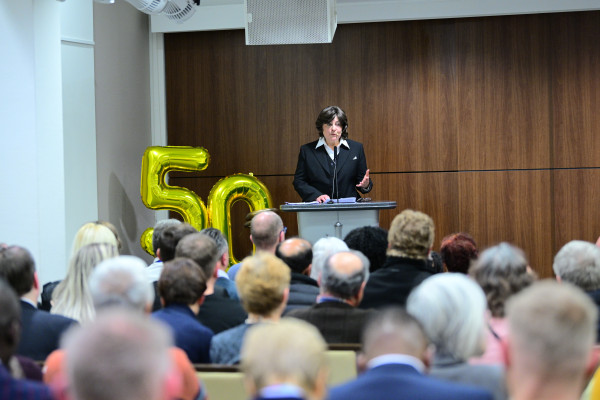
Scientologists from Belgium and from abroad celebrated two anniversaries on January 23, 2025: 50 years of the Church of Scientology in Belgium and 15 years of the organization’s headquarters on the Boulevard de Waterloo in Brussels.

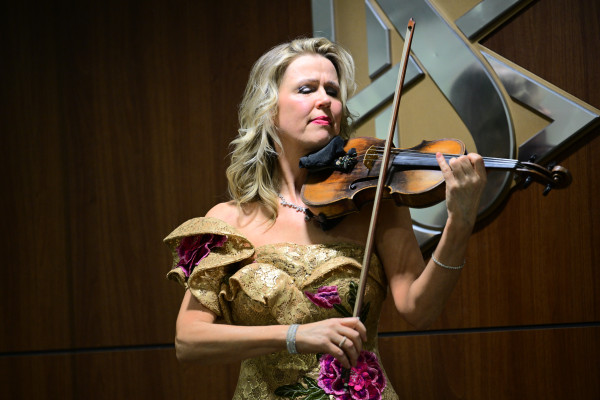
The night started with a light and healthy dinner. Right after, the master of ceremonies Ivan Arjona-Pelado, Scientology’s representative to the European institutions and the United Nations, introduced violinist Ilona Raasch for a live musical performance, played through classical violin pieces that set an intimate and warm atmosphere for the evening. 

Scientology Celebrates 50 Years in the capital of Europe and 15 Years on Boulevard de Waterloo
Musician Ilona Raasch

The impact of Scientology’s journey in Belgium was reflected on by attendees, including prominent figures from religious and civil society groups.

Tracing Five Decades of Religious Commitment

Arjona-Pelado, European representative since 2017, took the audience through the history of Scientology in Belgium. It originated in the 1950s and 1960s when believers of the faith found the teachings of L. Ron Hubbard abroad and began to share them in small home groups in Belgium. The initial establishment of the first official Scientology mission at the end of 1974 provided the foundation for a rapidly reinforced religious community and structured religious activities and public engagement, who attended lectures, workshops and seminars, often improvised by the veteran yet new members.

During the 1980s and 1990s, Scientology continued to grow internationally, and Belgium was an important country in its European growth. In 1980 incorporated the Church of Scientology of Belgium, and the establishment of the first European Scientology human rights office in Brussels took place in 1990-1991 marking a significant step on the role of the Church to promote and ensure human rights for everyone in alignment with European and International covenants. Thus, Brussels was not only the political capital of Europe but also the moral and ethical capital, where Scientology further increased its dialogue with other religions and social organizations. This period saw the church’s growing role in social outreach programmes, going beyond the provision of religious services to include advocacy and education.

Challenges and A Long Legal Battle that ended in Victory

However, all this was not without distractions for Scientology, as there were certain attacks in Belgium. In 1997, a Belgian parliamentary report classified 189 religious groups in a black-list which led to the public stigma and an increase of discrimination. In 1999 brought about a police raid, in which 120 officers entered the Church of Scientology, while Scientologists were hosting a religious freedom marathon through the city. The unjustified raids led to an 18-year-long legal battle, disrupting the lives of Scientologists and relatives. However, “with a strong belief that the truth will always prevail” as Arjona explained during his presentation, the Scientologists continued with their social activities such as the war on drugs and human rights education. 

It was only in 2016 when the major milestone was reached in Brussels, when the court acquitted the church and Scientologists of all suspicions and attacks in a 173-page verdict, which pointed out serious violations of the defense’s rights and the presumption of guilt based only on “religious prejudice of a prosecutor and some policemen who had taken the power of the state to carry out their personal witch hunt” states Arjona. This verdict was not only a victory for Scientology but also for religious freedom in Belgium. It also reinforced the position that religious minorities should not be subjected to unjustified discrimination, and therefore paved the way for the church’s vindication of religious freedom victory in the Belgium society.

The European Headquarters in Brussels

Another significant progress in this journey was the establishment of the new church called “Churches of Scientology for the European Communities” on the Boulevard de Waterloo 15 years ago, which was gifted by the International Association of Scientologists. The facility, which surpasses 8,000 square meters, is used for religious services, study, seminars and interfaith events. “Our Chapel has seen ceremonies and lectures held by Catholics, Protestants, Orthodox, Hindus, Jewish, Sikhs, Freemasons and others,” says Ivan Arjona, “as a true religion of religions”. The building is an architectural marvel and at the same time a warm welcome for all Scientologists and indeed visitors of all faiths and none. Arjona further reminded, during the celebration of the 50th Anniversary, that the building is an open and welcoming place for all religious and community groups to come together. It is an interreligious meeting place, and it hosts conferences and discussions with the aim of establishing good relations “that help to work together for a world in peace,” explained Arjona.

Besides the religious functions, the headquarters has also a role to play in humanitarian and educational work. Many events and actions of drug prevention, improving literacy and promoting human rights are coordinated from this central hub, thus showing the social responsibility of Scientology and its many friends. The facility, “one of the most beautiful buildings in Brussels” says Arjona, has been a venue for many workshops, meetings, and community activities that reinforce its position as a positive contributor in Brussels.

1738232263679b51c77b7ea1738232263679b51c77b7eb Scientology Celebrates 50 Years in the capital of Europe and 15 Years on Boulevard de Waterloo
Myriam Zonnekeyn, Public Affairs Director for Scientology in Belgium

Social Initiatives and Educational Campaigns

The event also featured some of the social campaigns of Scientology. Its drug prevention campaign channelled through “Foundation for a Drug Free World” is aimed at young people and is designed to ensure that they have clear information about substances and their effects to make informed decisions. The organization’s human rights education program “United for Human Rights” is based on the 1948 Universal Declaration of Human Rights, and the group works to ensure that these rights are actualized in people’s lives and not just theoretical concepts. Also, there is The Way to Happiness, a non-religious moral code written by L. Ron Hubbard and which deals with universal values like honesty and respect. These materials are provided free of charge to schools, municipalities and community groups to reach the general population.

In addition, the programs of Scientology have tangible results; thousands of educational booklets of are annually distributed, and many workshops are held for students and professionals. Thus, the church combines advocacy with practical tools to guarantee that its social initiatives result in positive change and better ethical and social behaviour of the community.

Acknowledging the Efforts of Volunteers and Civil Society

A particular part of the evening was the appreciation of the volunteers and the staff who make the church and its programs possible. Several people were called forward and applauded for their great contribution. Their contribution was recognized as an important determinant of the church’s progress in the recent past. The dedication and resilience of these volunteers have enabled Scientology to remain strong in Belgium, and have shown that individuals can make a big difference in the improvement of the community. Arjona also recognized some of those Civil Society activists that have been working alongside the Church, be it on human rights, drug prevention, promoting culture and peace and as well as helping the needy in the streets.

1738232029679b50ddbf35c1738232029679b50ddbf35e Scientology Celebrates 50 Years in the capital of Europe and 15 Years on Boulevard de Waterloo
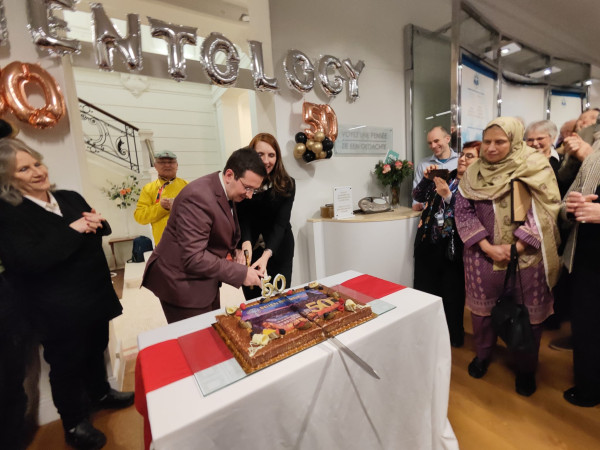
Ivan Arjona-Pelado with Executive Director of the Churches of Scientology for the European Communities in Boulevard de Waterloo, cutting the Birthday cake.

The 50th anniversary of Scientology in Belgium was not just the celebration of the past, it was a proclamation of the future. To finalize the event, the public was taken through the church’s informational exhibition to see the various outreach programs and materials that the church has, and were invited to champagne and a birthday cake cut with a replica of the Excalibur sword.