Friday, April 24, 2026
Home Blog Page 309

Gaza: More deaths reported as starvation spreads

0
Gaza: More deaths reported as starvation spreads

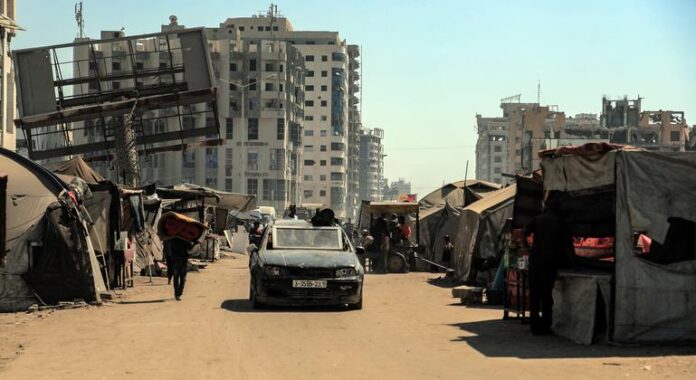
In an update on Friday, OCHA said that the starvation crisis is deepening across the enclave, with the local health authorities announcing that two more people had died from starvation the previous day.

Hunger and malnutrition increase the risk of illnesses that weaken the immune system, particularly among women, children, older people and persons with disabilities or chronic diseases, with deadly consequences. 

Food scarcity also impacts pregnant and breastfeeding women, increasing the risk of their babies being born with health complications and affecting mothers’ ability to breastfeed. 

Aid constrictions

The small trickle of supplies making it into the Strip is nowhere near adequate to address the immense needs as Israeli authorities continue to impose constraints on humanitarians and hamper their response. 

Out of 15 attempts to coordinate humanitarian movements inside Gaza on Thursday, four were outright denied, three were impeded, one was postponed and two others had to be cancelled by the organisers, with only five missions facilitated.

Even though the limited amount of fuel received yesterday was fully allocated to community kitchens, healthcare and water and sanitation facilities, the fuel shortage continues as the quantities entering Gaza remain insufficient to maintain essential facilities.

UN preparations

Despite severe constraints, UN teams are prepared to ramp up aid delivery and address these severe needs as soon as they are allowed to do so. 

For the UN to accelerate the delivery of food aid, health services, clean water and waste management, nutrition supplies and shelter materials, Israel must open its crossings, allow fuel and equipment in and permit humanitarian staff to operate safely.

The Under-Secretary-General for Humanitarian Affairs, Tom Fletcher, said in a social media post on Thursday that “we must save as many lives as we can – and we have a plan.” 

The plan he shared with Member States outlines the necessary steps to stop the horror and alleviate constraints on humanitarian operations. 

Mr. Fletcher has also written to the head of the Gaza Humanitarian Foundation (GHF), the aid distribution model backed by Israel and the United States, reiterating that the UN is ready to engage with any partner to provide desperately needed humanitarian aid to Gaza.

He stressed that any such partnership must adhere to the globally accepted principles of humanity, impartiality neutrality and independence, with aid going where needs are greatest and without discrimination and that humanitarians answer to civilians in need, not the warring parties. 

Mr. Fletcher also said that he welcomes dialogue on how to reach as many people as possible to alleviate suffering without causing harm. 

Source link

Niger: Déclaration de la Haute Représentante au nom de l’Union européenne

0
Niger: Déclaration de la Haute Représentante au nom de l’Union européenne

L’UE a publié une déclaration dans laquelle elle salue la libération de plusieurs prisonniers politiques au Niger, mais regrette la détention de Mohammed Bazoum et d’autres personnalités ainsi que de représentants de la société civile.

Source link

Statement by the High Representative on behalf of the EU on the alignment of certain countries concerning restrictive measures against serious human rights violations and abuses

0
Statement by the High Representative on behalf of the EU on the alignment of certain countries concerning restrictive measures against serious human rights violations and abuses

Statement by the High Representative on behalf of the European Union on the alignment of certain third countries with Council Decision (CFSP) 2025/1397 of 15 July 2025 amending Decision (CFSP) 2020/1999 concerning restrictive measures against serious human rights violations and abuses. Source link

Source link

Syria: Deadly sectarian violence displaces thousands in Sweida; healthcare attacked

0
Syria: Deadly sectarian violence displaces thousands in Sweida; healthcare attacked

Since 13 July, around 176,000 people have been displaced from Sweida,  according to the UN Office for the Coordination of Humanitarian Affairs (OCHA).

Mostly migrating to neighbouring Dar’a and Rural Damascus governorates, civilians are fleeing violent clashes between Bedouin tribal fighters, Syrian caretaker government forces and Druze militias.

Meanwhile in the north of the country, local authorities reported that a large explosion struck an ammunition depot in Ma’arrat Tasmarin, in Idleb Governorate, on Thursday, reportedly killing six people and injuring at least 140 others.

Although Syrian Civil Defense teams attempted to evacuate people and transfer the injured for medical care, secondary explosions in the vicinity significantly hindered emergency response efforts.

Attacks on healthcare

In Sweida, health facilities are under immense strain, with staff operating in extremely difficult conditions, while access to healthcare remains a challenge.

As WHO confirmed five attacks on healthcare, including the killing of at least two doctors, the organization also reported on the obstructions to and targeting of ambulances as well as the temporary occupation of hospitals.

“We know healthcare must never be a target. In fact, health facilities, patients and health workers must be actively protected,” said Dr. Christina Bethke, WHO acting representative in Syria, speaking from Damascus to journalists at the UN in Geneva on Friday.

Dr. Bethke said that Sweida’s hospitals are facing shortages of staff, electricity, water, and basic supplies, with the morgue at the city’s main hospital reaching capacity earlier this week.

“Ensuring that doctors, nurses and supplies can reach people safely is not just vital for saving lives, it is a responsibility under international law that all sides must uphold,” Dr. Bethke said.

Limited access

As different groups control different pathways, poor security conditions are restricting access to Sweida, limiting the ability of the UN and partners to deliver aid to those affected by the violence.

While access to the city remains limited, WHO has been able to deliver vital supplies to health facilities in Dar’a and Damascus governorates, including trauma supplies, essential medicine and hospital support.

In response to rising violence both in Sweida and in the north, UN humanitarian coordinator in Syria Adam Abdelmoula  launched an extension of the 2025 humanitarian appeal, which is currently less than 12 per cent funded. 

Source link

Statement by the High Representative on behalf of the EU on the alignment of certain countries concerning restrictive measures in view of the situation in Haiti

0
Niger: Déclaration de la Haute Représentante au nom de l’Union européenne

Statement by the High Representative on behalf of the European Union on the alignment of certain third countries with Council Decision (CFSP) 2025/1429 of 15 July 2025 amending Decision (CFSP) 2022/2319 concerning restrictive measures in view of the situation in Haiti.

Source link

Statement by the High Representative on behalf of the EU on the alignment of certain countries concerning restrictive measures in view of the situation in Haiti

0
Statement by the High Representative on behalf of the EU on the alignment of certain countries concerning restrictive measures against serious human rights violations and abuses

DISCLAIMER: Information and opinions reproduced in the articles are the ones of those stating them and it is their own responsibility. Publication in The European Times does not automatically means endorsement of the view, but the right to express it.

DISCLAIMER TRANSLATIONS: All articles in this site are published in English. The translated versions are done through an automated process known as neural translations. If in doubt, always refer to the original article. Thank you for understanding.

Source link

Interview with Delo

0
Interview with Delo

Interview with Piero Cipollone, conducted by Miha Jenko on 10 July 2025

26 July 2025

Mr Cipollone, the ECB is actively exploring the digital euro, the project was launched in July 2021. What are your arguments in favour of the introduction of a digital currency? Is it just a must, something that is necessary in the era of fast-paced digitalisation and of many alternative payment systems and cryptocurrencies, including stablecoins?

We definitely think that it’s a must, because we need to solve a fundamental problem.

Central banks do one fundamental thing: they offer a means of payment to the public. Both for retail, day-to-day transactions, and for the wholesale transactions of banks. At the retail level, we provide cash and we will continue to do so. With cash you can pay throughout the euro area in almost every shop. Paying with cash is one of the fundamental freedoms people have.

However, cash can not be used for a growing part of our day-to-day transactions: we all shop online, but to do that we cannot use cash. And Europeans increasingly prefer to use digital rather than physical means of payments. Today, there is no equivalent of cash for these transactions and we still do not have a European solution to pay digitally throughout the euro area for all our needs and occasions. As a result, we depend on non-European private payment service providers to perform such a basic activity in our life as paying.

By issuing a digital euro that has exactly the same functions as cash but is digital, we would allow central banks to provide a means of payment to the public to enable them to pay in those cases where physical cash cannot be used. Essentially, we are preserving people’s freedom to pay with public money: cash would be made available in both physical and digital form. And because the digital euro would be legal tender like banknotes and coins, it would be accepted for any digital payments.

What is the current situation on the way to the digital euro? How do you see the progress made and are you satisfied with the preparations so far?

There are two dimensions here.

The first dimension relates to the technical preparations for the digital euro, which is the responsibility of the ECB and euro area central banks. We are progressing on all technical aspects of the project and we are on schedule.

The second dimension is the legislative process, which will define the digital euro’s regulatory framework. On this side, progress has also been made but the legislation still needs to be finalised. We hope the legislative process can be completed as soon as possible so that we can reflect the choices of the legislators in the development of the digital euro. At the same time we understand that this is a complex project. Both the European Parliament and the Council of the EU – which brings together the ministers from each country – need to fully understand and take ownership of this process.

In short, while we hope that things move faster on the legislative side, we are making good progress on the technical side.

Do you feel political support from the European legislators? What is the mood among the politicians?

At the summit in March, European leaders clearly stated that “accelerating progress on a digital euro is key,” notably to support a competitive and resilient European payment system and contribute to Europe’s economic security. Some details have yet to be agreed upon and we are dealing with them. But we have the highest possible support, and the Heads of State have told us that we need to go ahead with this. For us this is very strong encouragement to continue.

But what about the people? Europeans eventually expect that the digital euro will provide the highest standards of quality, security, privacy and usability in payment systems. How is all that achievable in the near future?

This is what we have been working on since we started the digital euro project in 2021. It is a complex project but we have very capable people both at the ECB and at national central banks. We have been identifying the best technical solutions to ensure the greatest degree of simplicity, speed, security and privacy.

Let me take the example of privacy. The digital euro will provide the highest level of protection.

First, people will have the possibility to use the digital euro offline, something that so far no digital payment solution offers. In terms of privacy, this will be as good as cash. Only the payer and the recipient will know about the transaction, and no one else.

Second, when it comes to privacy for the online use of the digital euro, we at the central bank will only see a code for the payer and the payee. By law, we will not be able to identify the participants to the transaction.

Let me give you another example. We are working on the technical side to provide the very best user experience and we are designing the system so that it is ready for innovation.

In particular, we are giving banks and payment service providers the possibility to leverage on the digital euro’s technical platform to develop new services that are not yet available today. For instance, we are exploring conditional payments. As of today, users can only link a payment to time: “Pay this person at this point in time.” But users could decide to make a payment conditional on other events, and this would improve people’s lives.

Here is an illustration. We are experimenting across Europe, conducting tests with users, start-ups, universities, banks. One of the proposed projects involves buying tickets for trains or planes – currently, if you want to get reimbursed in case of delays, you have to go through a lot of hassle. With the digital euro, it would be possible for the payment to be made only if, say, the train arrives on time. This means that the payment is made only if the service is provided in full.

On the other hand, we know that many Europeans still love cash. For example, in May this year, the Slovenian Parliament even initiated official proceedings to introduce the right to use cash into our constitution. What is your message to the people who are sceptical about using any form of digital money?

My answer is simple: you will continue to be able to use physical cash. Cash will always be available and everyone will be able to use it. As I said, we are committed to providing cash to society. And we strongly support the legislative proposal by the European Commission to strengthen the mandatory acceptance of cash.

Moreover, we are designing a digital euro to be a digital form of cash: simple, free, inclusive, protecting privacy and accepted throughout the euro area. In any case, it will only provide an additional option: we will not force anyone to use it. We are guided by one objective: protecting people’s freedom to decide how to pay.

What about the very young people, the new generations, who frequently use mobile devices? Will you prepare any solution for them?

We are testing and analysing user solutions and organising focus groups to see people’s preferences. We are asking people about their priorities and how they would use the digital euro. We want to make sure that the product is simple to use and that everyone can understand it. This is the key point: people don’t wake up in the morning thinking, “I’d love to pay for something” – they pay because they want to buy things. So, payments need to be as simple, fast and as reliable as possible. And because the digital euro will be legal tender, you will know that you have a solution you can use to pay wherever digital payments are accepted, in a simple way, by placing your phone next to the payment device. And that you don’t have to worry whether the shop will accept your card or mobile payment app.

So is the basic idea that the main instrument for executing digital euro payments will be mobile phones and devices?

We will also provide physical cards to include people who are technologically less savvy or do not have mobile devices. We want to be as inclusive as possible.

By the end of this year the ECB’s Governing Council will decide whether to move on to the next phase of preparations. What will be the key considerations taken into account in that crucial decision?

We will assess where we stand in our technical preparations. At the same time, we will look at the discussion at the political level. We will look at whether the circumstances are developing in favour of issuing the digital euro.

It seems to me that there are important reasons for us to proceed with the project. Political leaders have expressed strong support and even asked us to accelerate progress. We are also seeing a growing public interest. People are telling us that they will use the digital euro if it is available. People understand the importance of having a digital form of cash in cases where it is not possible to use physical cash or where they prefer to pay digitally.

Who are the main stakeholders you communicate with?

We’re engaging with everyone – consumers, merchants, payment service providers, policymakers. We see a lot of support.

For example, consumers are very interested and ask us to ensure that the digital euro will be simple, free for basic use, inclusive.

Merchants are also very supportive because having an alternative to international card payments would reduce the high fees they pay for digital payment transactions. So they expect a reduction in costs, and they want to be sure that the digital euro will be easy to integrate with existing payment solutions. We recently had a meeting in Frankfurt with representatives of European merchant associations. Their main request was: do it, do it fast and do it simple!

Banks and payment service providers understand the importance of strategic autonomy. They want to be reassured that there won’t be excessive deposit outflows from bank accounts to the digital euro. In fact, this is not a big risk because the digital euro, as I said, is intended for payments rather than as a store of value. The digital euro will not be remunerated, so we do not expect people to keep high amounts in their digital euro wallet, and in any case there will be a holding limit. Furthermore, even if people do not have enough funds in their digital euro wallet, they will be able to pay with digital euro through a link to their bank account. So again, there will not be a need to keep high amounts in the digital wallet. We are also discussing with banks how to ensure the use of the digital euro within their IT systems in a cost-effective and less burdensome way, and how they will be compensated for the costs they incur. Banks seem to understand the importance of the project.

Currently, we are living in a very different world compared with two or three decades ago, when the euro project was designed and then launched into the lives of Europeans in the form of coins and banknotes on 1 January 2002. That was the biggest cash changeover in history. And presumably, we are heading to the euro digital changeover in the near future. When will we be able to pay with the digital euro?

Technically, we will be ready to launch in the next two-and-a-half to three years after the legislation is in place. So a lot depends on the adoption of the legislation. We cannot finalise the digital euro development until the legislation is adopted.

So we are talking about the year 2028 or 2029?

Yes, from 2028 onwards. But it really depends on the legislative process. Just an example to help people understand. We are still discussing whether people will be able to have one or several wallets. Technically, this means a completely different design and a different degree of complexity. We cannot finalise the technical specifications until we know what the legislation requires of us. That is why the current timeline very much depends on the legislation being adopted.

And should the legislation be adopted only at the EU level or also by the national parliaments?

No, just at the European level. We need the Council and the Parliament to adopt their positions and sit down together with the Commission to agree on a final text.

Will the digital euro also be used in the countries that haven’t adopted the euro yet?

No, the digital euro is for the residents of the euro area and for people who travel to the euro area. If a country that is in the EU but outside of the euro area wants to allow its citizens to use the digital euro, it needs to have an agreement between the ECB and its central bank. For countries outside the EU, an agreement is needed with both the government and the central bank.

In an interview for Expansión in March this year you pointed out that there is a growing sense of urgency as “the situation outside the euro area is a source of pressure and demands greater consideration of the risks we face in payments as a result of our fragility and our extreme dependence on foreign providers”. What kind of risks do you refer to?

We are currently in a situation where as many as two-thirds of card payments are processed by non-European companies. When you pay by card, our banking sector and payment service providers pay them fees. In addition, mobile payments are expanding their market share and when you pay with a mobile device, banks are losing fees and data. And we know that stablecoins – which are mostly denominated in dollars – are coming, which could take deposits away from banks. This would be a further step toward a deeper dependency of Europe on foreign providers.

This dependency is a concern for the central bank, as the resilience of payment systems is one of the mandates of central banks. We want to make sure that Europeans can pay independently of other regions of the world, so that we have the means to lead a normal life even if something happens outside the euro area. Right now, we do not have that certainty.

Yes, we are facing many new geopolitical and economical challenges, many of them coming from the other side of the Atlantic or from China. Given this new context, how could the digital euro boost EU competitiveness and enhance its strategic autonomy, as you’ve just mentioned?

What I wish to say is that we should be masters of our own destiny. Regardless of what happens. We wish to fix the problem we have. We have had a common currency for 25 years, but when we wish to use it online, we depend on somebody else. This is a concerning situation. And we need to fix it. Just to give you an example: if we do the digital euro, this means that Europe will have a unified infrastructure and a common standard for payments. Payment service providers are very innovative. For example, in Slovenia you have flik and they tell me that it is a very good solution for paying…

Yes, it is great for small payments.

So why cannot flik expand outside Slovenia? It is a good solution and people can use it, but the difficulty is the standards. If you have different standards in different countries, it is very difficult for small companies to expand abroad, even if they are very innovative. It is like having to face different languages. But if you have one single standard, one language in common, it is much easier for you to sell your product. That is what we should care about: creating an environment where our companies can compete, grow and become big.

In an article you wrote in the economics journal Bancaria, you pointed out that digital payments stand at the intersection of information technology and finance. Could you elaborate a little more on that?

When we discuss and compare ourselves to the United States in the long run and look at the sectoral composition of productivity, we see that the distance between the United States and us is mainly visible in those two sectors: IT and finance. They both have one fundamental characteristic: economies of scale are key, allowing you to increase your productivity. Our companies cannot grow because they operate in a fragmented market. Even if you invent something in Slovenia in these two sectors, it is very difficult to expand your business abroad because of market fragmentation. And you cannot reap the benefits of your increased activity.

So we need to ensure that our companies in these two fields can easily expand and take advantage of the EU’s single market. A study by the International Monetary Fund, which has been replicated several times, says that the non-tariff barriers that continue to hamper trade within the EU are equivalent to a tariff of 44% for goods and more than 100% for services. So it is important that those two sectors expand as much as possible in Europe, and to do so we need to address remaining barriers within the Single Market. For those two sectors, finance and IT, and for activities at their intersection – such as digital payments – economies of scale are essential to grow and thrive.

What is the experience of the countries that have already introduced their digital currencies so far? Could we eventually learn something from them?

The most advanced digital project so far is the Chinese one. But this is a completely different context in terms of rules, for example, a different level of privacy for digital wallets.

So we focus on addressing the needs of the euro area and the preferences of Europeans, for instance on privacy. It is also very important that the system is very resilient to fraud – that is of great importance to citizens, and is a point that European consumer organisations have placed particular emphasis on.

In fact, a number of central banks outside the euro area are looking at the progress we are making and reaching out to learn from our work. We in the euro area have a particular sense of urgency because the fragmentation of our payments landscape along national lines is inconsistent with our monetary union and does not allow to reap the full benefits of the Single Market. A digital euro would unify European payments.

How do you see the ECB’s latest interest rate decision this Thursday (24 July)? What is the rationale behind it? Could we expect more rate cuts in 2025?

Inflation is at our 2% target and the economy has proven resilient so far in a challenging global environment, but we still face considerable uncertainty, notably in relation to the trade outlook. Against this background, we have decided to leave rates unchanged.

Trade disruptions make it harder to assess recent data. In the first quarter, the economy grew more strongly than expected, largely because firms frontloaded exports and capital goods investment ahead of expected tariff hikes. In contrast, private consumption growth moderated and the savings rate increased.

In September – and later this year – we will have more information, which will feed into revised macroeconomic projections. We will then reassess our stance, in line with our data-dependent and meeting-by-meeting approach. In particular, we will be in a better position to assess the trade situation and look through the volatility generated by frontloading effects. This will allow us to better discern the underlying momentum in the economy and its implications for the inflation outlook.

For now, we see conflicting signals. Weak consumer confidence points to subdued consumption growth in the short term, while continued uncertainty and the unwinding of frontloading effects could weigh on business investment and exports. At the same time, the labour market has so far remained resilient, even as labour demand weakens, and real incomes are rising even as wage growth gradually moderates. Over time, higher public investment in defence and infrastructure is expected to support economic activity. Overall, we continue to see risks to economic growth as tilted to the downside, but the outlook for inflation is more uncertain than usual. In particular, we will need to see how prices in the euro area are affected by trade disruptions – including their impact on supply chains as well as on trade diversion that is already resulting in higher euro area imports from China.

After ten rate hikes between September 2022 and September 2023, the ECB has lowered borrowing costs eight (or nine) times since last June. What lessons has the ECB learnt from addressing the inflation in the past four years?

I can tell you the two key lessons I take from the recent episode. First, when sudden inflationary shocks occur, inflation dynamics may change, because there is so-called non-linearity in the system. Inflation can accelerate very fast, especially because firms tend to change prices much faster than we expected. They take many small steps, but frequently. This acceleration is very important and we must take this non-linearity into account.

Second, the recent inflation spike has confirmed the benefits of keeping inflation expectations under control. If you are able to anchor inflation expectations to your target level, the system will also adjust to this in a soft way. This way the implications of your monetary policy for the real economy may be less severe once you bring inflation expectations back to your target and you can bring back interest rates to lower levels earlier once the inflationary shock unwinds. Keeping inflation expectations close to our 2% inflation target is very important, and it’s one of the principles that we stressed a few weeks ago in our updated monetary policy strategy.

In this context: what are the main risks to the euro area inflation outlook? Are they to the upside or to the downside right now and why?

In our latest forecast, in June, we assessed that these risks are really balanced and are tilted neither to the upside nor to the downside. We now see an additional appreciation of the euro and a slight increase in energy costs. The overall assessment therefore stays the same. At that time, we also saw higher trade tensions and some concerns for the global economic outlook, which has so far been resilient. Overall, it seems to me that the June assessment can be confirmed and that inflation expectations are balanced.

And finally: what lies ahead for the euro area in the context of rising geopolitical tensions and uncertainties, fractured multilateral rules, Trump’s tariffs, increased defence challenges and spending? How to address all these issues and challenges and what should be the role of the ECB in this more complicated and changed world?

We have one fundamental mission: price stability. So we take all these factors into account and design the monetary policy to make sure that inflation stays at our target level. Price stability and financial stability create the conditions for people and businesses to take their decisions in a stable context, with as little uncertainty as possible. This is the role of the ECB – to provide, within our mandate, a macroeconomic environment that fosters long-term investment and reduces uncertainty for people when taking decisions. That is our key contribution.

Source link

Interview with Delo

0
Statement by the High Representative on behalf of the EU on the alignment of certain countries concerning restrictive measures against serious human rights violations and abuses

Interview with Piero Cipollone, conducted by Miha Jenko on 10 July 2025

26 July 2025

Mr Cipollone, the ECB is actively exploring the digital euro, the project was launched in July 2021. What are your arguments in favour of the introduction of a digital currency? Is it just a must, something that is necessary in the era of fast-paced digitalisation and of many alternative payment systems and cryptocurrencies, including stablecoins?

We definitely think that it’s a must, because we need to solve a fundamental problem.

Central banks do one fundamental thing: they offer a means of payment to the public. Both for retail, day-to-day transactions, and for the wholesale transactions of banks. At the retail level, we provide cash and we will continue to do so. With cash you can pay throughout the euro area in almost every shop. Paying with cash is one of the fundamental freedoms people have.

However, cash can not be used for a growing part of our day-to-day transactions: we all shop online, but to do that we cannot use cash. And Europeans increasingly prefer to use digital rather than physical means of payments. Today, there is no equivalent of cash for these transactions and we still do not have a European solution to pay digitally throughout the euro area for all our needs and occasions. As a result, we depend on non-European private payment service providers to perform such a basic activity in our life as paying.

By issuing a digital euro that has exactly the same functions as cash but is digital, we would allow central banks to provide a means of payment to the public to enable them to pay in those cases where physical cash cannot be used. Essentially, we are preserving people’s freedom to pay with public money: cash would be made available in both physical and digital form. And because the digital euro would be legal tender like banknotes and coins, it would be accepted for any digital payments.

What is the current situation on the way to the digital euro? How do you see the progress made and are you satisfied with the preparations so far?

There are two dimensions here.

The first dimension relates to the technical preparations for the digital euro, which is the responsibility of the ECB and euro area central banks. We are progressing on all technical aspects of the project and we are on schedule.

The second dimension is the legislative process, which will define the digital euro’s regulatory framework. On this side, progress has also been made but the legislation still needs to be finalised. We hope the legislative process can be completed as soon as possible so that we can reflect the choices of the legislators in the development of the digital euro. At the same time we understand that this is a complex project. Both the European Parliament and the Council of the EU – which brings together the ministers from each country – need to fully understand and take ownership of this process.

In short, while we hope that things move faster on the legislative side, we are making good progress on the technical side.

Do you feel political support from the European legislators? What is the mood among the politicians?

At the summit in March, European leaders clearly stated that “accelerating progress on a digital euro is key,” notably to support a competitive and resilient European payment system and contribute to Europe’s economic security. Some details have yet to be agreed upon and we are dealing with them. But we have the highest possible support, and the Heads of State have told us that we need to go ahead with this. For us this is very strong encouragement to continue.

But what about the people? Europeans eventually expect that the digital euro will provide the highest standards of quality, security, privacy and usability in payment systems. How is all that achievable in the near future?

This is what we have been working on since we started the digital euro project in 2021. It is a complex project but we have very capable people both at the ECB and at national central banks. We have been identifying the best technical solutions to ensure the greatest degree of simplicity, speed, security and privacy.

Let me take the example of privacy. The digital euro will provide the highest level of protection.

First, people will have the possibility to use the digital euro offline, something that so far no digital payment solution offers. In terms of privacy, this will be as good as cash. Only the payer and the recipient will know about the transaction, and no one else.

Second, when it comes to privacy for the online use of the digital euro, we at the central bank will only see a code for the payer and the payee. By law, we will not be able to identify the participants to the transaction.

Let me give you another example. We are working on the technical side to provide the very best user experience and we are designing the system so that it is ready for innovation.

In particular, we are giving banks and payment service providers the possibility to leverage on the digital euro’s technical platform to develop new services that are not yet available today. For instance, we are exploring conditional payments. As of today, users can only link a payment to time: “Pay this person at this point in time.” But users could decide to make a payment conditional on other events, and this would improve people’s lives.

Here is an illustration. We are experimenting across Europe, conducting tests with users, start-ups, universities, banks. One of the proposed projects involves buying tickets for trains or planes – currently, if you want to get reimbursed in case of delays, you have to go through a lot of hassle. With the digital euro, it would be possible for the payment to be made only if, say, the train arrives on time. This means that the payment is made only if the service is provided in full.

On the other hand, we know that many Europeans still love cash. For example, in May this year, the Slovenian Parliament even initiated official proceedings to introduce the right to use cash into our constitution. What is your message to the people who are sceptical about using any form of digital money?

My answer is simple: you will continue to be able to use physical cash. Cash will always be available and everyone will be able to use it. As I said, we are committed to providing cash to society. And we strongly support the legislative proposal by the European Commission to strengthen the mandatory acceptance of cash.

Moreover, we are designing a digital euro to be a digital form of cash: simple, free, inclusive, protecting privacy and accepted throughout the euro area. In any case, it will only provide an additional option: we will not force anyone to use it. We are guided by one objective: protecting people’s freedom to decide how to pay.

What about the very young people, the new generations, who frequently use mobile devices? Will you prepare any solution for them?

We are testing and analysing user solutions and organising focus groups to see people’s preferences. We are asking people about their priorities and how they would use the digital euro. We want to make sure that the product is simple to use and that everyone can understand it. This is the key point: people don’t wake up in the morning thinking, “I’d love to pay for something” – they pay because they want to buy things. So, payments need to be as simple, fast and as reliable as possible. And because the digital euro will be legal tender, you will know that you have a solution you can use to pay wherever digital payments are accepted, in a simple way, by placing your phone next to the payment device. And that you don’t have to worry whether the shop will accept your card or mobile payment app.

So is the basic idea that the main instrument for executing digital euro payments will be mobile phones and devices?

We will also provide physical cards to include people who are technologically less savvy or do not have mobile devices. We want to be as inclusive as possible.

By the end of this year the ECB’s Governing Council will decide whether to move on to the next phase of preparations. What will be the key considerations taken into account in that crucial decision?

We will assess where we stand in our technical preparations. At the same time, we will look at the discussion at the political level. We will look at whether the circumstances are developing in favour of issuing the digital euro.

It seems to me that there are important reasons for us to proceed with the project. Political leaders have expressed strong support and even asked us to accelerate progress. We are also seeing a growing public interest. People are telling us that they will use the digital euro if it is available. People understand the importance of having a digital form of cash in cases where it is not possible to use physical cash or where they prefer to pay digitally.

Who are the main stakeholders you communicate with?

We’re engaging with everyone – consumers, merchants, payment service providers, policymakers. We see a lot of support.

For example, consumers are very interested and ask us to ensure that the digital euro will be simple, free for basic use, inclusive.

Merchants are also very supportive because having an alternative to international card payments would reduce the high fees they pay for digital payment transactions. So they expect a reduction in costs, and they want to be sure that the digital euro will be easy to integrate with existing payment solutions. We recently had a meeting in Frankfurt with representatives of European merchant associations. Their main request was: do it, do it fast and do it simple!

Banks and payment service providers understand the importance of strategic autonomy. They want to be reassured that there won’t be excessive deposit outflows from bank accounts to the digital euro. In fact, this is not a big risk because the digital euro, as I said, is intended for payments rather than as a store of value. The digital euro will not be remunerated, so we do not expect people to keep high amounts in their digital euro wallet, and in any case there will be a holding limit. Furthermore, even if people do not have enough funds in their digital euro wallet, they will be able to pay with digital euro through a link to their bank account. So again, there will not be a need to keep high amounts in the digital wallet. We are also discussing with banks how to ensure the use of the digital euro within their IT systems in a cost-effective and less burdensome way, and how they will be compensated for the costs they incur. Banks seem to understand the importance of the project.

Currently, we are living in a very different world compared with two or three decades ago, when the euro project was designed and then launched into the lives of Europeans in the form of coins and banknotes on 1 January 2002. That was the biggest cash changeover in history. And presumably, we are heading to the euro digital changeover in the near future. When will we be able to pay with the digital euro?

Technically, we will be ready to launch in the next two-and-a-half to three years after the legislation is in place. So a lot depends on the adoption of the legislation. We cannot finalise the digital euro development until the legislation is adopted.

So we are talking about the year 2028 or 2029?

Yes, from 2028 onwards. But it really depends on the legislative process. Just an example to help people understand. We are still discussing whether people will be able to have one or several wallets. Technically, this means a completely different design and a different degree of complexity. We cannot finalise the technical specifications until we know what the legislation requires of us. That is why the current timeline very much depends on the legislation being adopted.

And should the legislation be adopted only at the EU level or also by the national parliaments?

No, just at the European level. We need the Council and the Parliament to adopt their positions and sit down together with the Commission to agree on a final text.

Will the digital euro also be used in the countries that haven’t adopted the euro yet?

No, the digital euro is for the residents of the euro area and for people who travel to the euro area. If a country that is in the EU but outside of the euro area wants to allow its citizens to use the digital euro, it needs to have an agreement between the ECB and its central bank. For countries outside the EU, an agreement is needed with both the government and the central bank.

In an interview for Expansión in March this year you pointed out that there is a growing sense of urgency as “the situation outside the euro area is a source of pressure and demands greater consideration of the risks we face in payments as a result of our fragility and our extreme dependence on foreign providers”. What kind of risks do you refer to?

We are currently in a situation where as many as two-thirds of card payments are processed by non-European companies. When you pay by card, our banking sector and payment service providers pay them fees. In addition, mobile payments are expanding their market share and when you pay with a mobile device, banks are losing fees and data. And we know that stablecoins – which are mostly denominated in dollars – are coming, which could take deposits away from banks. This would be a further step toward a deeper dependency of Europe on foreign providers.

This dependency is a concern for the central bank, as the resilience of payment systems is one of the mandates of central banks. We want to make sure that Europeans can pay independently of other regions of the world, so that we have the means to lead a normal life even if something happens outside the euro area. Right now, we do not have that certainty.

Yes, we are facing many new geopolitical and economical challenges, many of them coming from the other side of the Atlantic or from China. Given this new context, how could the digital euro boost EU competitiveness and enhance its strategic autonomy, as you’ve just mentioned?

What I wish to say is that we should be masters of our own destiny. Regardless of what happens. We wish to fix the problem we have. We have had a common currency for 25 years, but when we wish to use it online, we depend on somebody else. This is a concerning situation. And we need to fix it. Just to give you an example: if we do the digital euro, this means that Europe will have a unified infrastructure and a common standard for payments. Payment service providers are very innovative. For example, in Slovenia you have flik and they tell me that it is a very good solution for paying…

Yes, it is great for small payments.

So why cannot flik expand outside Slovenia? It is a good solution and people can use it, but the difficulty is the standards. If you have different standards in different countries, it is very difficult for small companies to expand abroad, even if they are very innovative. It is like having to face different languages. But if you have one single standard, one language in common, it is much easier for you to sell your product. That is what we should care about: creating an environment where our companies can compete, grow and become big.

In an article you wrote in the economics journal Bancaria, you pointed out that digital payments stand at the intersection of information technology and finance. Could you elaborate a little more on that?

When we discuss and compare ourselves to the United States in the long run and look at the sectoral composition of productivity, we see that the distance between the United States and us is mainly visible in those two sectors: IT and finance. They both have one fundamental characteristic: economies of scale are key, allowing you to increase your productivity. Our companies cannot grow because they operate in a fragmented market. Even if you invent something in Slovenia in these two sectors, it is very difficult to expand your business abroad because of market fragmentation. And you cannot reap the benefits of your increased activity.

So we need to ensure that our companies in these two fields can easily expand and take advantage of the EU’s single market. A study by the International Monetary Fund, which has been replicated several times, says that the non-tariff barriers that continue to hamper trade within the EU are equivalent to a tariff of 44% for goods and more than 100% for services. So it is important that those two sectors expand as much as possible in Europe, and to do so we need to address remaining barriers within the Single Market. For those two sectors, finance and IT, and for activities at their intersection – such as digital payments – economies of scale are essential to grow and thrive.

What is the experience of the countries that have already introduced their digital currencies so far? Could we eventually learn something from them?

The most advanced digital project so far is the Chinese one. But this is a completely different context in terms of rules, for example, a different level of privacy for digital wallets.

So we focus on addressing the needs of the euro area and the preferences of Europeans, for instance on privacy. It is also very important that the system is very resilient to fraud – that is of great importance to citizens, and is a point that European consumer organisations have placed particular emphasis on.

In fact, a number of central banks outside the euro area are looking at the progress we are making and reaching out to learn from our work. We in the euro area have a particular sense of urgency because the fragmentation of our payments landscape along national lines is inconsistent with our monetary union and does not allow to reap the full benefits of the Single Market. A digital euro would unify European payments.

How do you see the ECB’s latest interest rate decision this Thursday (24 July)? What is the rationale behind it? Could we expect more rate cuts in 2025?

Inflation is at our 2% target and the economy has proven resilient so far in a challenging global environment, but we still face considerable uncertainty, notably in relation to the trade outlook. Against this background, we have decided to leave rates unchanged.

Trade disruptions make it harder to assess recent data. In the first quarter, the economy grew more strongly than expected, largely because firms frontloaded exports and capital goods investment ahead of expected tariff hikes. In contrast, private consumption growth moderated and the savings rate increased.

In September – and later this year – we will have more information, which will feed into revised macroeconomic projections. We will then reassess our stance, in line with our data-dependent and meeting-by-meeting approach. In particular, we will be in a better position to assess the trade situation and look through the volatility generated by frontloading effects. This will allow us to better discern the underlying momentum in the economy and its implications for the inflation outlook.

For now, we see conflicting signals. Weak consumer confidence points to subdued consumption growth in the short term, while continued uncertainty and the unwinding of frontloading effects could weigh on business investment and exports. At the same time, the labour market has so far remained resilient, even as labour demand weakens, and real incomes are rising even as wage growth gradually moderates. Over time, higher public investment in defence and infrastructure is expected to support economic activity. Overall, we continue to see risks to economic growth as tilted to the downside, but the outlook for inflation is more uncertain than usual. In particular, we will need to see how prices in the euro area are affected by trade disruptions – including their impact on supply chains as well as on trade diversion that is already resulting in higher euro area imports from China.

After ten rate hikes between September 2022 and September 2023, the ECB has lowered borrowing costs eight (or nine) times since last June. What lessons has the ECB learnt from addressing the inflation in the past four years?

I can tell you the two key lessons I take from the recent episode. First, when sudden inflationary shocks occur, inflation dynamics may change, because there is so-called non-linearity in the system. Inflation can accelerate very fast, especially because firms tend to change prices much faster than we expected. They take many small steps, but frequently. This acceleration is very important and we must take this non-linearity into account.

Second, the recent inflation spike has confirmed the benefits of keeping inflation expectations under control. If you are able to anchor inflation expectations to your target level, the system will also adjust to this in a soft way. This way the implications of your monetary policy for the real economy may be less severe once you bring inflation expectations back to your target and you can bring back interest rates to lower levels earlier once the inflationary shock unwinds. Keeping inflation expectations close to our 2% inflation target is very important, and it’s one of the principles that we stressed a few weeks ago in our updated monetary policy strategy.

In this context: what are the main risks to the euro area inflation outlook? Are they to the upside or to the downside right now and why?

In our latest forecast, in June, we assessed that these risks are really balanced and are tilted neither to the upside nor to the downside. We now see an additional appreciation of the euro and a slight increase in energy costs. The overall assessment therefore stays the same. At that time, we also saw higher trade tensions and some concerns for the global economic outlook, which has so far been resilient. Overall, it seems to me that the June assessment can be confirmed and that inflation expectations are balanced.

And finally: what lies ahead for the euro area in the context of rising geopolitical tensions and uncertainties, fractured multilateral rules, Trump’s tariffs, increased defence challenges and spending? How to address all these issues and challenges and what should be the role of the ECB in this more complicated and changed world?

We have one fundamental mission: price stability. So we take all these factors into account and design the monetary policy to make sure that inflation stays at our target level. Price stability and financial stability create the conditions for people and businesses to take their decisions in a stable context, with as little uncertainty as possible. This is the role of the ECB – to provide, within our mandate, a macroeconomic environment that fosters long-term investment and reduces uncertainty for people when taking decisions. That is our key contribution.

Source link

Nigeria: Amid record hunger and surging insecurity, emergency food assistance to stall entirely

0
Nigeria: Amid record hunger and surging insecurity, emergency food assistance to stall entirely

While WFP has been able to hold hunger at bay across northern Nigeria in the first half of 2025, funding shortfalls are jeopardising such efforts, with lifesaving programmes set to grind to a halt by the end of July.  

Without immediate funding, millions of vulnerable people will be left without food assistance as WFP’s food and nutrition stocks have been completely exhausted, with the organization’s last supplies leaving warehouses in early July.  

With lifesaving assistance set to end after the current round of distributions is completed, millions of vulnerable people will face impossible choices: endure increasingly severe hunger, migrate or even risk possible exploitation by extremist groups in the region.  

Children at risk

“Nearly 31 million people in Nigeria are now facing acute hunger, a record number,” said WFP Country Director David Stevenson, with children set to be among the worst affected if vital aid ends.  

With more than 150 WFP-supported nutrition clinics in Borno and Yobe states set to close if funding is not renewed, over 300,000 children under the age of two will lose access to potential lifesaving treatment.  

“This is no longer just a humanitarian crisis,” he said. “It’s a growing threat to regional stability as families pushed beyond their limits are left with nowhere to turn.”  

Extremist groups  

In conflict-affected areas in the north, escalating violence from extremist groups is driving mass displacement, with some 2.3 million people across the Lake Chad Basin having been forced to flee their homes.  

As mass displacement strains already limited resources and pushes communities to the brink, the lack of emergency food assistance risks increasing recruitment by these groups.

“When emergency assistance ends, many will migrate in search of food and shelter. Others will adopt negative coping mechanisms, including potentially joining insurgent groups, to survive,” said Mr. Stevenson.    

“Food assistance can often prevent these outcomes,” he added, as WFP urgently seeks $130 million to sustain food and nutrition operations through the end of the year.

Source link

Statement by the High Representative on behalf of the EU on the alignment of certain countries concerning restrictive measures in view of actions destabilising the Republic of Moldova

0
Niger: Déclaration de la Haute Représentante au nom de l’Union européenne

Statement by the High Representative on behalf of the European Union on the alignment of certain third countries with Council Decision (CFSP) 2025/1435 of 15 July 2025 amending Decision (CFSP) 2023/891 concerning restrictive measures  in view of actions destabilising the Republic of Moldova.

Source link